
A legally compliant lease agreement protects landlords and tenants. In Germany the German Civil Code (Bürgerliche Gesetzbuch, BGB) governs central tenancy law: mandatory information on the security deposit (at most three months' cold rent, § 551 BGB), rules on rent increases (§ 558, § 559 BGB), termination requirements (legitimate interest, § 573 BGB) as well as the duration of notice periods (§ 573c BGB). Additionally, the Building Energy Act (Gebäudeenergiegesetz, GEG) and precise information on operating costs are mandatory.
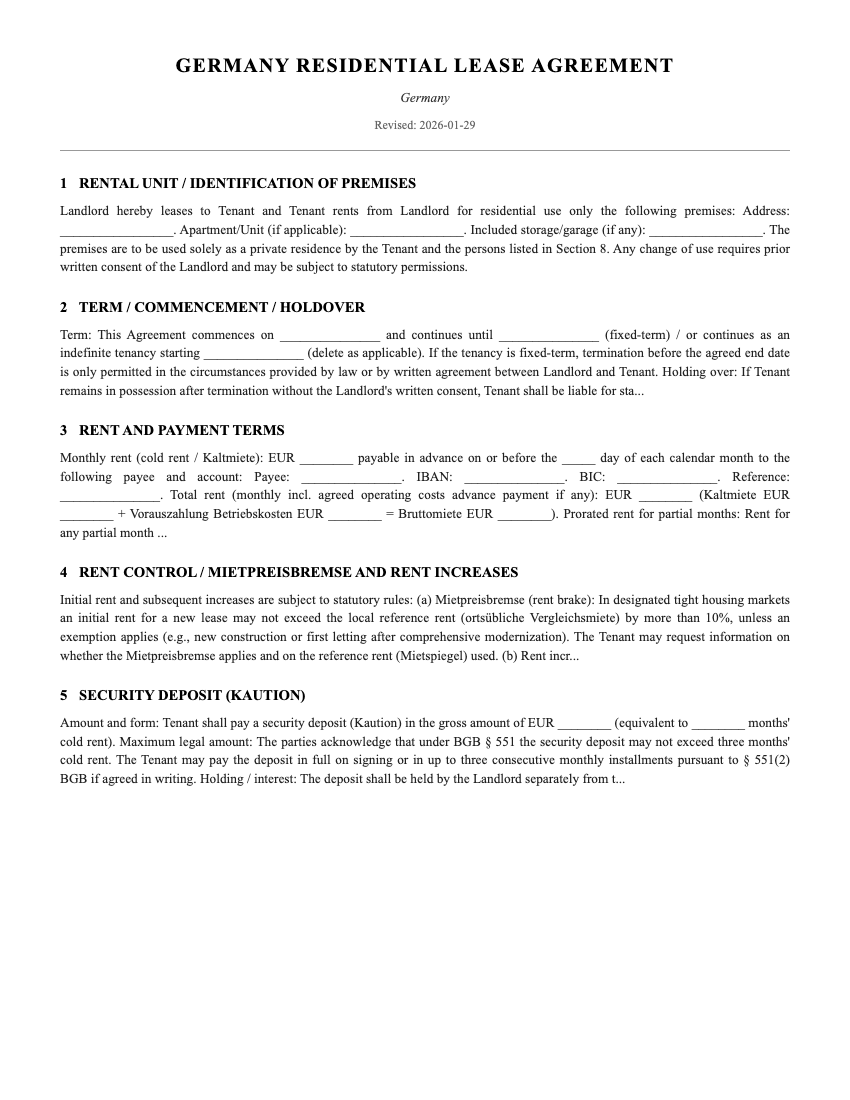
Our free template is designed for the most common residential tenancy scenarios (subletting, fixed-term tenancy, staggered/step rent, modernization) and contains formulations that reflect the statutory minimum requirements. It is not individual legal advice, but it helps to avoid typical pitfalls and to include the most important mandatory information.
What is a residential lease agreement in Germany?
A residential lease agreement (residential tenancy agreement, “Mietvertrag”) in Germany regulates the provision of residential space in return for payment of rent. It is primarily subject to §§ 535–580a BGB and other special statutory provisions (e.g. energy performance certificate under the GEG). The contract records the parties, rental object, rent amount (cold and warm rent), operating costs, security deposit (§ 551 BGB), term, notice periods (§ 573c BGB) and legally required notices (e.g. energy performance certificate) in writing.
Why old templates are dangerous (jurisdiction-specific pitfalls)
- Deposit errors (§ 551 BGB): Many older templates specify flat amounts instead of the statutory upper limit (max. 3 months' cold rent) or do not require separate custody; this leads to repayment claims and damages.
- Rent brake (local comparative rent): In areas with a rent brake the initial rent generally may not exceed the local comparative rent by more than 10% (observe exceptions). Old templates often contain no provision to check the local legal situation.
- Operating cost information: Missing or inaccurate definitions of chargeable operating costs and accounting periods lead to later disputes (cf. operating cost law, accounting obligations).
- Energy performance certificate (GEG): Without handing over or presenting the energy performance certificate fines may be imposed; descriptions of the handover are often missing in old templates.
- Notice periods & grounds for termination: Landlord terminations are subject to strict requirements (§§ 573, 573c BGB). Incorrect wording (e.g. missing factual grounds for owner’s own use) renders the termination invalid.
- Rent reduction (§ 536 BGB): Tenants have strong rights to reduce rent in the event of defects; old contracts sometimes attempt to limit reduction rights — such clauses are often invalid.
- Data protection (GDPR (DSGVO) / BDSG): Collecting and storing applicant data without a lawful basis can be costly.
What this template contains
- Parties: Full names and addresses of landlord and tenant.
- Rental object: precise property description (apartment number, location, living area), key handover.
- Rent: cold rent, advance payments for operating costs (warm rent), payment date.
- Operating cost clause: enumeration of chargeable operating costs and annual accounting obligation.
- Security deposit: wording according to § 551 BGB (no more than three months' cold rent), separate custody, interest rule and repayment modalities.
- Lease term: indefinite or fixed-term with statutory effectiveness check; step rents/index rents as an option.
- Rent increases: provisions for adjustment to the local comparative rent (§ 558 BGB) and modernization surcharge (§ 559 BGB).
- Termination: formulations for ordinary and extraordinary termination, notes on legitimate interest (§ 573 BGB) and periods (§ 573c BGB).
- Modernization and cosmetic repair clauses: legally compliant designs and notes on invalid blanket clauses.
- Pet, subletting and house rules clauses: clear regulations with space for individual agreements.
- Energy performance certificate & mandatory information: handover/presentation confirmation (GEG) and notes on operating cost information.
- Data protection: GDPR-compliant notice for applicant data and consent to data processing.
- Appendices: handover protocol, blank operating cost statement, energy performance certificate confirmation, house rules.
Download options
- PDF (final, print-ready version): /downloads/germany-lease-agreement-2026.pdf
- DOCX (editable): /downloads/germany-lease-agreement-2026.docx
Tip: Fill out the DOCX version and perform a final check with an AI contract review tool before signing.
How to finalize your lease
- Identity & credit check: request copies of ID, proof of income (GDPR-compliant) and store only with a lawful basis.
- Document energy performance certificate & operating costs: hand over the energy performance certificate and explain the type of chargeable operating costs.
- Arrange the deposit: amount (max. 3 x cold rent), keep account separately, clarify interest rules.
- Check individual clauses: adjust pet, subletting, cosmetic repairs; avoid invalid standard formulations.
- an AI contract review tool Check: upload the final version to an AI contract review tool for automated review of mandatory information and risky clauses.
- Signature & handover protocol: both parties sign, prepare annex with handover protocol and document key handover.
Related Lease Agreement Templates
Frequently asked questions (briefly answered)
Further FAQs can be found below in more detailed form.
Conclusion
This template reflects the most common statutory requirements but does not replace individual legal advice in complex cases (e.g. modernization disputes, extensive defects, complicated terminations). Use an AI contract review tool as an additional review mechanism and consult a specialist lawyer (Fachanwältin/Fachanwalt) for tenancy law if in doubt.
<div class="ml-embedded" data-form="bBZ9zR"></div>
Frequently Asked Questions

About Designer Content
Designer Content creates practical legal document resources for landlords, contractors, and small business owners. We simplify complex legal concepts into actionable guidance. Connect with us on LinkedIn.