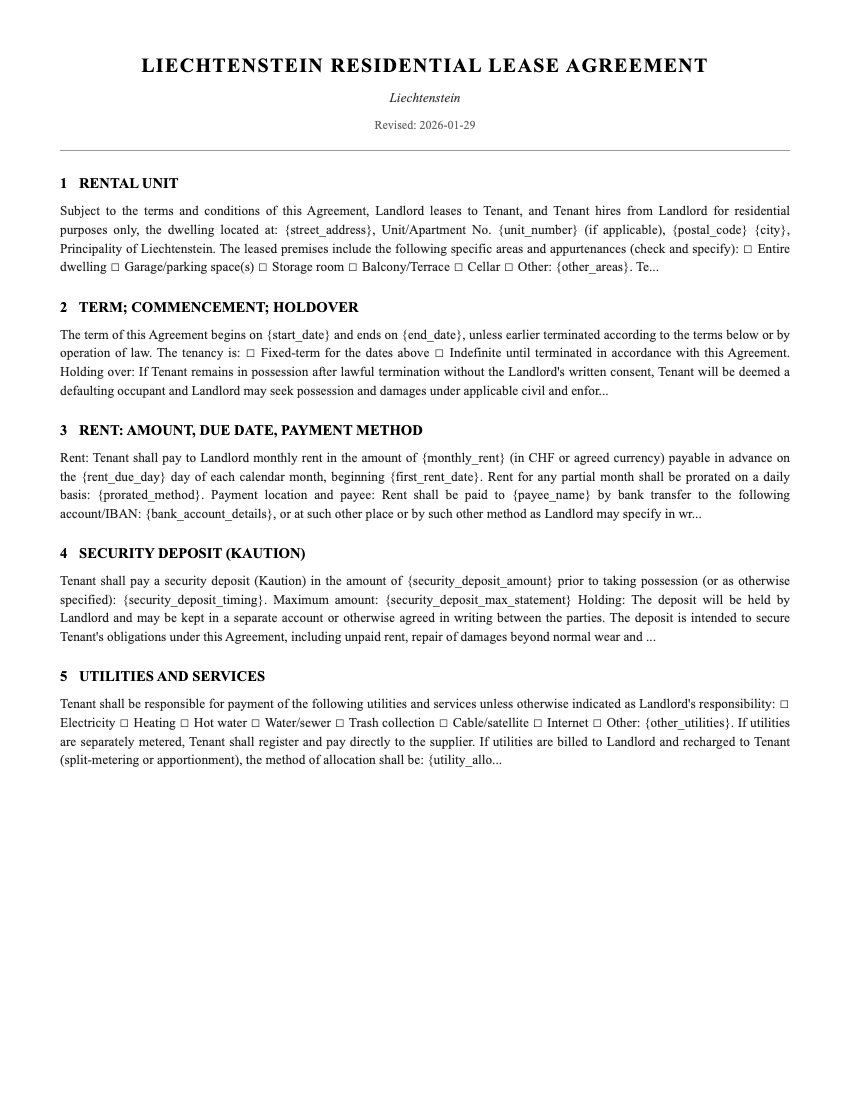
Secure & Customizable Tenancy Agreement Template, aligned with ABGB‑Rechtstradition and EWR‑DSGVO-Anforderungen in Liechtenstein
================================================================================================
Use instructions
- This document is a template for a residential lease. Adapt amounts, periods and specifics to the individual case.
- Clauses marked with [OPTIONAL] can be included or removed according to the parties' agreement and local mandatory law.
- This template is drafted with regard to the civil-law principles of the ABGB‑Rechtstradition and the data-protection principles required by the EWR‑DSGVO‑Anforderungen, but it does not replace local legal advice. Consult a Liechtenstein-qualified lawyer for binding drafting and to ensure compliance with mandatory provisions.
1. Parties
- Landlord: [Full name], Address: [Address], ID/Company Reg. No.: [No.]
- Tenant: [Full name], Address: [Address], ID/Passport No.: [No.]
2. Leased property
- Address: [Full address]
- Type: [apartment/house/room]
- Floor/Unit: [ ]
- Inventory/Fixtures attached: see Annex A (inventory list)
- Purpose: residential use only (other uses require written consent)
3. Contract term
- Commencement date: [DD.MM.YYYY]
- Fixed term until: [DD.MM.YYYY] OR Indefinite term with monthly/quarterly notice
- If fixed-term, early termination: [conditions, e.g., mutual agreement or statutory reasons]
4. Rent and payment
- Monthly rent (net): CHF/EUR [amount]
- Due date: on or before the [day] of each calendar month
- Payment method: bank transfer to account: [IBAN / BIC / Bank]
- Rent indexation: [e.g., annual CPI adjustment / fixed increases — specify method and limit] [OPTIONAL]
- Late payment: interest and reminder costs: [e.g., statutory interest rate + collection costs] (must comply with mandatory provisions)
5. Additional charges (Nebenkosten)
- Utilities included/excluded: Electricity, heating, water, waste, building insurance, property tax, caretaking, etc.
- If service charges are payable: method of calculation and annual reconciliation (provide clear accounting and receipts)
- Advance payments: Tenant shall pay monthly/quarterly advances for utilities of CHF/EUR [amount]; final settlement within [30/60] days after accounting period.
6. Security deposit (Kaution)
- Amount: CHF/EUR [amount] (recommendation: typically up to three months’ rent; adapt to local practice and mandatory limits)
- Payment: upon signing / before handover
- Deposit handling: deposit shall be held in a separate interest-bearing escrow account or otherwise securely and clearly documented; interest accrues to [tenant/landlord] according to applicable rules.
- Use and return: Landlord may use deposit to cover unpaid rent, damages beyond normal wear and tear, and other valid claims; itemized deduction statement and supporting invoices shall be provided. Balance to be returned within [30/60] days after termination and handover, or within the period required by mandatory law.
- Disputes over deductions: remaining deposit may be deposited with a court or escrow until resolved [OPTIONAL: mediation clause].
7. Handover, condition and inventory
- Handover protocol: an inventory and condition report (Annex A) shall be prepared and signed by both parties at start and end of tenancy.
- Repairs for pre-existing defects [listed in Annex A] are excluded from tenant’s liability.
- Tenant must notify defects without delay.
8. Use, maintenance and alterations
- Tenant’s obligations:
- Use premises in a tenant-like manner and comply with house rules.
- Perform ordinary cleaning and minor maintenance (e.g., changing bulbs, bleeding radiators) as customary.
- Prohibit unlawful activities and respect co-tenants/neighbours.
- Landlord’s obligations:
- Ensure the property is habitable and carry out structural repairs and major maintenance.
- Alterations: Tenant must obtain written consent before any structural changes or permanent installations.
- Decoration/damage: Tenant must restore alterations on termination unless otherwise agreed.
9. Subletting and assignment
- Subletting in whole or in part requires the landlord’s prior written consent; such consent shall not be unreasonably withheld if statutory conditions are met.
- Assignment of lease: [allowed/only with landlord’s consent]
10. Pets
- Pets: [allowed / prohibited / allowed with consent and additional deposit]
- If allowed: conditions, care, and liability for damage.
11. Repairs and defects
- Reporting: Tenant must report defects immediately.
- Emergency repairs: Tenant may arrange urgent measures to avoid damage; costs are reimbursable if pre-approved or objectively necessary.
- Landlord shall remedy defects within a reasonable time.
12. Liability and insurance
- Tenant liability: for damage caused by negligence or breach of contract.
- Landlord liability: for structural defects and statutory obligations.
- Insurance: Tenant is strongly recommended to maintain household liability and contents insurance.
13. Termination and notice periods
- Tenant notice: [e.g., three months’ notice to the end of a calendar month] — specify exact form and delivery method.
- Landlord notice: must comply with mandatory statutory grounds and notice periods; recommended clause: landlord notice requires justification and follows statutory periods (e.g., minimum [three/six] months depending on local rules).
- Extraordinary termination for cause: either party may terminate for material breach after written notice and expiry of a cure period [e.g., 14/30 days] unless immediate termination is justified.
- Form of termination: termination must be in writing and received by the other party [e.g., by registered mail or personally].
14. Inventory and final accounting
- Final inspection and inventory: to be conducted on handover date; both parties sign a final protocol.
- Deduction claims: itemized list and invoices to be provided within [30/60] days.
15. Data protection (EWR‑DSGVO‑Anforderungen)
- Data controller: Landlord: [name/contact]
- Purpose of processing: evaluation of tenant application, contract performance, rent collection, mandatory legal obligations (e.g., tax, court).
- Categories of data: identification data, contact details, payment data, creditworthiness information, inventory and condition reports, photos where necessary.
- Legal basis: contract performance (Art. 6(1)(b) EWR‑DSGVO), legitimate interest (Art. 6(1)(f) EWR‑DSGVO) for property management, and consent where applicable.
- Recipients: property manager, credit-check providers, public authorities where legally required, appointed contractors for maintenance.
- Retention period: data retained for the duration of the contractual relationship and thereafter as required by statutory retention periods (e.g., accounting/tax), or until legitimate interest ends.
- Tenant rights: access, rectification, restriction, erasure (where applicable), data portability, objection to processing, and right to lodge a complaint with a supervisory authority. Contact for exercising rights: [contact details].
- Security measures: appropriate technical and organizational measures are in place to protect personal data.
- [OPTIONAL] Consent clause for additional processing (e.g., marketing): [text of optional consent].
16. Entry and inspections
- Landlord’s right of access: for inspections, repairs and viewings with reasonable notice (e.g., 24–48 hours) unless in emergency.
- Tenant agrees to allow reasonable viewings near contract end (with prior notice).
17. Default and remedies
- Remedies for late payment, breach and damage: late payment interest, reminders, and contractual penalties where permitted by law.
- Right to cure: where practicable, party in breach shall be given notice and reasonable period to cure before termination.
18. Dispute resolution and applicable law
- Governing law: Principality of Liechtenstein (ABGB‑Rechtstradition applies as general civil-law reference) and mandatory local statutory provisions.
- Jurisdiction: Courts of [Place], Liechtenstein, unless parties agree on mediation/arbitration [OPTIONAL].
- Mediation/alternative dispute resolution: [optional clause encouraging mediation prior to litigation].
19. Miscellaneous provisions
- Entire agreement: this contract and attachments constitute the entire agreement.
- Severability: if a provision is invalid, other provisions remain in force; parties shall replace invalid provision with a valid one reflecting the original economic intent.
- Amendments: written form required for amendments.
- Language: German is the contract language for interpretation [OPTIONAL: confirm which language prevails].
20. Signatures
Landlord: ______________________ Date: __________
Tenant: ______________________ Date: __________
Annexes (to be attached)
- Annex A: Inventory and Condition Report (handover protocol, photos)
- Annex B: House rules (if applicable)
- Annex C: Energy certificate / safety certificates [if applicable]
- Annex D: Data processing notice and contact details
Practical notes and recommendations (Kautionen, Kündigungsfristen, notwendige Klauseln)
- Kaution:
- Keep deposit amount reasonable and in line with local practice. Many jurisdictions commonly use up to three months’ rent as a guideline, but check Liechtenstein-specific limits and mandatory rules.
- Place the deposit on a separate interest-bearing account or escrow and document interest handling.
- Provide a written, itemized explanation of any deductions with receipts.
- Return the deposit within a short, specified period after handover; longer delays invite disputes.
- Kündigungsfristen (Notice periods):
- Clarify whether the lease is fixed-term or indefinite. For indefinite leases, specify tenant notice periods (often three months in practice) and the form of notice.
- For landlord-initiated terminations, ensure compliance with statutory safeguards and longer notice periods where required; include objective grounds for termination where appropriate.
- Include provisions for extraordinary termination (serious breach) with a clear cure period.
- Necessary clauses to reduce risk:
- Clear rent and payment clauses (due date, bank details, consequences of late payment).
- Detailed inventory and handover protocol.
- Clear rules on repairs, minor maintenance, and allocation of costs.
- Subletting and assignment rules.
- Liability and insurance obligations (tenant recommended to obtain insurance).
- Data protection clause compliant with EWR‑DSGVO‑Anforderungen (disclose processing, legal basis, rights).
- Entry/inspection rights and notice rules.
- Procedure for dispute resolution and jurisdiction.
- Clause requiring written form for amendments and notices.
Final remark
- This template is a practical starting point. Because mandatory rules under Liechtenstein law and court practice may impose specific requirements and limits (particularly concerning deposit handling, consumer-protection rules, notice periods and statutory termination rights), have the final draft reviewed by a local lawyer to ensure full compliance with ABGB‑Rechtstradition and EWR‑DSGVO‑Anforderungen.