
Introduction
If you are renting residential property in the Principality of Monaco, your lease should be clear, enforceable and tailored to Monégasque law. Residential leases in Monaco are governed primarily by the Code civil (Monaco) and general principles of contract law: parties are largely free to agree commercial terms (rent, deposit, duration) but must respect mandatory obligations such as providing habitable premises, good faith performance and data-protection rules (Loi n° 1.165). Because eviction (expulsion) requires judicial procedure and evidence (état des lieux and written contract), a carefully drafted lease reduces the risk of costly litigation.
This template is designed for landlords, tenants and property managers who need a Monaco-specific starting point — with required disclosures, recommended clauses and an AI contract review tool compatibility for a contract safety check.
For a comprehensive lease review checklist covering residential and commercial terms, see our Lease Agreement Review Guide.
Definition — What is a Monaco residential lease?
A residential lease (bail résidentiel) in Monaco is a consensual contract under the Code civil (Monaco) by which a landlord transfers the use of a dwelling to a tenant for a determined or indeterminate duration in exchange for rent. The lease should record the parties, the premises, the rent and indexation mechanism (if any), the security deposit, the state of the premises (état des lieux) and any mandatory disclosures, and must comply with applicable data-protection rules (Loi n° 1.165). See Code civil (Monaco) and related procedural rules on judicial enforcement.
Why Old Templates Are Dangerous (Monaco-specific traps)
Using a generic or foreign template can create serious problems in Monaco:
- No état des lieux or poor inventory: Without a signed état des lieux (inventory/condition report), a landlord’s claim on a deposit for damage is much harder to prove in court.
- Deposits treated as a simple receipt: Monégasque practice requires itemization on return and an express deadline in the contract helps avoid disputes. There is no statutory cap, but lenders and courts expect reasonable amounts (commonly 1–3 months).
- Missing privacy compliance: Tenancy generates personal data (identity, guarantors, bank details). Failing to include a Loi n° 1.165–compliant privacy notice and lawful basis for processing can trigger administrative scrutiny and undermine lawful data use.
- Improper eviction language: Eviction in Monaco must be judicially ordered and executed; templates that suggest landlords can self-help by changing locks or seizing belongings expose the landlord to liability.
- Indexation and rent increases not documented: Monaco has no general rent-control law — any indexation or increase mechanism must be expressly agreed in the lease. Vague references are unenforceable and invite dispute.
- Conflicting foreign-law clauses: A clause choosing foreign law or foreign courts can be ineffective for residential property located in Monaco and may impede enforcement.
What's Included in This Template
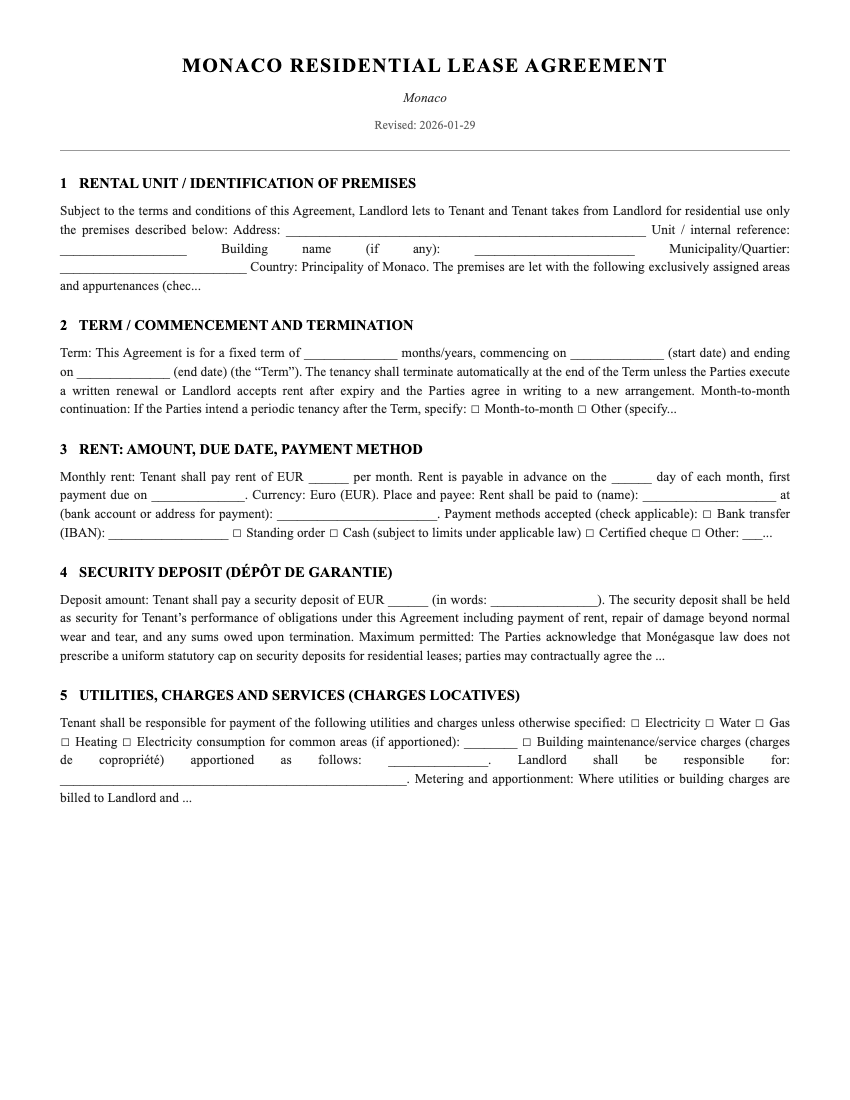
This Monaco residential lease template (editable) includes:
- Parties and premises (address, cadastral reference where applicable)
- Detailed rent clause with payment method and optional indexation formula
- Security deposit clause: amount, itemization requirement, recommended return deadline (30–60 days) and remedies
- Duration and renewal terms (fixed-term and periodic options)
- Etat des lieux (inventory and condition-report) annex with checklist
- Required disclosures: personal-data/privacy notice (Loi n° 1.165), known structural/safety hazards and lead-based paint disclosure (standard international clause for older buildings)
- Maintenance and repairs allocation (landlord vs tenant)
- Notice and cure periods for breaches and termination timelines (customizable)
- Eviction and enforcement: statement that expulsion requires judicial order and outlines judicial steps
- Optional guarantor clause and subletting/guest rules
- Governing law: Code civil (Monaco) / courts of Monaco (customizable)
- Signature blocks and list of annexes
All variable fields are clearly marked for easy customization. The template is provided in both PDF and editable formats and is an AI contract review tool–ready for automated review.
Related Lease Agreement Templates
Download Options
- Printable PDF (ready to sign): /downloads/monaco-lease-agreement-2026.pdf
- Editable DOCX (customize before an AI contract review tool check)
- an AI contract review tool upload: use the DOCX to run the automated Monaco compliance check and receive a clause-by-clause report
If you use the PDF, we recommend printing two identical originals so each party keeps a signed copy. For multilingual situations (e.g., French and English), include both-language versions and specify which text controls in the event of a conflict.
How to Finalize Your Lease
- Complete all variable fields in the editable version, including the exact address, rent, deposit amount and any indexation formula.
- Prepare and attach an état des lieux (inventory) signed by both parties at handover. The état des lieux should accompany the lease as Annex A.
- Include the Loi n° 1.165–compliant privacy notice and obtain tenant consent for processing personal data where required.
- Sign two originals (one for landlord, one for tenant) and date the lease; record the handover date for keys and the état des lieux.
- Consider an AI contract review tool review or local lawyer review to confirm compliance with Monaco practice and to validate eviction/termination clauses.
- Keep signed copies and digital backups; maintain records (in case of future civil claims where prescription trentenaire may apply).
Practical Tips
- Deposit timeline: even though there is no statutory return deadline, specifying a 30–60 day return period in the contract reduces disputes.
- Evidence: take dated photos at move-in and move-out and retain them with the état des lieux.
- Language: draft the controlling version in French if both parties understand it — courts will apply Monaco law and French-language evidence.
- Guarantor: where tenant is an international assignee, require a local guarantor or bank guarantee.
<div class="ml-embedded" data-form="bBZ9zR"></div>
Frequently Asked Questions

About Designer Content
Designer Content creates practical legal document resources for landlords, contractors, and small business owners. We simplify complex legal concepts into actionable guidance. Connect with us on LinkedIn.