
Introduction
Renting residential property in the Netherlands requires attention to both civil-law tenancy rules (Burgerlijk Wetboek, Boek 7, Titel 4) and EU/Dutch data-protection rules (AVG / UAVG). Whether you rent in the social (gereguleerd) sector under the woningwaarderingsstelsel or in the vrije sector, the contract must correctly reflect the rent regime, required disclosures (energielabel, opleveringsstaat / inventory), deposit arrangements, and the limited circumstances under which a landlord may obtain termination through the courts.
This template is designed for 2026 use: it follows the general rules in Boek 7 (huur van woonruimte), integrates privacy notices for tenant data processing under the AVG/UAVG, and flags energy-performance and safety disclosures. It is not legal advice — use it as a robust starting point and run a final check with a qualified adviser or an AI contract review tool contract-check (see below).
For a comprehensive lease review checklist covering residential and commercial terms, see our Lease Agreement Review Guide.
What is a Netherlands residential lease?
A residential lease (huurcontract / huurovereenkomst) governed by Burgerlijk Wetboek Boek 7, Titel 4 is a contract under which a landlord grants a tenant the right to use a dwelling in exchange for rent. The law distinguishes regulated (social) housing — assessed under the woningwaarderingsstelsel (points system) with rent limits and special protection — and liberalised private sector housing (vrije sector). Termination by a landlord usually requires statutory grounds and a court order; tenant protections are strong.
Why Old Templates Are Dangerous (Netherlands-specific traps)
- Misclassifying regulated vs vrije sector housing: The woningwaarderingsstelsel (points system) determines whether a dwelling is regulated and which maximum initial rent applies. Using a generic template can expose the landlord to rent-reduction claims or administrative challenges if the rent exceeds the social-housing cap.
- Incorrect termination clauses: Dutch law requires statutory grounds for landlord-initiated termination in most cases and generally a court decision. An old template that purports to allow immediate landlord termination or self-help eviction is unenforceable and may lead to damages.
- Deposit handling errors: There is no statutory nationwide cap, but practice expects 1–3 months' rent and itemisation of deductions. Failing to specify how the deposit will be held, or not providing a post-tenancy inspection procedure, increases dispute risk.
- Missing AVG/UAVG privacy notice: The AVG requires landlords to document the legal basis for processing tenant personal data and to provide a privacy notice. Templates that ignore data protection risk fines and contested data uses.
- Omitting energy and safety disclosures: Tenants must be informed of the energielabel and the condition inventory (staat van oplevering). Older templates often miss these required disclosures and the inventory that protects both parties at move-in/move-out.
- Local rules for short-term letting: Municipalities (gemeenten) frequently restrict short-term and holiday rentals. Templates that allow short lets without municipal compliance can expose landlords to fines.
What's Included in This Template
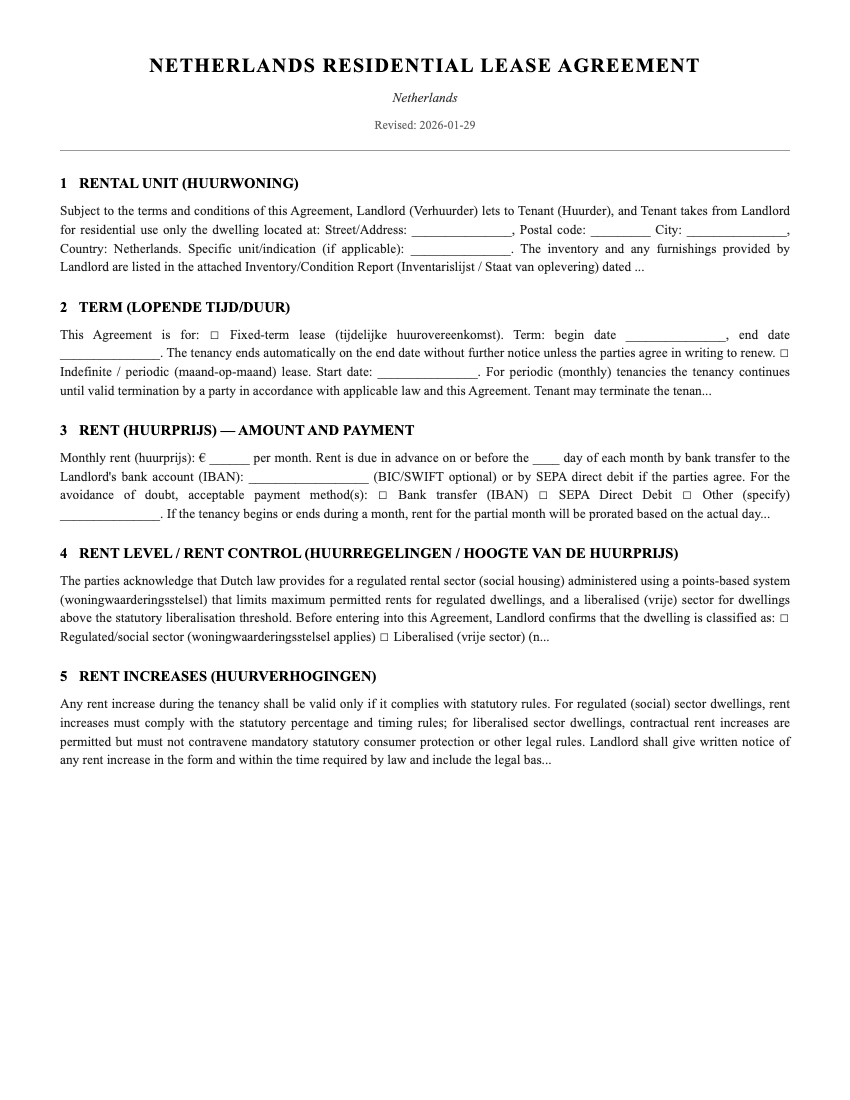
- Parties, property description, and permitted use
- Rent amount, payment method, and rent review clauses (clear separation for regulated vs vrije sector) with references to woningwaarderingsstelsel
- Security deposit clause with common-practice limits (1–3 months) and requirement to itemize deductions on termination
- Term, renewal and rules for lawful temporary contracts (fixed-term temporary agreements) and open-ended leases
- Termination clauses explaining statutory grounds and procedure (landlord termination requires court application where applicable)
- Inventory / move-in condition report (staat van oplevering) and a checklist for known defects
- Energy performance (energielabel) disclosure paragraph and obligations to provide the certificate when required
- Privacy (AVG/UAVG) data-processing notice: lawful basis, retention periods, rights of data subjects, and contact information
- House rules, sublet/guest and pets clauses tailored to Dutch practice
- Dispute-resolution and jurisdiction clause (Dutch courts) and references to statutory provisions
Download Options
- PDF (finalized, print-ready): /downloads/netherlands-lease-agreement-2026.pdf
- DOCX (editable template): available on request or via the download page for customization
- Digital-signature ready: Use approved e-sign providers that meet EU eIDAS rules; keep a signed PDF copy for archive
We recommend saving one signed PDF per party and uploading the executed lease to an AI contract review tool for a final compliance scan and secure storage.
How to Finalize Your Lease
- Confirm the rent regime (woningwaarderingsstelsel): determine whether the dwelling falls in the regulated sector by applying the points system. Incorrect classification can lead to rent-reduction claims.
- Complete the inventory (staat van oplevering) at move-in and attach photos. Both parties should sign the inventory.
- Specify deposit details: amount agreed, where funds are held (a separate bank account or third-party escrow), and the inspection/return procedure including itemization of deductions.
- Add the AVG/UAVG privacy notice and obtain tenant acknowledgment for necessary processing (identity checks, references). Do not collect excessive data.
- Have both parties sign (wet-schrijvende handtekening not required); keep signed copies. For contested matters, a clear signed contract with dated inventory materially reduces litigation risk.
Related Lease Agreement Templates
Frequently Asked Questions (Netherlands)
- Q: Is there a statutory maximum for security deposits in the Netherlands?
A: No nationwide statutory maximum exists in the Dutch Civil Code. Practice and local custom typically limit deposits to 1–3 months' rent. The contract must require itemization of deductions. Unlawful withholding can be litigated. (See: Burgerlijk Wetboek Boek 7 — Huur) - Q: How do rent increases work — can a landlord raise rent freely?
A: It depends on whether the dwelling is in the regulated sector (woningwaarderingsstelsel) or vrije sector. Social housing follows statutory limits and procedures; vrije sector contracts generally allow contractual increases subject to statutory consumer-protection rules. Annual permitted increases for regulated dwellings are set by government policy and differ from vrije sector rules. - Q: What disclosures are required when renting a dwelling in the Netherlands?
A: Key disclosures include the Energy Performance Certificate (energielabel) where applicable, a written inventory / move-in condition report (staat van oplevering), known hazardous conditions (e.g., major damp, mould, structural defects, asbestos where known), and a privacy/data-processing notice under the AVG/UAVG. Note: U.S. federal lead-paint laws do not apply; disclose any known lead risks if relevant. - Q: Can a landlord evict a tenant for nonpayment quickly?
A: No. A landlord must normally send a demand for payment and then seek termination and eviction through the civil courts. Courts can grant tenants an opportunity to cure arrears. Immediate self-help eviction is unlawful. - Q: Can tenants host guests or sublet the property?
A: Subletting generally requires the landlord's consent unless specifically allowed in the contract. Short-term letting (Airbnb, holiday rentals) is often restricted by municipal rules — check local gemeente regulations. Day-to-day guests are usually permitted within reasonable limits but excessive use or subletting can breach the agreement. - Q: Do I need to provide an energielabel and how does it affect renting?
A: You should provide the dwelling's energielabel where legally required and inform the tenant of the energy performance. Energy-label obligations tie into disclosure duties and in some municipal contexts rental permits or subsidies.
Sources
- Burgerlijk Wetboek Boek 7 — Titel 4: Huur van woonruimte. wetten.overheid.nl: https://wetten.overheid.nl/BWBR0005290/Boek7/Titel4 — (Dutch Civil Code: tenancy title)
- Regulation (EU) 2016/679 (General Data Protection Regulation — AVG). EUR-Lex: https://eur-lex.europa.eu/eli/reg/2016/679/oj — (EU GDPR)
- Uitvoeringswet AVG (UAVG). wetten.overheid.nl: https://wetten.overheid.nl/BWBR0040940/tekst_vo — (Dutch implementing law for the AVG)
- Rijksoverheid — Huurwoning, informatie voor verhuurders en huurders: https://www.rijksoverheid.nl/onderwerpen/huurwoning — (official government guidance on renting)
- Rijksdienst voor Ondernemend Nederland (RVO) — Woningwaarderingsstelsel and information on rent regulation: https://www.rvo.nl/onderwerpen/huurwoning/woningwaarderingsstelsel — (housing valuation / points system)
- Rijksoverheid — Energielabel voor gebouwen: https://www.rijksoverheid.nl/onderwerpen/energielabel-gebouwen — (energy performance certificate obligations)
Notes and Legal Reminder
This template and article summarize key Dutch tenancy rules but are not a substitute for legal advice. Statutory interpretation (particularly on regulated vs vrije sector classification, eviction grounds, and municipal short-term-rental rules) can be fact-specific. For complex cases, court proceedings, or disputes, consult a Dutch lawyer or local huurteam.
<div class="ml-embedded" data-form="bBZ9zR"></div>
Frequently Asked Questions

About Designer Content
Designer Content creates practical legal document resources for landlords, contractors, and small business owners. We simplify complex legal concepts into actionable guidance. Connect with us on LinkedIn.