
Why compliance matters
A written lease in Nevada defines the legal rights and responsibilities of landlords and tenants and reduces disputes. Nevada landlord-tenant law is governed primarily by the Nevada Revised Statutes, Chapter 118A (the Residential Landlord and Tenant Act). That statute sets duties on security deposits, required disclosures, notice periods, cures for lease breaches, habitability and repair obligations, and the unlawful detainer process for removing tenants. Federal rules — including the lead-based paint disclosure for pre-1978 housing — also apply.
Using a lease that references Nevada law and includes required disclosures protects both parties and helps avoid statutory penalties, costly litigation, and invalid notice attempts. This template adapts common lease terms to Nevada law; it is not a substitute for local counsel or a specific municipal ordinance review (some Nevada cities and counties may have additional rules).
For a comprehensive lease review checklist covering residential and commercial terms, see our Lease Agreement Review Guide.
Definition: What is a Nevada residential lease?
A Nevada residential lease is a written contract between a landlord and tenant that sets the terms of occupancy for a dwelling in Nevada, including rent, length of tenancy, security deposit handling, permitted uses, disclosure obligations, notice and termination procedures, and remedies for default. The lease must be implemented in light of the Nevada Revised Statutes, Chapter 118A (Residential Landlord and Tenant Act), applicable municipal ordinances, and federal disclosure laws.
Why old templates are dangerous (Nevada-specific traps)
- No statutory deposit cap does not mean "any" deposit is permitted: while Nevada law does not set a maximum amount for security deposits, the amount must still be reasonable and the lease must comply with Nevada's deposit accounting and return requirements (see Nev. Rev. Stat. Chapter 118A). An unconscionably high deposit can trigger dispute and bad-faith claims.
- Missing itemized accounting language: Nevada requires landlords to provide an itemized statement for deductions when returning a deposit. Using an older template that omits this can forfeit defenses and expose landlords to statutory remedies.
- Incorrect notice periods: Some templates use uniform 30-day or 60-day notices without regard to the statutory cure and termination requirements under NRS Chapter 118A. Eviction filings based on incorrect notice periods can be dismissed and delay recovery of possession.
- Federal disclosure omissions: Older forms often omit the federally required lead-based paint disclosure (for units built before 1978) or the landlord/manager contact information required by Nevada practice and local ordinances.
- Local law conflicts: Municipalities (for example, certain ordinances in Clark County/Las Vegas or Reno) may require additional disclosures, registration, or short-term rental restrictions. A statewide template must be reviewed for local compliance.
What's included in this template
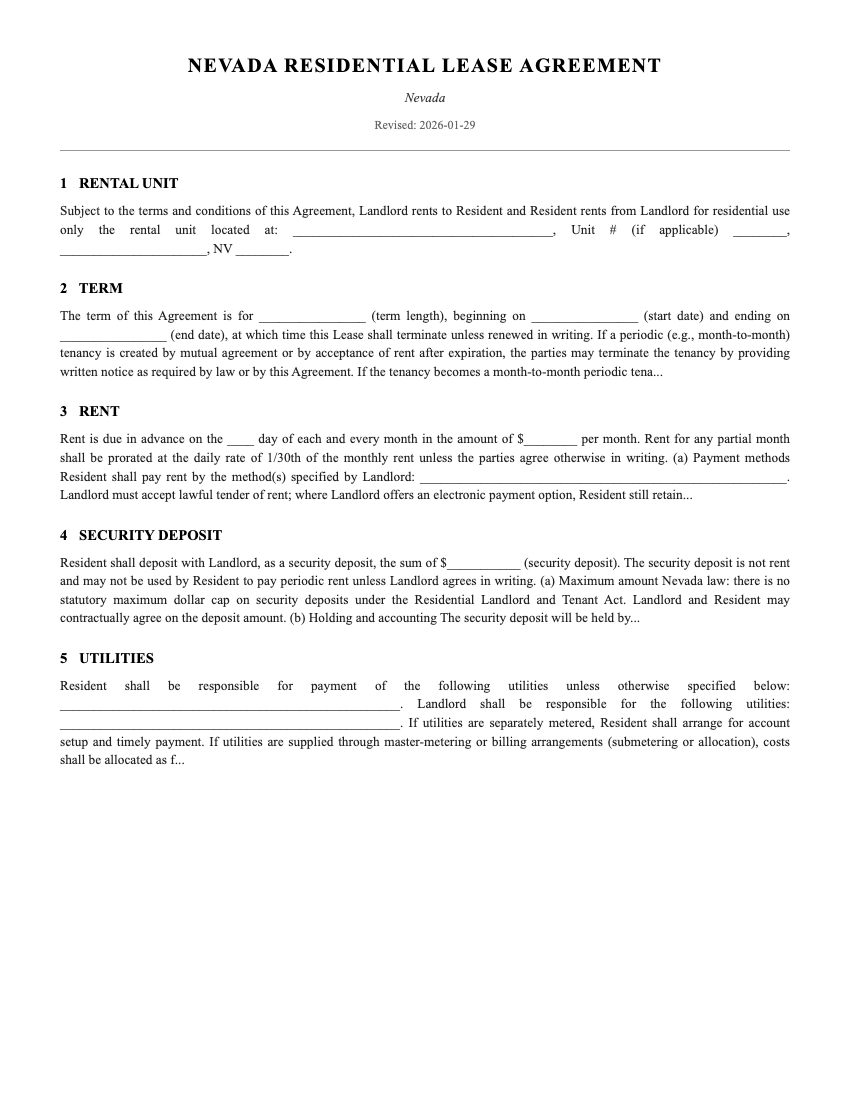
This Nevada lease template (2026) includes:
- Basic lease terms: parties, property description, lease term, rent amount, rent due date, late fees and returned check fees (adjustable).
- Security deposit clause: amount (contractual), permitted uses, required itemized accounting and return timing reference to NRS Chapter 118A.
- Entry and repairs: landlord right of entry for inspections/repairs with notice provisions consistent with NRS Chapter 118A and habitability duties.
- Termination and notices: sample notices for nonpayment, cure/quit language and guidance to follow NRS Chapter 118A before filing unlawful detainer actions.
- Required disclosures: federal Lead-Based Paint Disclosure (for pre-1978 properties), management/owner contact disclosure, advisory on sex offender registry access, and material habitability and safety disclosures.
- Utilities and maintenance responsibilities: allocation language so parties have clear duties.
- Sublease and guest policy: rules for subleasing and long-term guest occupancy.
- Default and remedies: remedies for breach and landlord/tenant obligations, cross-referenced to NRS Chapter 118A where applicable.
- Signature blocks and an optional move-in/move-out checklist for itemizing condition at delivery of possession.
Each clause includes notes that explain where Nevada statute or local ordinance review is recommended.
Download Options
- Single-Unit Lease (PDF): /downloads/nevada-lease-agreement-2026.pdf — a printable, fill-in-the-blank PDF for one dwelling unit.
- Multi-Unit Addendum (PDF): an addendum for landlords who manage multiple units with uniform policies (available within the download package).
- Editable DOCX: request or generate an editable Word version from the download page if you need to customize terms before an AI contract review tool review.
All downloads are provided as starting templates. After editing, run the lease through an AI contract review tool for automated checks and then get Nevada legal advice for complex issues.
How to Finalize Your Lease
- Fill in all blank fields: parties' names, property address, rent, deposit amount, lease dates, late fee structure, and utility responsibilities.
- Verify deposit language: explicitly state the deposit amount, permissible deductions, and reference Nevada statutory requirements for return and itemization (see Nev. Rev. Stat. Chapter 118A).
- Add any required local disclosures or registrations: check city/county rules for rental registration, business licenses, or short-term rental prohibitions.
- Run the completed lease through an AI contract review tool to detect missing Nevada-specific clauses or conflicts with NRS Chapter 118A.
- Provide the required federal and state disclosures to the tenant at or before lease signing (Lead-Based Paint disclosure for pre-1978 units; management/owner contact information; advisory notices).
- Have both parties sign and date the lease; provide each party with a fully executed copy and retain one for your records.
Common Nevada lease provisions explained
- Security deposits: Nevada has no statutory cap on residential security deposits. However, Nevada law requires landlords to follow statutory procedures for accounting, itemization, and return of deposits. Include explicit authorization for deductions for unpaid rent, cleaning beyond normal wear and tear, and repairs for tenant-caused damage. Reference NRS Chapter 118A in the lease so tenants understand their statutory rights.
- Rent increases and rent control: Nevada does not have statewide rent control or mandatory just-cause eviction protections. Rent increases are governed by the lease terms and notice obligations; parties should confirm any municipal rules where the property is located.
- Eviction and notice procedures: The template provides sample cure and termination notices but requires landlords to follow the processes and timeframes in NRS Chapter 118A before filing an unlawful detainer. Improper notices can delay recovery of possession.
- Required disclosures: The lease includes the federally mandated lead-based paint disclosure (for dwellings built before 1978), owner/manager contact information, and an advisory about the Nevada sex offender registry. Additional material habitability and safety disclosures are included where relevant.
Related Lease Agreement Templates
FAQs
- Q: Is there a maximum security deposit amount in Nevada?
A: No. Nevada does not impose a statutory maximum amount for residential security deposits. The deposit amount is contractual between the landlord and tenant, but landlords must comply with Nevada's statutory requirements for handling, accounting, and returning deposits. See Nev. Rev. Stat. Chapter 118A for statutory obligations and remedies. - Q: How soon must a landlord return a security deposit in Nevada?
A: Nevada law requires the landlord to return the security deposit and provide an itemized statement of deductions in the time frame established by the statute after termination and delivery of possession. Consult Nev. Rev. Stat. Chapter 118A for the exact deadlines and procedural requirements that apply to your tenancy. - Q: Does Nevada have rent control or just-cause eviction protections?
A: No statewide rent control or mandatory just-cause eviction requirement exists under Nevada law. Landlords may increase rent consistent with the lease terms and applicable notice requirements. Check municipal ordinances for any local tenant-protection measures that may apply. - Q: What disclosures are required when renting in Nevada?
A: Required disclosures include the federal Lead-Based Paint Disclosure for dwellings built before 1978, owner/manager contact information, advisories such as access to the Nevada Sex Offender Registry, and any material habitability or safety disclosures mandated by statute or local ordinance. This template includes those disclosures and prompts for additional local requirements. - Q: What notice must a landlord give before filing for eviction in Nevada?
A: Notice requirements (pay or quit for nonpayment, cure or quit for breaches, and termination of a periodic tenancy) are governed by NRS Chapter 118A. The template provides sample notices but landlords must ensure the notices they serve comply with the statutory timeframes and content required by Chapter 118A before filing an unlawful detainer. - Q: Can tenants have long-term guests or sublet the unit?
A: The template includes optional clauses that prohibit subleasing without written landlord consent and that limit the duration of guests (for example, guests staying more than 14 days without notice may be treated as occupants). Nevada law permits parties to contractually set sublease and guest rules, but local ordinances and fair-housing protections still apply.
Final notes
This template is a law-adapted starting point designed for Nevada residential rentals. Because Nevada law interacts with local ordinances and federal requirements, use an AI contract review tool to scan your completed lease for statutory omissions, then consult Nevada counsel for edge cases, complex regulatory questions, or high-value disputes.
<div class="ml-embedded" data-form="bBZ9zR"></div>
Frequently Asked Questions

About Designer Content
Designer Content creates practical legal document resources for landlords, contractors, and small business owners. We simplify complex legal concepts into actionable guidance. Connect with us on LinkedIn.