
Introduction
Creating a legally compliant residential lease in Utah matters. A properly drafted lease protects both landlord and tenant by defining rent, deposits, notices, maintenance responsibilities, permitted uses, and remedies for breach. Utah landlords and tenants are governed primarily by the Residential Landlord and Tenant Act (Utah Code Title 57, Chapter 22) and eviction/forcible entry statutes in Utah Code Title 78B, Chapter 6. This template is drafted to align with those statutes and common Utah practices (including the six-year statute of limitations for written contracts under Utah Code § 78B-2-309).
Use this template as a starting point. Local municipal ordinances (for example, city-level requirements in Salt Lake City, Ogden, or Provo) may add requirements or disclosures. Always confirm local rules and consider a contract review before signing.
For a comprehensive lease review checklist covering residential and commercial terms, see our Lease Agreement Review Guide.
What is a Utah residential lease?
A Utah residential lease is a written agreement between a landlord and a tenant that sets the term (fixed-term or periodic), rent amount and due dates, security deposit terms, maintenance and repair responsibilities, notice requirements, and lawful grounds for termination. In Utah, leases operate alongside the Residential Landlord and Tenant Act (Utah Code Title 57, Chapter 22) and eviction procedures in Title 78B, Chapter 6; where statutory law imposes requirements, the lease must comply.
Key Legal Points to Keep in Mind
- Governing statutes: Residential Landlord and Tenant Act (Utah Code Title 57, Chapter 22) and Forcible Entry and Detainer (Utah Code Title 78B, Chapter 6).
- Statute of limitations: six years for written contracts (Utah Code § 78B-2-309).
- Security deposits: no statewide cap, but Utah law requires an itemized accounting and return within the statutory period set by the Residential Landlord and Tenant Act; interest is not generally required unless a local ordinance or written agreement mandates it.
- Rent control: Utah has no statewide rent control; check local ordinances for narrow municipal rules.
- Required disclosures: federal lead-based paint disclosure (for properties built before 1978), statutory rights under Utah law, security deposit accounting disclosure, and any municipal/local disclosures.
Why Old Templates Are Dangerous (Utah-specific traps)
- Out-of-date notice periods: Many older templates use incorrect notice periods for nonpayment or termination. Utah commonly uses a 3-day pay-or-vacate notice for nonpayment under eviction practice, and a 30-day notice for month-to-month terminations unless the lease specifies otherwise; rely on current statutory and case law (Title 78B, Chapter 6).
- Missing Utah-specific disclosures: Federal lead paint disclosures and statutory landlord-tenant rights must be provided. Some municipal ordinances require additional disclosures.
- Security deposit mistakes: Templates that do not require an itemized accounting, do not specify the return timeline, or improperly withhold funds can expose a landlord to statutory damages, loss of deposit, and fees.
- Illegal fee provisions: Utah law and courts may refuse enforcement of punitive or unconscionable fee provisions. An unlawful provision can make enforcement of other remedies harder.
- Conflicting tenant protections: Utah courts will enforce statutory protections even if a lease attempts to waive them. A clause that contradicts Title 57 may be unenforceable.
What's Included in This Template
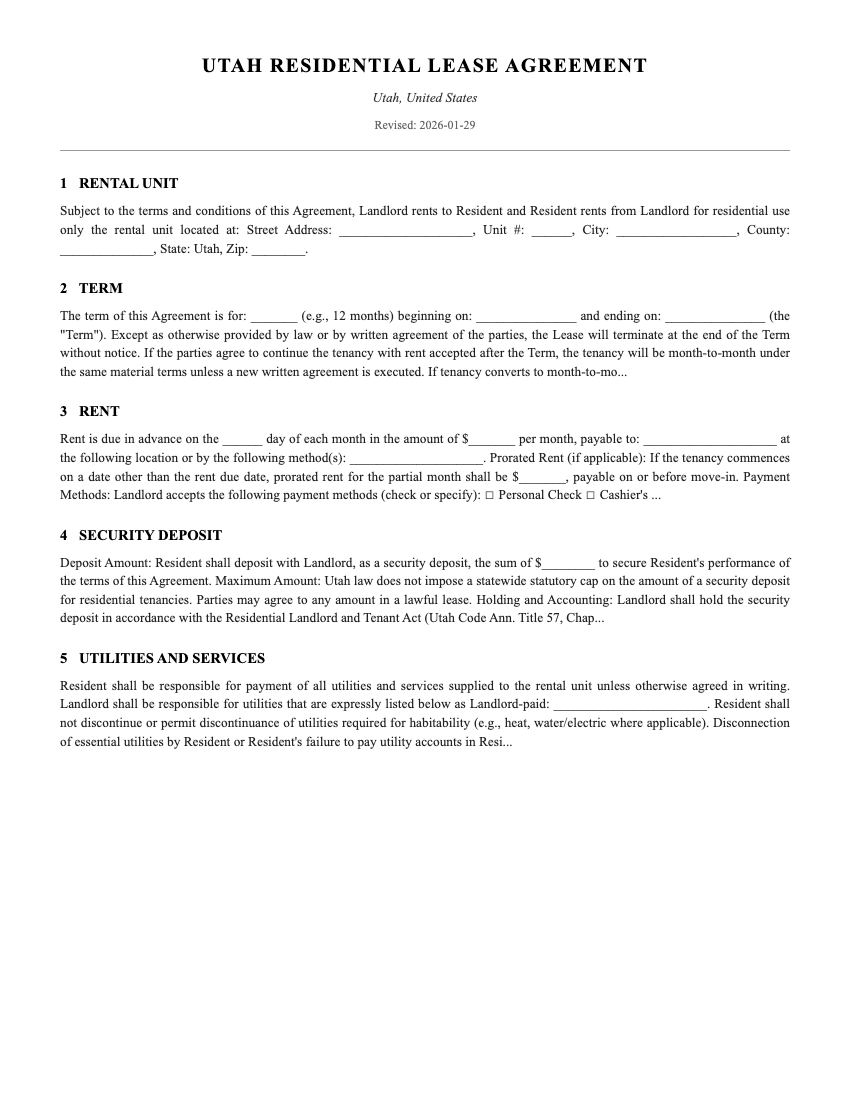
- Lease header with landlord and tenant identification
- Premises description and permitted uses
- Term: fixed-term and month-to-month options
- Rent: amount, due date, grace period, late fees (limited to lawful charges)
- Security deposit clause: amount, required itemized accounting, return timing consistent with Utah law
- Utilities and maintenance responsibilities
- Entry by landlord: notice and reasonable times
- Repairs and habitability obligations aligned with Utah statutes
- Default and remedies: cure periods, notice language consistent with Utah practices
- Eviction process summary and cross-reference to Utah Code Title 78B, Chapter 6
- Required disclosures: lead-based paint, statutory rights, security deposit accounting notice, and placeholder for municipal disclosures
- Optional addenda: pet addendum, lead-paint disclosure form, move-in checklist, and early termination addendum
Download Options
- Single-file PDF (fillable): /downloads/utah-lease-agreement-2026.pdf
- DOCX editable template: available on request (contact support)
- Addenda package: pet addendum, lead-based paint disclosure, move-in checklist
Choose PDF for a final signed copy; use DOCX to customize terms before an AI contract review tool review.
How to Finalize Your Lease
- Customize the template with accurate names, dates, rent, and deposit amounts.
- Add municipal disclosures required by the property's city or county (check local code).
- Run the completed lease through an AI contract review tool for a Utah-specific compliance check.
- Make any necessary edits based on an AI contract review tool recommendations and, if needed, consult a Utah-licensed attorney for complex issues.
- Have all parties sign and date every page. Provide the tenant with copies and deliver required disclosures in writing at or before lease signing.
- Keep signed originals and maintain records of the security deposit accounting and any move-in inspection reports.
Related Lease Agreement Templates
Frequently Asked Questions (Utah)
- Q: Is there a statutory cap on security deposits in Utah?
A: No. Utah has no statewide maximum on security deposit amounts. However, the landlord must provide an itemized accounting and return the net deposit within the time required by the Residential Landlord and Tenant Act (Utah Code Title 57, Chapter 22). Local ordinances may impose additional rules. - Q: How long does a landlord have to return a security deposit in Utah?
A: Utah’s Residential Landlord and Tenant Act requires landlords to return the security deposit, less lawful deductions, together with an itemized statement of deductions within the statutory period set out in the Act (see Utah Code Title 57, Chapter 22). Failure to comply can result in statutory remedies. Check the chapter for the specific time period that applies. - Q: Does Utah have rent control or limits on rent increases?
A: No statewide rent control exists in Utah. Landlords may increase rent consistent with the lease and any required notice periods. Some cities may adopt narrow local rules — check municipal ordinances where the property is located. - Q: What notice is required before starting an eviction for nonpayment of rent?
A: For nonpayment, landlords commonly serve a 3-day pay-or-vacate notice before filing a forcible entry and detainer action, subject to the procedures in Utah Code Title 78B, Chapter 6. Always confirm current statutory procedures and local court requirements. - Q: What disclosures are required when renting a Utah property?
A: Required disclosures include the federal lead-based paint disclosure for properties built before 1978 (42 U.S.C. § 4852d), a disclosure of statutory landlord-tenant rights under Utah law (Title 57), an itemized security deposit accounting at move-out, and any local/municipal disclosures required by the property’s jurisdiction. - Q: Can a lease limit tenant guests or subletting in Utah?
A: Yes — leases can include guest and subletting rules, but they must be reasonable and cannot conflict with statutory protections. Broad or arbitrary prohibitions can cause enforcement problems. Include clear definitions (e.g., how many days constitutes an unauthorized occupant) and a lawful process for approval or denial.
Final Notes
This template is a practical starting point tailored to Utah statutory frameworks. Because laws and local ordinances can change, always confirm the current statutory text and city/county rules. Use an AI contract review tool to scan for compliance issues and consult a Utah-licensed attorney for complex situations, unusual properties, or high-risk tenants.
<div class="ml-embedded" data-form="bBZ9zR"></div>
Frequently Asked Questions

About Designer Content
Designer Content creates practical legal document resources for landlords, contractors, and small business owners. We simplify complex legal concepts into actionable guidance. Connect with us on LinkedIn.