
A Pennsylvania Master Services Agreement (MSA) is a reusable contract that sets the baseline legal terms for an ongoing service relationship in Pennsylvania, with individual projects handled through attached Statements of Work (SOWs). Instead of renegotiating payment, IP, confidentiality, liability, and dispute rules every time you start a new engagement, you sign one MSA and reuse it. For Pennsylvania freelancers, consultants, and agencies, a state-tailored MSA helps manage scope creep, late payments, and client-provided contracts that quietly shift risk. It also makes your SOWs faster to approve because the “legal boilerplate” is already settled.
Definition: A Pennsylvania Master Services Agreement is a governing contract between a service provider and a client that operate in (or choose) Pennsylvania law. It establishes the core rules—like invoices and late-payment interest, ownership of deliverables, confidentiality, warranty disclaimers, and limits on liability—that automatically apply to every future project performed under the relationship. Each project is then described in a separate SOW (scope, timeline, deliverables, fees). Because Pennsylvania contract disputes are typically evaluated under state contract principles and applicable statutes (including Pennsylvania’s UCC for certain transactions), the template’s terms are drafted to be enforceable in Pennsylvania courts.
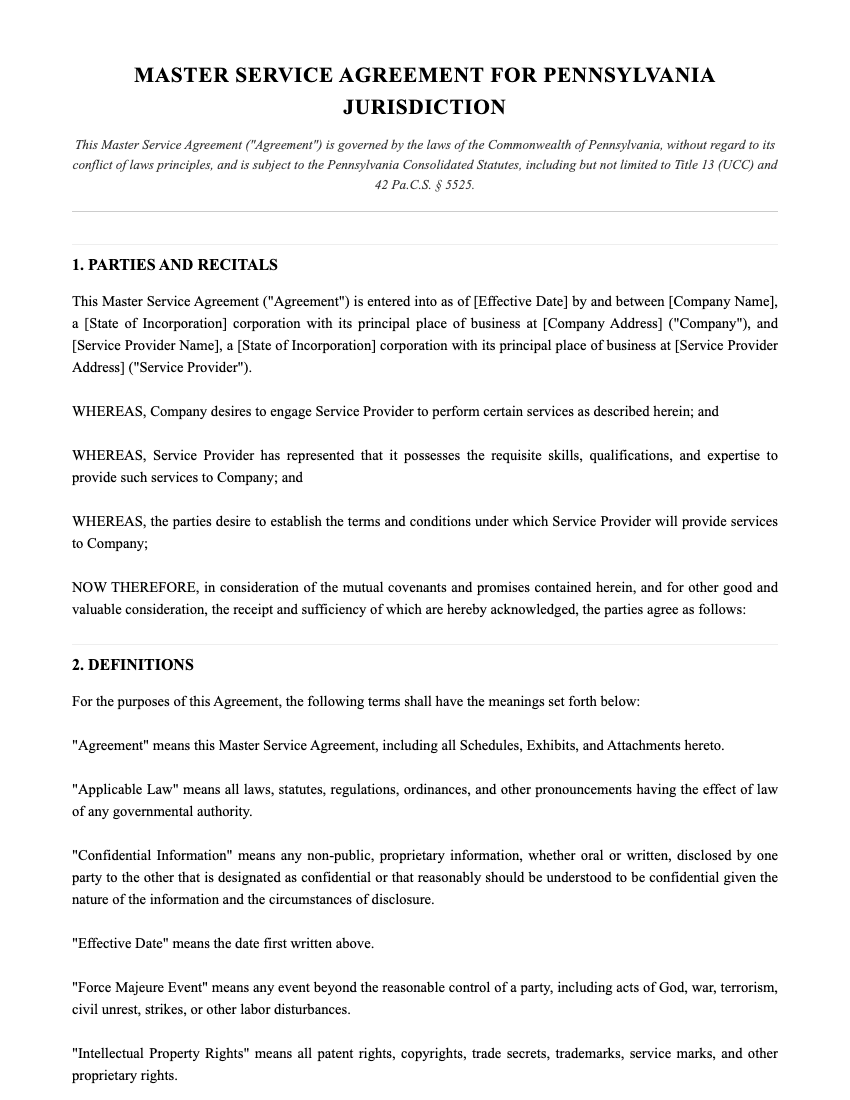
Why You Cannot Use a Generic MSA in Pennsylvania
Generic MSAs are usually written for “any U.S. state,” which sounds convenient but often fails in Pennsylvania where (1) worker classification is fact-specific and enforced through multiple agencies and statutes, (2) non-compete enforceability depends on strict Pennsylvania rules and evolving case law, and (3) IP ownership language must be drafted to match federal copyright rules while still fitting Pennsylvania contract practice. A template that defaults to Delaware venue, uses California-style non-compete bans, or assumes “work made for hire” always transfers ownership can create expensive surprises.
Another common Pennsylvania problem is time and leverage: SMB owners often discover contract weaknesses only when something goes wrong—like a missed deadline, a client refusing to pay, or a data incident involving customer information. At that point, you’re no longer negotiating; you’re enforcing. A Pennsylvania-specific MSA is designed to hold up when you have to send a demand letter, calculate interest on overdue invoices, or file a claim in a Pennsylvania Court of Common Pleas. Pennsylvania also has a four-year statute of limitations for many contract actions (commonly applied to written and implied contracts), so a good MSA should be clear about accrual, invoices, and recordkeeping in case you need to enforce later. See 42 Pa.C.S. § 5525.
For a comprehensive guide to structuring MSAs and SOWs that protect your business, see our Freelancer Contracts Guide.
3a. Worker Classification Rules (Pennsylvania)
Pennsylvania does not rely on a single “one-size” test across all contexts. For many Pennsylvania wage-and-hour and employment analyses, agencies and courts look to a common-law “right to control” framework—focusing on whether the client controls the manner of work, not just the result. In the unemployment context, Pennsylvania’s Unemployment Compensation Law has a specific independent contractor framework: under 43 P.S. § 753(l)(2)(B), a worker can be excluded from “employment” only if they are (1) free from control or direction over performance, and (2) customarily engaged in an independently established trade, occupation, profession, or business.
Why it matters in an MSA: if your contract reads like an employment handbook (set hours, required methods, mandatory internal training, exclusive service), it can be used as evidence of control. Misclassification can trigger back unemployment contributions, interest, and penalties through the Pennsylvania Department of Labor & Industry, and it can also expose clients to wage claims depending on the facts. A Pennsylvania-ready MSA template should include clear independent contractor language, but also practical structure: provider controls tools/methods, can subcontract (if permitted), and is responsible for taxes and insurance—while still letting the client specify deliverables and acceptance criteria through SOWs.
3b. Non-Compete Enforceability (Pennsylvania)
Unlike states that broadly ban non-competes, Pennsylvania may enforce non-compete agreements—but only when they meet strict requirements. Pennsylvania courts generally require that a non-compete be (1) incident to an employment relationship or a sale of a business, (2) supported by adequate consideration, and (3) reasonably necessary to protect legitimate business interests, with reasonable time and geographic limits. Key cases often cited for these standards include Sidco Paper Co. v. Aaron, 351 A.2d 250 (Pa. 1976) and Hess v. Gebhard & Co., 808 A.2d 912 (Pa. 2002).
For B2B MSAs (agency-to-client, consultant-to-business), non-competes are frequently the wrong tool. A broad clause saying “Provider shall not work for any competitor” can be challenged as overbroad, unsupported by legitimate interest, or not tied to an employment/sale context. Even if it’s not automatically void, an aggressive non-compete can stall procurement, trigger redlines, and reduce enforceability.
A Pennsylvania-specific template should usually avoid blanket non-competes and instead use enforceable alternatives that protect real interests: (a) confidentiality and trade secret protections, (b) limited non-solicitation of the other party’s employees/contractors, and (c) a narrow “no circumvention” clause preventing the client from bypassing the provider to hire key subcontractors introduced during the project. If a non-compete is truly needed (rare in B2B services), it should be narrowly drafted (short duration, defined competitors, defined territory) and paired with clear consideration and legitimate-interest recitals consistent with Pennsylvania case law.
3c. IP/Work-for-Hire Considerations
IP ownership is often where generic MSAs fail. Copyright ownership is controlled by federal law, and “work made for hire” exists only in specific situations under 17 U.S.C. § 101 and 17 U.S.C. § 201(b) (employee works, or certain commissioned categories with a signed agreement). Many Pennsylvania service relationships don’t fit those categories, so a bare “work made for hire” sentence may not transfer ownership. A Pennsylvania MSA should use a belt-and-suspenders approach: (1) define deliverables, (2) state whether pre-existing materials remain with the provider, and (3) include an explicit present-tense assignment (“hereby assigns”) of IP rights upon payment, plus a duty to execute further documents.
What's Included in This Template
Flexible SOW Structure: The MSA is your umbrella agreement; each SOW contains scope, milestones, acceptance criteria, and pricing. This separation reduces renegotiation and makes it easier to approve new work while keeping Pennsylvania-law terms consistent.
Pennsylvania-Specific Indemnification: The template uses mutual, service-appropriate indemnities with clear triggers (third-party claims, IP infringement, bodily injury/property damage) and carve-outs for the other party’s negligence or misuse. It is drafted to be understandable to a Pennsylvania judge and to fit typical SMB insurance policies.
Dispute Resolution and Venue: The template defaults to Pennsylvania governing law and Pennsylvania state or federal courts located in Pennsylvania, which helps avoid being forced to litigate out of state. It also aligns timelines with Pennsylvania’s contract limitations period (see 42 Pa.C.S. § 5525).
Additional Pennsylvania-focused provisions include:
- Late-payment interest aligned with Pennsylvania’s legal rate concept (see 41 P.S. § 202).
- Contract limitations awareness and recordkeeping expectations (see 42 Pa.C.S. § 5525).
- Data incident and breach-notification cooperation duties for personal information handled in Pennsylvania (see 73 P.S. § 2301 et seq.).
- UCC alignment for certain “goods” components or mixed transactions (see 13 Pa.C.S.).
Who Needs This Document?
| User Type | Relationship | Key Benefit |
|---|---|---|
| Marketing/Creative Agencies | Retainers + project SOWs | Stops scope creep and standardizes approvals |
| IT/MSP Providers | Ongoing support + change orders | Clear SLAs, limits of liability, and ticketing boundaries |
| Consultants (ops, finance, HR) | Advisory + deliverables | Defines what’s included vs. billable extras |
| Software/Dev Shops | Builds + maintenance SOWs | IP terms, acceptance testing, and payment triggers |
How to Use This MSA Template
Step 1: Identify the parties correctly
Use the exact legal names and entity types (LLC, corporation, sole proprietor) and a Pennsylvania service address for notice. This helps with enforceability and service of process.
Step 2: Set the term and termination rules
Choose a fixed term or evergreen renewal and define how either party can terminate (notice period, payment for work in progress, transition assistance). Pennsylvania disputes often turn on what notice was required and whether it was given.
Step 3: Attach your first SOW
Put all project specifics in the SOW: scope, timeline, deliverables, acceptance criteria, and fees. The MSA should stay stable while SOWs change.
Step 4: Sign once, then reuse
After signature, each new project is a new SOW that automatically incorporates the MSA. Keep signed copies and invoice records in case you need to enforce payment or interest later.
Related MSA Templates
Get the Template
Sign up for our newsletter to receive the template.
Frequently Asked Questions

About Designer Content
Designer Content creates practical legal document resources for landlords, contractors, and small business owners. We simplify complex legal concepts into actionable guidance. Connect with us on LinkedIn.