
Introduction
Complying with Quebec's rules on residential rentals protects both the landlord and the tenant. In Quebec, the lease is governed mainly by the Code civil du Québec (C.c.Q.) and disputes are decided by the Tribunal administratif du logement (TAL). The use of the TAL's official form is strongly recommended — and often required — for most dwellings. This 2026 template is designed to reflect the obligations to deliver a dwelling in a good state of habitability, the limitations related to security deposits, the disclosure requirements (health, environment, privacy) and the notice and termination procedures compliant with Quebec civil law.
Définition — Qu'est‑ce qu'un bail résidentiel au Québec ?
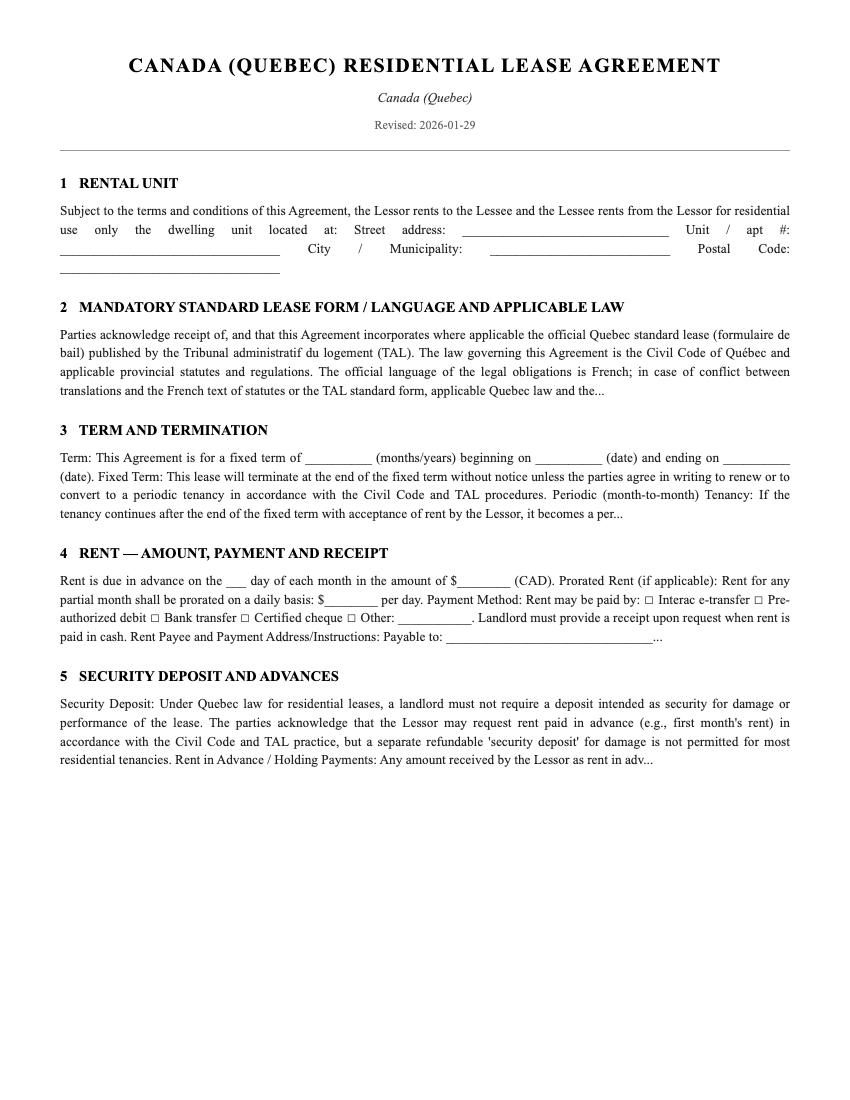
A residential lease in Quebec is a civil contract between a lessor (owner) and a lessee governing the use of a dwelling. It is governed by the Code civil du Québec (C.c.Q., CQLR c CCQ-1991) and the rules of implementation and interpretation are applied by the Tribunal administratif du logement (TAL). The lease specifies the duration, the rent, the obligations relating to repairs and maintenance, and the conditions of termination and access. The TAL's official form is the reference tool for most residential rentals.
Why Old Templates Are Dangerous
Old lease templates, especially those not adapted to Quebec, raise several specific risks:
- Use of a form not compliant with the TAL: the TAL publishes a widely used standard form; using an incompatible text may lead to challenges or invalidations.
- Illegal security deposit clauses: the Civil Code and TAL practice generally prohibit "deposits for damages"; a model imported from another province/US state may contain prohibited clauses.
- Non‑compliance with Loi 25 (protection of personal information): collecting and storing tenant data without a legal basis or adequate consent.
- Inappropriate notices/ timeframes: outdated forms can indicate incorrect notice periods for the end of lease or termination, resulting in applications rejected by the TAL.
- Lack of environmental disclosures: known risks (mould, radon, asbestos) not disclosed can increase the lessor's liability.
- Clauses contradictory to the Civil Code (rent obligations, repairs, assignment of lease): the TAL interprets according to civil law; anglo‑Saxon formulations may be inapplicable.
What's Included in This Template
This 2026 template for Quebec includes:
- A version compliant with the form and the principles of the Tribunal administratif du logement (TAL).
- Clause on rent, method of payment, and treatment of prepayments (e.g. first month’s rent) — specifying that a "dépôt pour dommages" is prohibited.
- Provisions on delivery and condition of the dwelling (reference to the Code civil du Québec) and maintenance obligations.
- Termination and notice procedures compliant with TAL rules (notice periods, recommended wording).
- Section "Divulgations obligatoires et avis": habitability, known material defects, suspected or confirmed presence of mould, radon, asbestos, lead, and guidance related to the risks.
- Clauses protecting personal information and limited consent under Loi 25 (collection, retention, access, destruction of files).
- Procedure in case of non‑payment and description of the recourse route (reference to the TAL).
- Appendices: inventory / condition report, accessibility checklist for exits, schedule of urgent and non‑urgent repairs.
- Practical advice for serving notices and keeping evidence (signatures, copies, registered email).
Download Options
- PDF ready to print (official format) — /downloads/canada-quebec-lease-agreement-2026.pdf
- Fillable version (interactive PDF) for electronic signatures in compliance
- Word/ODT editable version (for local adaptation — caution: keep mandatory clauses)
- TAL compliance checklist + disclosure guide (separate file)
How to Finalize Your Lease
- Fill out the form respecting the TAL sections and indicating precisely any prepayment (e.g. first month), qualifying it correctly to avoid the appearance of a security deposit.
- Attach the signed condition report (move‑in) and any required disclosures (known defects, environmental risks).
- Have the lease analyzed by an AI contract review tool to spot problematic clauses and obtain compliance recommendations.
- Obtain signatures (lessor and lessee) — keep a paper copy and a timestamped digital copy; if electronic signature, use a reliable solution that preserves the document's integrity.
- Provide a copy to the tenant no later than the time of taking possession (or keep proof of delivery), and document any handover of keys and payments.
- If a dispute arises, file an application with the Tribunal administratif du logement (www.tal.gouv.qc.ca) and attach the signed lease and condition reports as evidence.
Related Lease Agreement Templates
FAQs
Q: Can I require a security deposit to cover damages?
A: No. In Quebec, deposits made exclusively as a guarantee for rental damages are generally prohibited for residential dwellings. The landlord may, however, request a rent prepayment (e.g. the first month) — it must be specified that it is prepaid rent and not a security deposit. The Tribunal administratif du logement sanctions the illegal collection of deposits and may order reimbursement and damages (see Code civil du Québec and TAL jurisprudence).
Q: Is there provincial rent control?
A: No. Quebec does not impose a general provincial cap on rent increases. Increases must respect the contractual terms and can be contested before the Tribunal administratif du logement, which assesses the reasonableness and the reasons invoked by the lessor. Municipal programs or subsidized housing may, however, contain specific rules.
Q: What disclosures must the landlord make at signing?
A: The lessor must disclose known material defects, known environmental risks (lead, asbestos, radon, infestation) and any information relevant to habitability. They must also comply with Loi 25 regarding the collection and protection of personal information (consent, purpose, retention period). Use the "Divulgations" section of this template to record these items.
Q: What is the eviction procedure for non‑payment?
A: In case of non‑payment, the lessor must give written notice specifying the amounts owed and provide an opportunity to pay. If the tenant does not comply, the lessor can seize the Tribunal administratif du logement to obtain repossession of the dwelling. Time limits, notice forms and procedural criteria follow the Code civil du Québec and TAL rules; the tenant often retains an opportunity to settle by payment before the actual eviction.
Q: Can I limit the duration of visitors or prohibit subletting?
A: The lessor can set reasonable rules regarding the use of the dwelling, visitors and subletting, but these rules must not contravene the Civil Code. Assignment or subletting may depend on the lessor's consent; however, abusive refusals can be contested before the TAL. Draft clear and reasonable clauses in the lease and avoid general prohibitions without objective criteria.
Q: What obligations apply regarding protection of personal information (Loi 25)?
A: Loi 25 (An Act to modernize legislative provisions as regards the protection of personal information, P‑39.1.1) imposes on the lessor transparency obligations, limitations on collection, retention and security for tenants' data. State in the lease the purpose of collection, the retention period for files, the third parties with access to the data (e.g. credit reference), and the means for the tenant to exercise their access or correction rights.
Sources
- Civil Code of Québec (droit civil, textes officiels) — http://legisquebec.gouv.qc.ca/en/showdoc/cs/CCQ-1991 — Gouvernement du Québec
- Tribunal administratif du logement (TAL) — Formulaires, guides et décisions — https://www.tal.gouv.qc.ca/ — Tribunal administratif du logement
- Loi 25 — An Act to modernize legislative provisions as regards the protection of personal information (P‑39.1.1) — https://www.legisquebec.gouv.qc.ca/en/showdoc/cs/P-39.1.1 — Gouvernement du Québec
- Health Canada — Radon (guidance for homes) — https://www.canada.ca/en/health-canada/services/environmental-workplace-health/air-quality/indoor-air/radon.html — Gouvernement du Canada
- Hazardous Products Act (R.S.C., 1985, c. H‑3) — https://laws-lois.justice.gc.ca/eng/acts/H-3/ — Justice Laws Website
Final remarks
Use this template as a starting point compliant with Quebec requirements, then have the final lease reviewed by an AI contract review tool and/or a lawyer specialized in Quebec rental law before signing. Compliance with the Code civil du Québec and the prescriptions of the Tribunal administratif du logement protects the parties and facilitates dispute resolution.
<div class="ml-embedded" data-form="bBZ9zR"></div>
Frequently Asked Questions

About Designer Content
Designer Content creates practical legal document resources for landlords, contractors, and small business owners. We simplify complex legal concepts into actionable guidance. Connect with us on LinkedIn.