
Alaska Residential Lease Agreement Template — Why compliance matters
Using a lease that reflects Alaska law protects both landlords and tenants. Alaska's landlord-tenant relationship is governed primarily by the Alaska Statutes (see AS 34.03 et seq.). Key practical points for Alaska leases include security deposit handling and itemization requirements, statutory notice periods for termination and eviction, required federal and state disclosures (lead paint, sex offender registry, flood hazards, and known environmental hazards), and the three-year statute of limitations for most contract claims (AS 09.10.053).
A lease that fails to reflect these rules can result in lost deposit claims, improper evictions, or exposure to statutory remedies and attorney fees. This template is designed as a starting point to help you create a compliant, clear residential lease tailored to Alaska, but it is not a substitute for local counsel or municipal rule checks.
For a comprehensive lease review checklist covering residential and commercial terms, see our Lease Agreement Review Guide.
What is an Alaska residential lease?
An Alaska residential lease is a written contract between a landlord and a tenant that sets the terms for occupying a dwelling in Alaska, including rent, security deposit, term length, obligations of each party, and remedies for breaches. The lease operates alongside Alaska's landlord-tenant statutes (AS 34.03 et seq.) and applicable federal disclosure requirements.
Why Old Templates Are Dangerous (Alaska-specific traps)
- Security deposit timing and itemization: Alaska requires timely return of deposits and an itemized statement of deductions. Using an old template with a different deadline or no itemization language can expose landlords to statutory claims (see AS 34.03).
- Notice periods: Common practice in Alaska uses a 14-day notice for nonpayment and a 30-day notice for terminating month-to-month tenancies, but older forms may specify incorrect periods or omit cure periods required by statute or case law.
- Municipal rules and local ordinances: Alaska has no statewide rent control, but municipalities or boroughs may have local regulations or permit requirements (for example, municipal licensing or inspection rules in larger cities). Old statewide templates may miss local requirements.
- Required disclosures: Federal lead-based paint rules and Alaska-specific informational notices (sex offender registry info, and recommended flood hazard disclosure in high-risk areas) must be included where applicable. Missing disclosures can delay enforcement or lead to damages.
- Habitability and repairs: Alaska tenants can rely on statutory remedies if landlords fail to maintain habitable premises; an out-of-date lease may attempt to waive statutory remedies in ways courts will not enforce.
- Eviction procedure compliance: Using obsolete eviction language or skipping required procedural steps (service methods, court filings) can lead to dismissal of unlawful detainer actions and statutory exposure for the landlord.
What's Included in This Template
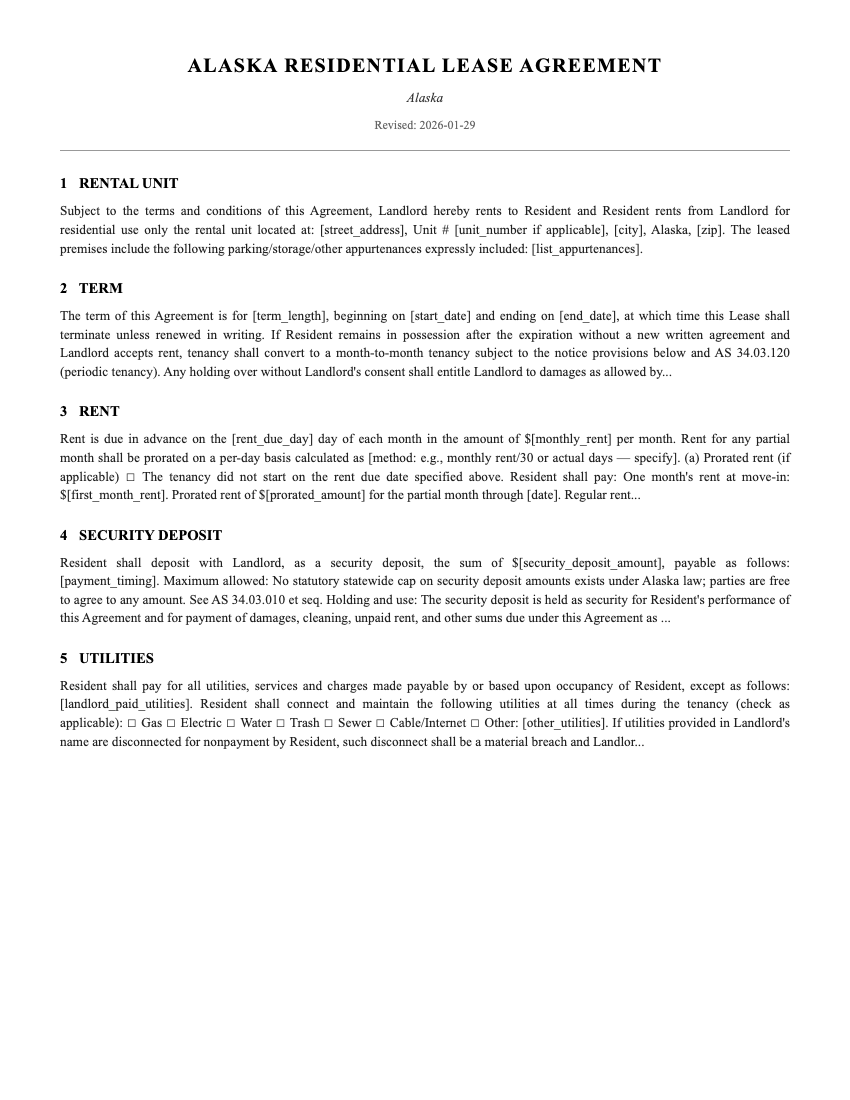
This Alaska Residential Lease Agreement template includes:
- Parties, premises description, and term (fixed-term and month-to-month options)
- Rent amount, due date, late fees (calibrated to avoid usury and unconscionability), and permitted rent increases for renewals
- Security deposit clause: amount (no statewide cap), procedures for holding, requirement to provide itemized deductions and return balance within the statutory period (see AS 34.03)
- Required disclosures section: federal lead-based paint, Alaska sex offender registry notice, flood hazard recommendation, and environmental/hazardous materials disclosure if known
- Tenant and landlord maintenance and repair responsibilities, including notice and access provisions for repairs and inspections
- Notice and termination provisions: nonpayment notice, cure periods, 30-day month-to-month termination language, and eviction procedures consistent with Alaska law
- Utilities and services allocation, assignment/subletting rules, and rules regarding pets and smoking (customizable)
- Entry and access provisions consistent with Alaska practice
- Arbitration and dispute resolution clause (noting enforceability under Alaska law; parties should review AS arbitration statutes)
- Move-in / move-out inspection form and inventory checklist
- Signature blocks and optional notary acknowledgment
Download Options
- Fillable PDF: /downloads/alaska-lease-agreement-2026.pdf (recommended for most users)
- Editable Word doc: available on request for customization
- Plain text / copy-and-paste version: for landlords using property management software
Each download option includes instructions for customizing fields like rent, deposit amounts, and special terms.
How to Finalize Your Lease
- Customize the template: insert correct names, address, rent, deposit amount, utilities, and any property-specific rules.
- Confirm local rules: check municipal ordinances (city or borough) that may affect licensing, inspection, or additional disclosures.
- Complete the disclosures: attach federal lead-based paint disclosure and provide the Alaska sex offender registry notice and any flood or environmental disclosures if applicable.
- Conduct move-in inspection: complete the inventory checklist; both parties should sign to reduce move-out disputes.
- Take and store condition photos: timestamped photos help defend against unreasonable damage claims.
- Sign and exchange copies: have both parties sign and exchange original or PDF-signed copies. Consider notarization if required for specific enforcement contexts.
- Run the AI contract review tool safety check: upload to an AI contract review tool to identify issues and confirm statutory compliance; address any flagged items before occupancy.
Persona table
| User Persona | Property Type | Key Benefit of This Template |
|---|---|---|
| Individual landlord | Single-family home or duplex | Clear security deposit handling and move-in checklist to reduce disputes |
| Professional property manager | Multi-unit building | Standardized clauses for rent collection, late fees, and eviction notice templates aligned with AS 34.03 |
| First-time tenant | Rented apartment | Transparent disclosures and a move-in condition form protecting deposit rights |
| Real estate attorney or paralegal | Lease review and customization | A reliable baseline lease referencing Alaska statutes to speed client work |
Related Lease Agreement Templates
FAQs
Q: Is there a cap on security deposits in Alaska?
A: No. Alaska does not impose a statewide statutory cap on security deposit amounts. Parties may agree to any amount subject to contract law and anti-discrimination rules. Landlords must, however, follow the statutory requirements for holding and returning deposits and must provide an itemized statement of deductions (see AS 34.03). Municipal rules may add specifics—verify local ordinances.
Q: How soon must a landlord return a security deposit after a tenancy ends?
A: Under Alaska law and common statutory practice, landlords must return the security deposit balance and provide an itemized statement of deductions within a short statutory period after termination and delivery of possession. This template uses a 14-day timeframe for an itemized statement and return; landlords should confirm the exact statutory timing and case law in their municipality (AS 34.03).
Q: Does Alaska have rent control or limits on rent increases?
A: No. Alaska has no statewide rent control regime and no statutory caps on rent increases. Rent terms are governed by the lease and by general contract law. Municipalities may have specific rules; confirm local ordinances for any city- or borough-level restrictions.
Q: What notices are required for eviction in Alaska?
A: For nonpayment, landlords typically provide a written notice to pay or quit; 14-day notices are commonly used for periodic tenancies. For breaches other than nonpayment, a written notice specifying the breach and a reasonable time to cure is required where statute or case law mandates a cure period. Month-to-month tenancies generally require at least 30 days' notice to terminate. Any eviction must be completed through Alaska courts following the procedural rules (AS 34.03; Alaska court rules).
Q: What disclosures must I include in an Alaska residential lease?
A: Required disclosures include the federal lead-based paint disclosure for pre-1978 housing, an Alaska informational notice regarding the sex offender registry, and any known environmental or hazardous-materials information. Flood hazard information is strongly recommended in flood-prone areas, and some municipal programs may require additional disclosures.
Q: Can a lease require arbitration of disputes in Alaska?
A: Yes—arbitration agreements are generally enforceable under Alaska arbitration statutes. However, arbitration clauses must comply with statutory requirements and cannot waive certain non-waivable statutory rights. Consider having a local attorney review arbitration or waiver language to ensure enforceability.
Sources
- Alaska Statutes — Landlord & Tenant (AS 34.03): https://www.akleg.gov/basis/folio.asp#34.03 (Alaska Legislature, accessed 2026-01-30)
- Alaska Statutes — Limitations of Actions (AS 09.10.053): https://www.akleg.gov/basis/statutes.asp#09.10.053 (Alaska Legislature, accessed 2026-01-30)
- Alaska Department of Public Safety — Sex Offender Registry: https://dps.alaska.gov/sor (Alaska DPS, accessed 2026-01-30)
- U.S. Environmental Protection Agency — Lead Information for Realtors and Landlords: https://www.epa.gov/lead (EPA, accessed 2026-01-30)
- FEMA Flood Map Service Center: https://msc.fema.gov (FEMA, accessed 2026-01-30)
- Alaska Court System — Rules and Self-Help Information: https://www.courts.alaska.gov/selfhelp/landlordtenant.htm (Alaska Court System, accessed 2026-01-30)
Final notes
This template is designed to reflect key Alaska statutory rules and common practice but is not a substitute for legal advice. Always verify municipal rules (city/borough) and consult local counsel for complex situations, large deposits, or contested evictions.
<div class="ml-embedded" data-form="bBZ9zR"></div>
Frequently Asked Questions

About Designer Content
Designer Content creates practical legal document resources for landlords, contractors, and small business owners. We simplify complex legal concepts into actionable guidance. Connect with us on LinkedIn.