
Introduction
Using a lease that fits Hawaii law is essential for both landlords and tenants. Hawaii landlord-tenant relations are governed primarily by Hawaii Revised Statutes (HRS) Chapter 521 (Landlord and Tenant), supplemented by consumer protection rules (HRS Chapter 480), federal disclosure requirements (e.g., lead-based paint for pre-1978 housing), and applicable court rules. This template adapts common lease terms to Hawaii law: it addresses security-deposit handling (return and itemization within 14 days), notice practices for nonpayment and breaches, and the disclosures commonly required in Hawaii.
A lease that fails to reflect Hawaii statutes or omits required disclosures can expose a landlord to damages, delays in eviction, or liability under consumer protection law. Tenants who sign noncompliant leases may unknowingly waive rights that cannot be lawfully waived.
For a comprehensive lease review checklist covering residential and commercial terms, see our Lease Agreement Review Guide.
"What is a Hawaii residential lease?"
A Hawaii residential lease is a written contract between a landlord and tenant that sets the terms of occupancy of a dwelling in Hawaii. It must be consistent with Hawaii Revised Statutes Chapter 521 and federal disclosure laws (e.g., lead-based paint for pre-1978 buildings). The lease defines rent, security deposit handling (including return and itemized deductions within 14 days after termination and delivery of possession), notice periods for nonpayment and breaches, permitted uses, and required statutory disclosures. (See HRS Chapter 521.)
Why Old Templates Are Dangerous (Hawaii-specific traps)
- Security deposit mistakes: Hawaii does not cap deposits by statute, but HRS Chapter 521 requires landlords to return the unused portion of the deposit within 14 days after termination and delivery of possession, with a written itemized statement of deductions. Using a template that ignores the 14-day deadline or fails to require itemization can lead to statutory claims and consumer-protection exposure (HRS Chapter 521; HRS Chapter 480).
- Missing federal disclosures: Federal law requires lead-based paint disclosure (42 U.S.C. §4852d) for housing built before 1978. Templates that omit federal disclosures risk enforcement and civil liability.
- Improper notice language: Eviction and termination procedures are governed by HRS Chapter 521 and court rules. A template that provides incorrect cure periods, or that attempts to shorten statutorily required notice, will not be enforceable.
- Short-term rental and local rules: Hawaii counties regulate short-term vacation rentals and registration/licensing. Using a generic lease that does not address county registration requirements, transient accommodations tax, or prohibited uses risks fines and civil penalties in some counties.
- Waiving non-waivable rights or misrepresenting remedies: Some templates attempt to disclaim duties or reduce landlord obligations (e.g., habitability). Hawaii law and consumer-protection statutes may render those clauses unenforceable and expose the drafter to damages.
What's Included in This Template
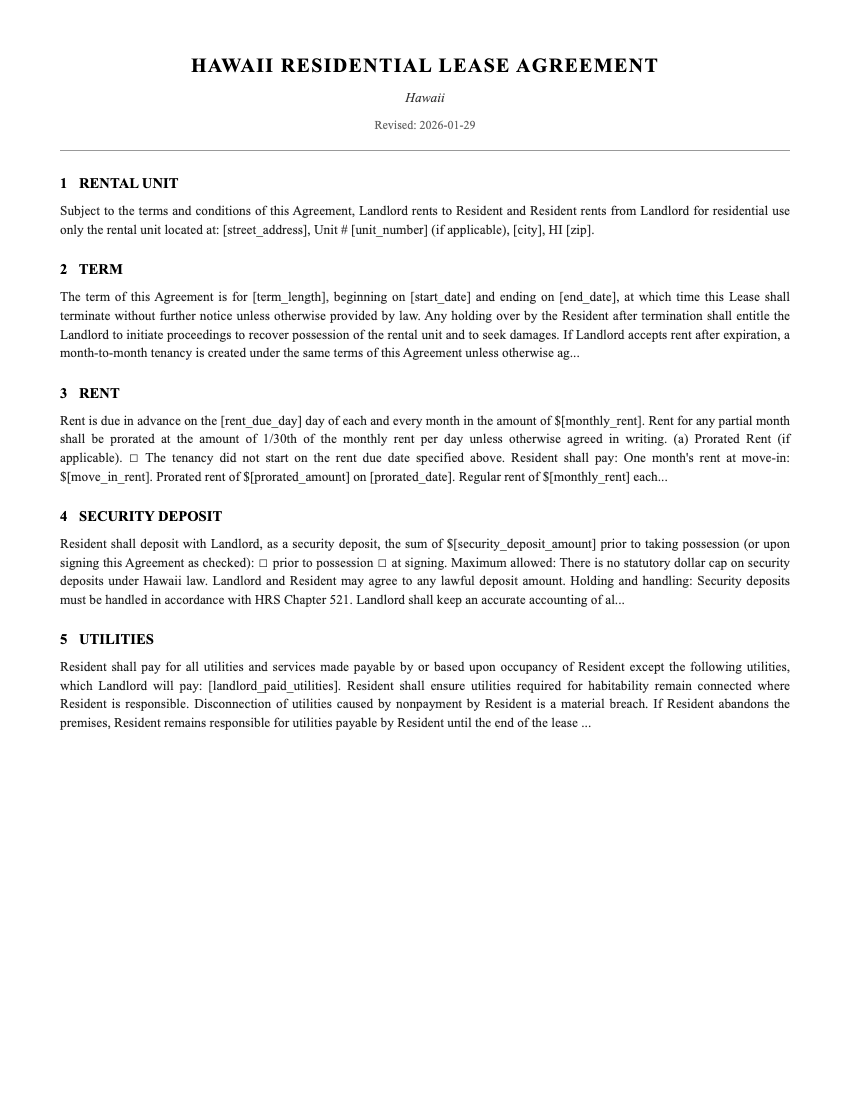
- Clear lease term options: fixed-term and month-to-month provisions tailored to HRS Chapter 521.
- Security deposit clause compliant with Hawaii rules: specifies deposit handling, the 14-day return deadline, required written itemization of deductions, and consequences for improper retention.
- Rent clause: amount, due date, acceptable payment methods, late fees (subject to reasonableness), and notice mechanics for rent increases consistent with the lease and Hawaii law.
- Notices and remedies: model pay-or-quit and breach cure notices consistent with local practice (nonpayment notices commonly follow a 5-day practice; cure periods for breaches commonly 10 days where appropriate) and references to HRS Chapter 521.
- Required disclosures: federal lead-based paint disclosure for pre-1978 housing, landlord identity and statutory notice statements, flood-hazard advisory, and county-required disclosures.
- Use and occupancy rules: guest policies, subletting rules, quiet enjoyment, and short-term rental restrictions to reflect county regulations.
- Maintenance and repair obligations, habitability standard, and entry notice provisions.
- Default and eviction process explanation (statutory requirements) and allocation of legal fees where permitted by law.
Download Options
- Quick fill PDF (recommended for landlords who want a simple editable fill-in-the-blanks lease): /downloads/hawaii-lease-agreement-2026.pdf
- Editable Word (.docx) — available on request for law firms and property managers (contact support)
- Sample filled lease — shows common variable clauses and how to handle deposits, move-in checklists, and disclosure checkboxes.
How to Finalize Your Lease
- Confirm the property's county rules — some counties have additional registration or short-term rental restrictions.
- Complete the template with accurate landlord contact and property information.
- Attach required disclosures (lead-based paint, flood advisory, county notices) and the move-in condition form.
- Run the completed lease through an AI contract review tool for a rapid contract check to flag missing statutory language or contradictory clauses.
- Provide the tenant with copies of all signed documents and retain originals for your records.
- If there are unusual provisions (large security deposit, pets, subletting permissions), consider a targeted review by a Hawaii-licensed attorney.
Related Lease Agreement Templates
FAQs
- Q: What is the maximum security deposit allowed in Hawaii?
A: Hawaii law (HRS Chapter 521) does not set a statutory maximum security deposit. Parties may agree to any lawful amount. However, the landlord must return the unused portion of the security deposit within 14 days after termination and delivery of possession and must provide a written itemized statement of deductions (HRS Chapter 521). - Q: How long does a landlord have to return a security deposit in Hawaii?
A: Under HRS Chapter 521, the landlord must return the unused portion of the security deposit and provide a written itemized statement of deductions within 14 days after termination and delivery of possession. - Q: Is there statewide rent control in Hawaii? Can landlords increase rent at will?
A: Hawaii has no statewide rent-control statute. Landlords may increase rent consistent with the lease terms and applicable notice requirements. Always review the existing lease for rent-increase clauses and provide any required advance notice. Local county ordinances may affect short-term rentals and related obligations, but they generally do not impose statewide rent caps. - Q: What disclosures are required when leasing a residence in Hawaii?
A: Commonly required disclosures include: the federal lead-based paint disclosure for properties built before 1978 (42 U.S.C. §4852d), landlord identity and statutory notices under HRS Chapter 521, flood-hazard advisories where relevant, and any county-specific notices (for example, short-term rental registration information). Always confirm county-level requirements. - Q: How do eviction procedures work in Hawaii for nonpayment or lease violation?
A: Eviction (summary possession) procedures are governed by HRS Chapter 521 and the applicable rules of court. Landlords generally must provide the statutory notice appropriate to the default (commonly a pay-or-quit notice for nonpayment; local practice often uses a 5-day notice) and then file for a court remedy. A court order is required to remove a tenant, and landlords should not attempt self-help eviction measures that violate the law. Consult HRS Chapter 521 and local court rules before proceeding. - Q: Are there local rules about guests or short-term subletting in Hawaii?
A: The template includes guest and subletting provisions. Many Hawaii counties regulate short-term vacation rentals, require registration, and impose taxes (e.g., transient accommodations tax). Tenants should not host short-term guests in violation of county rules or the lease. Landlords should expressly prohibit short-term rentals when they are not allowed or require separate written permission and compliance with county registration and tax rules.
Final Notes
This template is designed to reflect common Hawaii landlord-tenant legal requirements, but it is not a substitute for legal advice. Laws change; always verify statutory citations and consult a Hawaii-licensed attorney for unusual situations or contested evictions. For a rapid contract review, upload your completed lease to an AI contract review tool to catch missing or inconsistent statutory language before signing or serving notices.
<div class="ml-embedded" data-form="bBZ9zR"></div>
Frequently Asked Questions

About Designer Content
Designer Content creates practical legal document resources for landlords, contractors, and small business owners. We simplify complex legal concepts into actionable guidance. Connect with us on LinkedIn.