
Introduction
Having a well-drafted residential lease agreement is essential in Colombia. The relationships between landlord and tenant are governed by Ley 820 de 2003 —que regula el régimen de arrendamientos de vivienda urbana— and by rules in the Código Civil, Ley 1480 de 2011 (Estatuto del Consumidor) and Ley 1581 de 2012 (protección de datos personales). A clear contract reduces the risk of disputes that can end in restitution proceedings before the competent judges according to the Código General del Proceso (Ley 1564 de 2012).
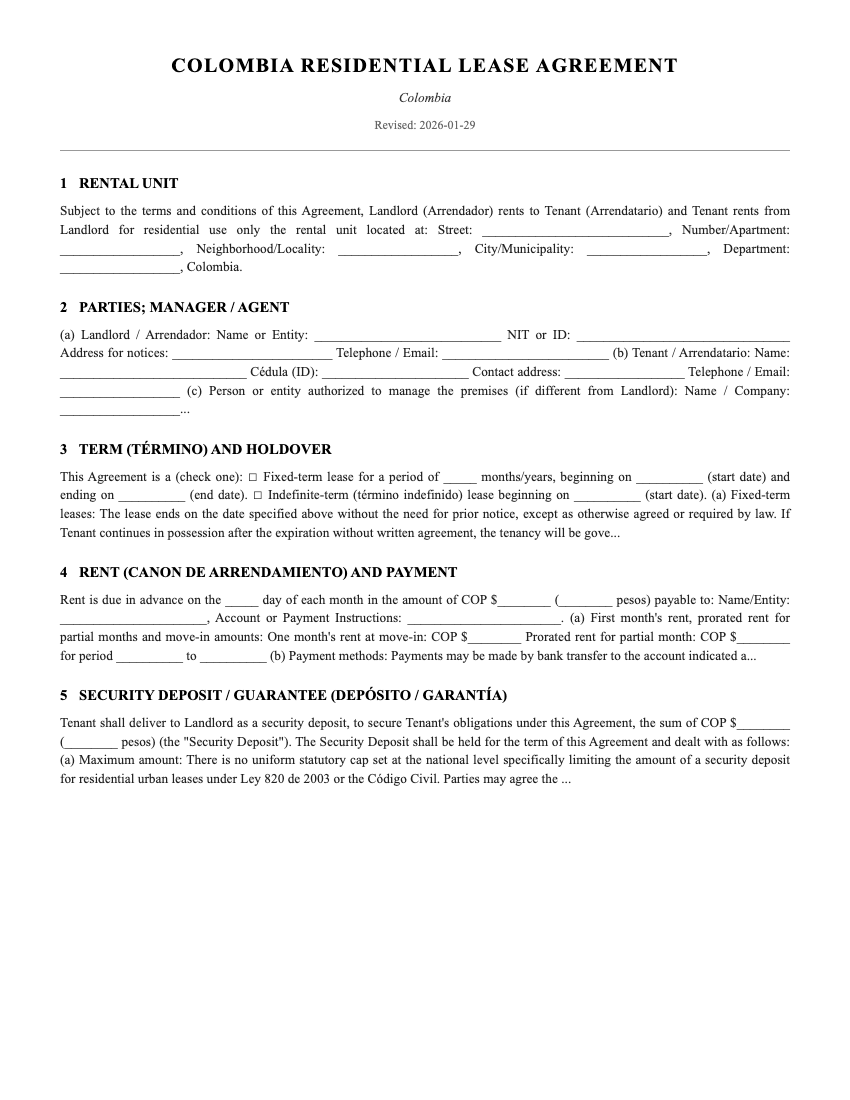
This template has been adapted to reflect common practices in Colombia: clauses on security deposit (no fixed national cap), notice periods, habitability obligations and notices on processing of personal data. It does not replace review by a local lawyer, especially where municipal ordinances or housing programs impose additional rules.
For a comprehensive lease review checklist covering residential and commercial terms, see our Lease Agreement Review Guide.
Definición: ¿Qué es un contrato de arrendamiento de vivienda en Colombia?
Un contrato de arrendamiento de vivienda urbana es un acuerdo por el cual una persona (arrendador) concede a otra (arrendatario) el uso y goce de un inmueble destinado exclusivamente a habitación por un tiempo determinado o indeterminado, a cambio de un canon de arrendamiento. Está regulado principalmente por la Ley 820 de 2003, el Código Civil y las normas de protección al consumidor y de datos personales aplicables.
Why old templates are dangerous (specific risks in Colombia)
- Lack of references to Ley 820 de 2003: that law contains specific provisions on urban housing leases that are not in generic civil contracts.
- Undetailed deposits: although there is no national cap, the absence of a clause requiring itemization and a deadline for return can leave the tenant without an easy remedy; the template includes an obligation to itemize deductions.
- Missing data protection notice: omitting the Aviso de Tratamiento de Datos Personales (Ley 1581/2012) exposes the landlord to sanctions by the Superintendencia de Industria y Comercio and to claims.
- Abusive clauses and consumer practices: contracts that impose disproportionate penalties can be sanctioned under Ley 1480 de 2011.
- Ignoring local ordinances: some municipalities or housing programs have particular rules (subsidies, co-ownership rules) that change rights and duties.
- Restitution procedures: copying foreign templates may not respect procedural requirements of the Código General del Proceso (Ley 1564 de 2012), exposing parties to delays in an eviction process.
What this template includes
- Identification of the parties (landlord, tenant, guarantor when applicable).
- Description of the property and exclusive use for habitation.
- Duration of the contract (fixed term or clause for term by automatic renewals) and rules on extension and termination.
- Rent: amount, payment method and indexation mechanism (if agreed by the parties).
- Deposit/guarantee: agreed amount, itemization of possible deductions, deadline for accounting and return (recommended: 30 días), no national obligation to pay interest unless expressly agreed.
- Maintenance and repair obligations; delivery of inventory and condition report.
- Sublease and assignment clause: conditions and prior authorization.
- Rules on visitors and use of common areas.
- Aviso de tratamiento de datos personales (Ley 1581/2012) and consent where necessary.
- Conditions for early termination, breach and judicial restitution procedure (aligned with Ley 1564 de 2012).
- Notices and communications clauses (physical and electronic addresses) and signature or indication of electronic signature (Ley 527 de 1999).
- List of mandatory disclosures: consumer information, co-ownership rules (if applicable), warnings about risks and disasters, and disclosure of known hazardous materials (lead, asbestos).
Disclaimers and mandatory notices (included in the template)
- Aviso de tratamiento de datos personales (Ley 1581 de 2012).
- Information as a consumer contract (Ley 1480 de 2011) if the lease constitutes a consumer relation.
- Regulations and co-ownership rules when applicable.
- Risk notice / contingency plan for disasters (recommended by local authorities).
- Disclosure about known existence of hazardous materials (lead/asbestos) as known by the landlord.
Why Old Templates Are Dangerous (practical summary)
- They do not meet data protection requirements (fines by the SIC).
- They may impose clauses that Ley 1480/2011 considers abusive (penalties, unjustified extra charges).
- Omission of minimum notification procedures and reasonable cure periods, which complicates judicial restitution actions.
What’s Included in This Template
- Versions: editable PDF and DOCX.
- Fields marked for customization: amounts, addresses, cure periods, inventory annexes and co-ownership regulations.
- Inline instructions on articles of Ley 820 de 2003 and useful references.
- Recommended clause for handling deposits and final settlement with an example format of the delivery condition document.
Download Options
- Immediate download in PDF: [/downloads/colombia-lease-agreement-2026.pdf]
- Editable version (DOCX) available at the end of the download process.
- Premium package: template + signing checklist + guide for notices and handover letter (local lawyer review available as an additional service).
How to Finalize Your Lease
- Complete all mandatory fields: personal details, rent amount, term, deposit amount.
- Attach inventory and dated photos of the property condition as an annex.
- Insert the Aviso de Tratamiento de Datos Personales and obtain consent if you will store or share data.
- Review termination clauses and cure period (recommended: 5–15 days for minor breaches; 30 días for notices in indefinite-term contracts), and adjust according to city practices or agreements between parties.
- Sign in person or with a valid electronic signature (Ley 527 de 1999) and give copies to both parties.
- Upload the final contract to an AI contract review tool for an automatic check and then to a local lawyer for final review if there are doubts or special municipal rules.
Practical tips for landlords and tenants
- Landlords: document the property's condition with dated photos and a signed inventory; detail any deposit deductions in an annexed document.
- Tenants: insist on the accounting clause for the deposit and a clear deadline for its return; review the Aviso de Tratamiento de Datos before authorizing the use of your information.
- Both: agree in writing on the cure period for late payments and maintenance tasks to avoid preventive disputes.
Related Lease Agreement Templates
Frequently Asked Questions (summary on the page — detailed answers below)
See the FAQ section later for answers about deposit, rent increases, notices and judicial restitution procedures.
Frequently Asked Questions

About Designer Content
Designer Content creates practical legal document resources for landlords, contractors, and small business owners. We simplify complex legal concepts into actionable guidance. Connect with us on LinkedIn.