
Introduction
Complying with national regulation and observing consumer protection and personal data provisions is key to avoiding costly disputes in residential locación contracts in Argentina. This template is designed to reflect the obligations established by the Código Civil y Comercial de la Nación (Ley No. 26.994), the Ley de Alquileres (Ley No. 27.551) and the consumer protection and personal data rules applicable to the locative relationship.
Although there is no single nationwide cap on deposits nor a single federal pre-eviction notice period, the contract should contain clear clauses regarding deposit, inventory, payment terms, adjustments and the declarations required by national regulation. In addition, provincial and municipal procedural rules influence enforcement and eviction, so it is advisable to verify local civil-court practice.
For a comprehensive lease review checklist covering residential and commercial terms, see our Lease Agreement Review Guide.
Definition: What is a residential lease contract in Argentina?
A residential lease contract is a written agreement between the lessor (owner) and the lessee (tenant) that establishes the temporary use of real property for residential purposes, governed by the Código Civil y Comercial (Ley No. 26.994) and, where applicable, by the Ley de Alquileres (Ley No. 27.551) and norms on consumer protection and personal data. It must define term, rent, guarantees, deposit, inventory, and the obligations of maintenance and provision of mandatory information.
Why Old Templates Are Dangerous
- Legislative changes: Ley No. 27.551 (2020) reformed aspects of the locative regime; an outdated model may omit obligations or contemplate obsolete terms and adjustment formulas.
- Legal certainty of the deposit: there is no national cap, but consumer protection rules require transparency and itemization. An old contract that does not require an inventory or payment receipts facilitates disputes over improper withholdings.
- Indices and adjustments: poorly drafted rent-update clauses (imprecise formulas or conflicting with provincial regulation) generate litigation. Avoid entangling the formula: better to refer to a clear, calendared methodology.
- Abusive clauses: the Ley de Defensa del Consumidor (Ley No. 24.240) can annul clauses that imply unjustified waiver of consumer rights; old templates may contain clauses that are declared null.
- Data protection: without a notice of data processing (Ley No. 25.326) and consent where appropriate, the data controller may face administrative sanctions.
What's Included in This Template
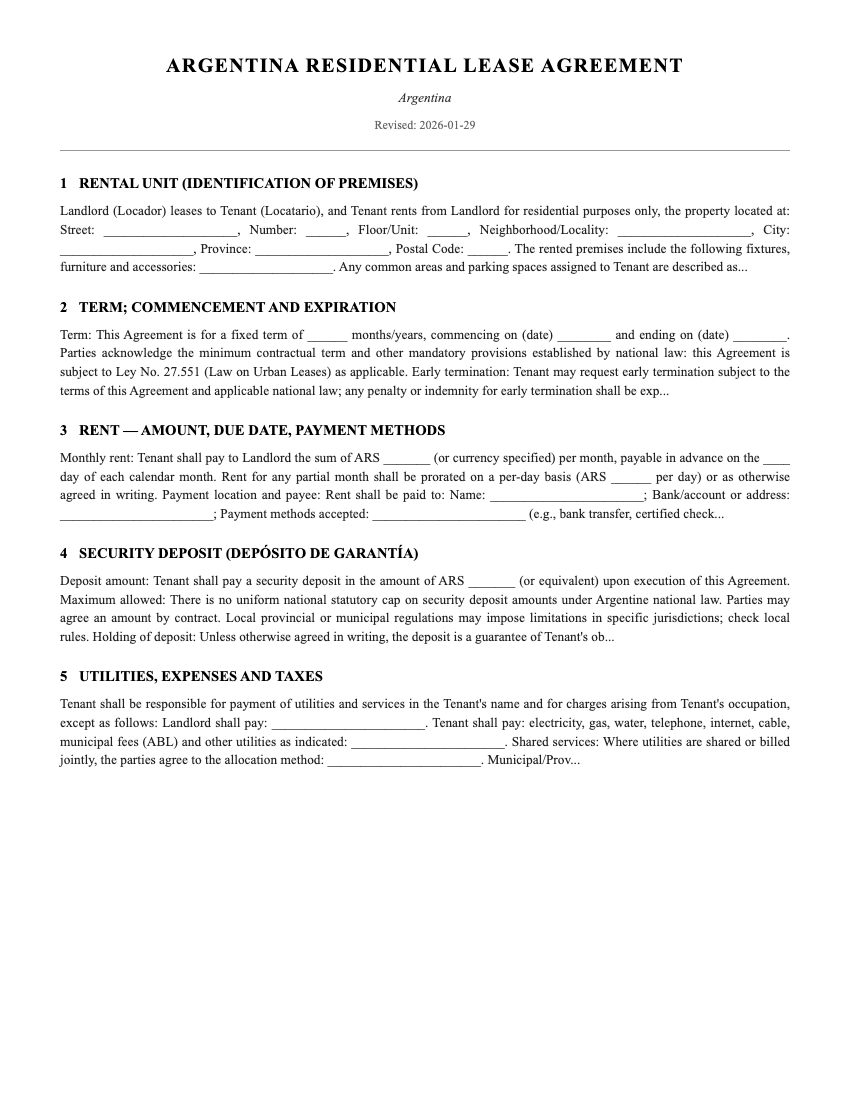
- Header identifying the parties (lessor, lessee), legal domicile and contact details.
- Contract term and options for renewal or tacit extension with clear instructions.
- Rent amount, method and due date of payment, and an adjustment clause (indicating periodicity and formula if the parties agree one).
- Guarantees: specification of type (cash deposit, garantía propietaria, seguro de caución), with instructions for enforcement.
- Deposit (cash guarantee): agreed amount, obligation to itemize deductions, suggested period for return after delivery of possession (recommended: 30 days unless otherwise agreed), and procedure for inspection of the property condition.
- Inventory and condition: mandatory annex describing furniture, paint, appliances and general condition; signature of both parties.
- Maintenance and repair obligations: distinction between locative repairs and extraordinary repairs.
- Insurance: recommendation to take out fire and civil liability insurance.
- Notices and legal domiciles: clause determining how notices are exchanged between the parties.
- Causes and procedure for early termination, with cure periods for breach (practical recommendation: 3 to 15 days for payment default, although parties may agree different terms).
- Mandatory declarations: consumer information (Ley No. 24.240), notice of personal data processing (Ley No. 25.326), and declaration regarding apparent or known defects.
- Jurisdiction and applicable law clause (it is recommended to indicate the jurisdiction of the property for procedural purposes and to clarify that the subject matter will follow national regulation and provincial procedural rules).
Download Options
- PDF ready to print: /downloads/argentina-lease-agreement-2026.pdf
- Editable document (Word): available on the download page to adapt names, amounts and annexes.
- Complete package: PDF + signing checklist + editable inventory annex.
How to Finalize Your Lease
- Complete mandatory fields: full names, DNI/CUIT, domiciles, rent amount, agreed guarantee, term and start date.
- Attach the detailed inventory signed by both parties and, if applicable, dated photographs.
- Include mandatory notices: consumer information and data protection notice.
- Verify the deposit clause and return periods; determine a reasonable term (e.g. 30 days) and an obligation to provide an itemized summary of withholdings.
- Stamp and sign: signature of the contract by both parties; if greater security is desired, sign before a notary public (not required at national level for validity of the locación, but may facilitate enforcement and evidence).
- Final check with an AI contract review tool: upload the document for a risk report and recommendations before exchanging keys and delivering the deposit.
Related Lease Agreement Templates
Frequently Asked Questions (FAQ)
- Is there a national legal cap for the security deposit?
There is no national cap in Argentina. The parties may freely agree the deposit amount. However, the Ley de Defensa del Consumidor (Ley No. 24.240) requires transparency in contractual dealings and provincial or municipal regulations may impose local limits. We recommend setting the amount and return procedures in the contract and attaching a signed inventory.
- How long does the lessor have to return the deposit?
There is no single national timeframe. The Código Civil y Comercial (Ley No. 26.994) and principles of good faith require return once possession is delivered and deductions are substantiated. Common practice is to agree a term (for example, 30 days). Failure to return or to itemize may give rise to claims under Ley No. 24.240.
- How are rent increases regulated?
There is no national price-control regime. Ley No. 27.551 (Ley de Alquileres) amended the locative regime in 2020 and the parties may agree adjustment formulas in the contract; it is recommended to use clear and calendared formulas. Also check for any provincial or municipal measures that may affect indices or local practices.
- What is the procedure for eviction for non-payment?
Eviction (judicial eviction) generally requires legal action before the civil courts competent in the jurisdiction of the property. There is no single federal pre-eviction notice requirement: the parties may agree a cure period in the contract (3 to 15 days is usual). Practical enforcement and timeframes depend on the provincial civil procedural code. Consult a local lawyer to initiate eviction proceedings.
- Does the contract need a notice of personal data processing?
Yes. The controller who collects personal data (DNI, references, proofs) must inform the data subject about processing pursuant to Ley No. 25.326 (Protección de Datos Personales). The template includes a notice to obtain consent where appropriate and to describe the purpose of processing (e.g. guarantee assessment, contract management).
- May I prohibit guests and subletting entirely?
Yes, the parties may agree restrictions on subletting and prolonged stays by third parties; however, clauses must be clear and reasonable. An absolute prohibition without possibility of authorization may be contestable if it affects essential rights of the lessee. Include procedures for requesting authorization and consequences of breach.
Sources
- Código Civil y Comercial de la Nación (Ley No. 26.994). Boletín Oficial. https://www.boletinoficial.gob.ar/detalleAviso/primera/121728 (Código Civil y Comercial)
- Autor: Boletín Oficial de la República Argentina
- Fecha: 2015-08-01 - Ley No. 27.551 (Ley de Alquileres). Boletín Oficial. https://www.boletinoficial.gob.ar/detalleAviso/primera/234774/20200611
- Autor: Boletín Oficial de la República Argentina
- Fecha: 2020-06-11 - Ley No. 24.240 (Ley de Defensa del Consumidor). InfoLEG. http://servicios.infoleg.gob.ar/infolegInternet/anexos/0-4999/865/norma.htm
- Autor: InfoLEG / Secretaría de Comercio Interior
- Fecha: 1993-09-24 - Ley No. 25.326 (Ley de Protección de Datos Personales). InfoLEG. http://servicios.infoleg.gob.ar/infolegInternet/anexos/60000-64999/64280/norma.htm
- Autor: InfoLEG / Dirección Nacional
- Fecha: 2000-10-28 - Dirección Nacional de Defensa del Consumidor — Argentina. Guías y asesoramiento para consumidores y locadores. https://www.argentina.gob.ar/defensadelconsumidor
- Autor: Gobierno de la Nación Argentina
- Fecha: n.d.
Final Notes
This template aims to reflect principles and obligations applicable at the national level, but procedural rules and certain norms may vary by province or municipality. Before signing, update amounts, terms and annexes in accordance with your local situation and use an AI contract review tool as an automatic compliance and risk check.
<div class="ml-embedded" data-form="bBZ9zR"></div>
Frequently Asked Questions

About Designer Content
Designer Content creates practical legal document resources for landlords, contractors, and small business owners. We simplify complex legal concepts into actionable guidance. Connect with us on LinkedIn.