
Introduction
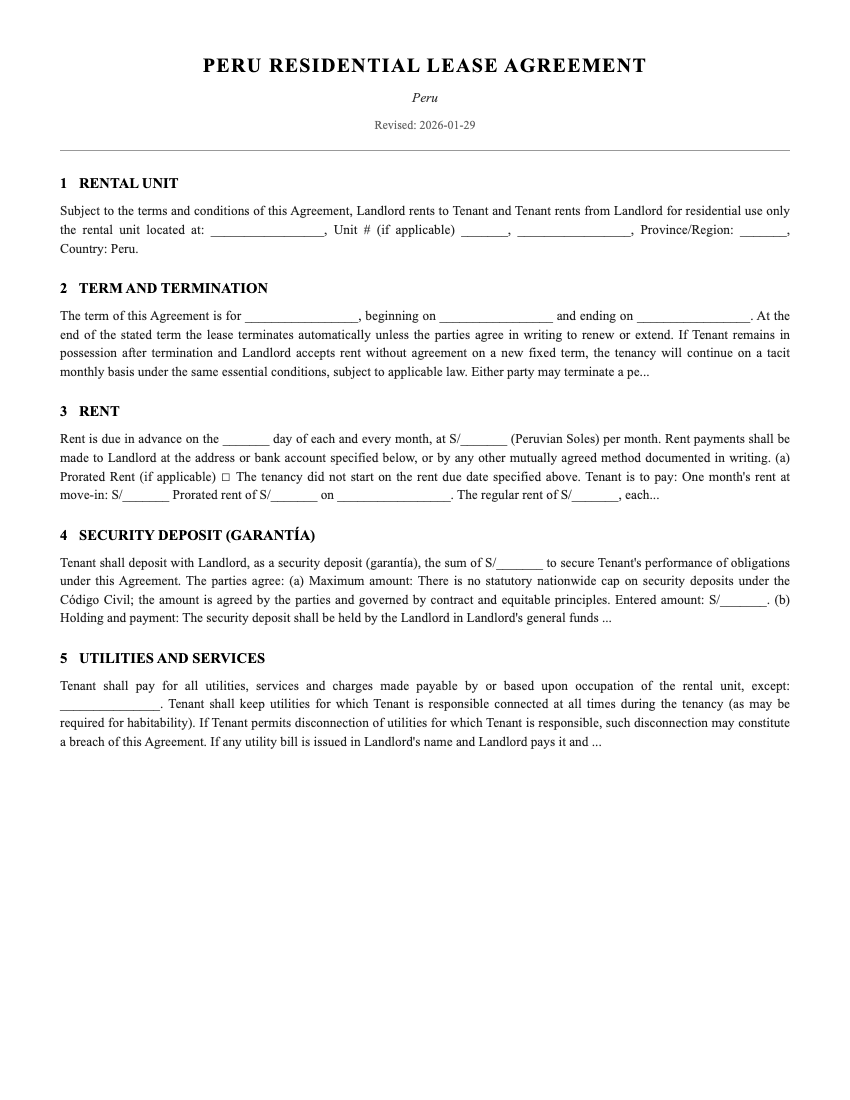
Complying with local regulations when drafting a residential lease agreement in Peru is not optional: it protects the landlord’s investment and the tenant’s rights. This template is designed to align with the principles of the Código Civil (aprobado por Decreto Legislativo N° 295) and obligations arising from Ley N° 29733 sobre Protección de Datos Personales and consumer protection rules. It includes recommended clauses for security deposit, inventory (acta de entrega), notice periods, dispute-resolution mechanisms and mandatory notices.
Definición — ¿Qué es un arrendamiento residencial en Perú?
A residential lease (contrato de arrendamiento) is a civil contract by which one party (arrendador) grants another (arrendatario) the temporary use of a property intended for housing, in exchange for rent. In Peru the autonomy of the parties’ will governs, subjecting the contract to the norms of the Código Civil, Ley de Protección de Datos Personales (Ley N° 29733) and the consumer protection provisions against abusive clauses.
Por qué importa cumplir la normativa
A well-drafted contract reduces the likelihood of disputes, facilitates eviction processes when appropriate, and minimizes risks from undue retention of the deposit. Additionally, standardized contracts may be subject to consumer protection rules if the landlord is considered a professional offeror or if the terms are unbalanced.
Why Old Templates Are Dangerous (riesgos específicos en Perú)
- Clauses that ignore Ley N° 29733: Collecting or publishing tenant data (DNI, references, bank details) requires justification and security measures. Old templates often do not contemplate consent or protective measures.
- Retaining the deposit without itemization: Civil law requires liability for unjust enrichment; failing to provide a breakdown of deductions can lead to claims for damages and costs.
- Incorrect deadlines and notices: Procedural rules for eviction follow the Código Procesal Civil; not respecting reasonable notice periods (e.g., 3–15 days for overdue payment) complicates court actions.
- Abusive/standard clauses: Contracts copied from other jurisdictions or outdated templates may contain clauses that Indecopi or the courts deem abusive under consumer protection rules.
- Ignoring prescription: Actions arising from contracts prescribe in 10 years according to the general rules of the Código Civil; however, correct documentation and proof of payments is crucial.
Qué incluye esta plantilla
- Full details of the parties and the property.
- Term and types of renewal (fixed term and rules for tacit reconduction).
- Rent amount, form and dates of payment.
- Security deposit: agreed amount, conditions for use, obligation to itemize and deadline for return (recommended: 30 days presumptive).
- Inventory and acta de entrega (mandatory annex to avoid disputes about deterioration).
- Maintenance and repairs: landlord’s and tenant’s responsibilities.
- Prohibitions (subletting, works without authorization) and guest policy.
- Notices and addresses for contract purposes.
- Data protection clause (consent, purpose, retention period, right of access and rectification) in accordance with Ley N° 29733.
- Clause on compliance with consumer protection rules and warning about abusive clauses.
- Procedure for early termination and reasonable penalties.
- Signatures and space for notarial acknowledgement if the parties want greater evidentiary security.
Related Lease Agreement Templates
Download Options
- Fillable PDF (ready to print and sign): /downloads/peru-lease-agreement-2026.pdf
- Microsoft Word (.docx) editable (to adjust specific clauses).
- Google Docs template (link to copy and customize).
Each format includes instructions on which fields are mandatory and drafting suggestions for sensitive clauses.
How to Finalize Your Lease
- Verify identity and references: request DNI, proof of income and references when appropriate; respect Ley N° 29733 and obtain written consent for processing personal data.
- Complete the inventory and the acta de entrega: attach dated/timestamped photographs; have both parties sign.
- Accept and include the deposit clause: state the agreed amount and the method of return with itemization of deductions.
- Establish the payment method and receipts: bank transfers preferred and documentary proof of receipt.
- Consider notarization if the duration exceeds one year or for greater evidentiary security; for long-term leases, evaluate registration in public registries according to legal advice.
- Upload the final contract to an AI contract review tool for a compliance and risk check before the definitive signature.
Preguntas frecuentes
(Brief answers; see below for referenced legal details)
- ¿Cuál es el tope legal para el depósito de garantía en Perú?
There is no nationwide legal cap. The amount is agreed between the parties. Practical recommendation: one month’s rent for residential leases is common, but it may vary.
- ¿En cuánto tiempo debo devolver el depósito?
There is no single legal deadline; it is recommended to return the deposit or the balance after justified deductions within 30 days as a reasonable presumptive period. A written itemization of deductions must be provided.
- ¿Perú tiene control de rentas a nivel nacional?
No. There is no national rent-control regime applicable to private residential leases. Rents and increases are governed by the contract and the principles of good faith; specific public programs may have different rules.
- ¿Qué avisos son necesarios antes de iniciar un proceso de desalojo por falta de pago?
There is no single mandatory national requirement; practice advises a demand for payment letter (commonly 3–15 days) before filing suit. The judicial procedure is processed in accordance with the Código Procesal Civil.
- ¿Puedo prohibir que el inquilino reciba visitas o tenga huéspedes?
You can regulate reasonable use of the property and prolonged stays of third parties. However, excessively restrictive clauses or those affecting the tenant’s basic rights may be challenged under consumer-protective rules.
- ¿Qué obligaciones tengo sobre datos personales del inquilino?
You must comply with Ley N° 29733: inform the purpose of the processing, obtain consent when applicable, adopt security measures and allow the exercise of rights of access, rectification and deletion. Include a privacy notice in the contract.
Consejos prácticos para arrendadores y arrendatarios
- Always document payments (receipts or bank transfers).
- Use inventories with dated photographs to prove condition at start and end.
- Avoid clauses that impose broad waivers of rights; they may be declared null.
- For complex issues (e.g., very long-term contracts, clauses on improvements with compensation), consult a specialized attorney.
Recursos y fuentes legales
Consulte las normas citadas para redacción y cumplimiento:
- Código Civil (Perú) — Consulte el texto vigente en el portal del Congreso: https://www.leyes.congreso.gob.pe/ (buscar "Código Civil" o "Decreto Legislativo N° 295").
- Ley N° 29733 — Ley de Protección de Datos Personales (incluye disposiciones sobre consentimiento, seguridad y derechos ARCO): https://www.gob.pe/institucion/pcm/normas-legales y publicaciones en El Peruano: https://busquedas.elperuano.pe/.
- Código de Protección y Defensa del Consumidor — normativa aplicable a cláusulas estandarizadas y prácticas comerciales: consulte INDECOPI (https://www.indecopi.gob.pe/) y OSCE para orientación sobre contratación pública y buenas prácticas (https://www.osce.gob.pe/).
- Código Procesal Civil — reglas para la tramitación de demandas civiles y procesos de desalojo: https://www.leyes.congreso.gob.pe/ (buscar "Código Procesal Civil").
<div class="ml-embedded" data-form="bBZ9zR"></div>
Frequently Asked Questions

About Designer Content
Designer Content creates practical legal document resources for landlords, contractors, and small business owners. We simplify complex legal concepts into actionable guidance. Connect with us on LinkedIn.