
Introduction
Using a lease that matches Illinois law matters. Illinois landlords and tenants must follow specific statutory rules for security deposits, required disclosures (federal lead-based paint; Illinois Radon Awareness Act), and eviction procedures under the Forcible Entry and Detainer provisions (735 ILCS 5/9‑101 et seq.). Chicago properties also must comply with the Chicago Residential Landlord Tenant Ordinance (RLTO), which imposes additional disclosure and deposit-handling rules. This template is drafted to conform to Illinois state law and called-out Chicago requirements where applicable.
This page explains what the template includes, why older or out-of-state forms can cause legal exposure, and how to finalize a lease that will hold up under Illinois law. We also explain how to use an AI contract review tool for an extra verification layer before signing.
For a comprehensive lease review checklist covering residential and commercial terms, see our Lease Agreement Review Guide.
What is an Illinois residential lease?
A residential lease in Illinois is a written contract between a landlord and tenant that sets the terms for renting a dwelling located in Illinois. It fixes the parties' rights and obligations (rent amount and due dates, security deposit terms, length of tenancy, repairs, utilities, required disclosures, and grounds and notice periods for termination). Where the rental unit is inside Chicago, certain additional local rules (Chicago RLTO) apply and are referenced in this template.
Why Old Templates Are Dangerous (Illinois-specific traps)
- Security deposit rules changed and vary by locality: Illinois state law (Security Deposit Return Act, 765 ILCS 710) requires itemization and timelines for returns; interest requirements apply for larger properties and Chicago imposes special holding/interest rules. Older forms often omit required interest language and the correct return timeline.
- Chicago RLTO differences: Chicago requires additional disclosures (RLTO summary, bed bug, certain utility and deposit-handling notices). Using a generic state form can leave you noncompliant in Chicago.
- Eviction procedure misstatements: Filing an eviction under 735 ILCS 5/9‑101 et seq. requires strict adherence to notice and procedural rules; errors in notice periods or pre-suit demands can result in dismissal and delay.
- Required federal/state disclosures: Federal lead-based paint law (for pre‑1978 housing) and Illinois Radon Awareness Act (420 ILCS 46) require specific language. Old templates may lack the exact required language or disclosure timing.
- Data privacy and biometric laws: Collecting biometric or sensitive personal data (for keys, building access, or tenant screening) may implicate Illinois Biometric Information Privacy Act (BIPA) and consumer protection obligations. Old leases rarely include compliance provisions.
What's Included in This Template
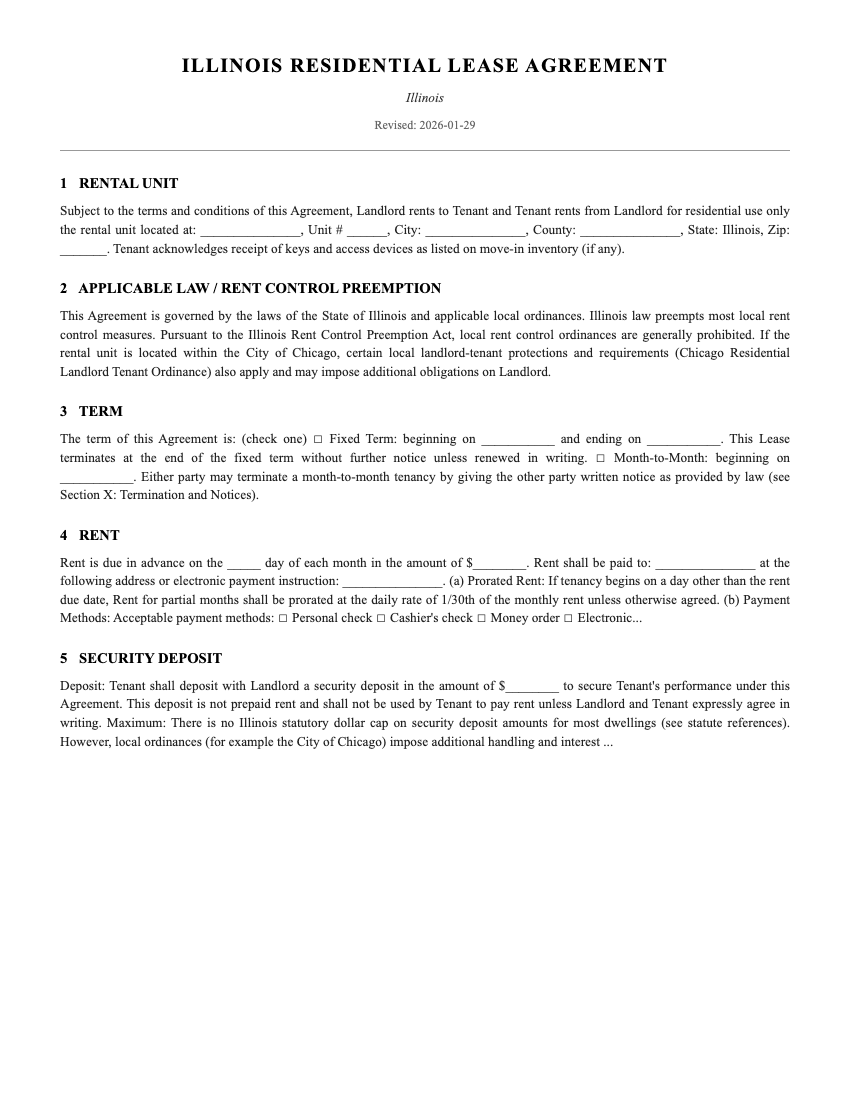
- Parties, premises, and lease term (fixed-term and month-to-month options)
- Rent amount, due date, late fees (consistent with Illinois law and local ordinances)
- Security deposit clause complying with the Security Deposit Return Act (765 ILCS 710): itemization, return timeline (30 days standard), and interest rules (including Chicago handling where applicable)
- Utilities, maintenance, and habitability obligations consistent with Illinois common law and local code requirements
- Permitted occupants, subletting and assignment rules, and guest policy language tailored for Illinois enforcement norms
- Notice and cure provisions compatible with common Illinois practice (5-day pay or quit for nonpayment, 10-day cure for violations where appropriate, 30-day termination for month-to-month) and a reminder to confirm any differing local requirements
- Required disclosures integrated into the lease package: Federal Lead-Based Paint Disclosure, Illinois Radon Awareness Act notice, Security Deposit Disclosure statements, foreclosure status disclosure, and Chicago RLTO summary / bed bug disclosure for Chicago properties
- Chicago-specific addendum when the premises are located in the City of Chicago (RLTO summary, deposit handling, registration notice)
- Entry and inspection procedures and Illinois-specific habitability standards
- Default and termination procedures aligned with Illinois forcible entry and detainer statutes (735 ILCS 5/9‑101 et seq.) and instructions for notice and timing
- Signature blocks and instructions for electronic signing where permitted
Download Options
- Single-unit lease (12-month fixed-term) — Download: /downloads/illinois-lease-agreement-2026.pdf
- Month-to-month addendum — included in the download package
- Chicago RLTO addendum — included in the download package and automatically flagged when you indicate the property is in Chicago
All downloads include a checklist of required disclosures for Illinois and a printable receipt form for security deposit payments.
How to Finalize Your Lease
- Confirm local rules: verify whether the rental property is subject to any municipal ordinances (e.g., Chicago RLTO). If in Chicago, use the RLTO addendum included with this template.
- Fill in all blanks: names, property address, rent, deposit amount, lease dates, and any special provisions.
- Attach required disclosures: lead-based paint statement (if built before 1978), Radon Awareness notice, security deposit disclosure, foreclosure status notice, and Chicago-specific notices if applicable.
- Run an AI contract review tool safety check: upload the completed lease to an AI contract review tool for automated review and suggested edits specific to Illinois statutes and Chicago RLTO.
- Sign and exchange originals: have landlord and all tenants sign the final lease; provide tenant with executed copies and a receipt for any security deposit and first month’s rent.
- Keep records: retain the signed lease, deposit receipts, and any disclosure acknowledgments for at least the period allowed by Illinois law or until after possession is surrendered and deposit accounting is complete.
Related Lease Agreement Templates
Frequently Asked Questions (Illinois-specific)
- How much security deposit can my landlord charge in Illinois?
Illinois state law (Security Deposit Return Act, 765 ILCS 710) does not impose a statewide dollar cap on security deposits. However, local ordinances may impose deposit-handling rules (for example, the City of Chicago requires deposits be placed in an interest-bearing account and sets specific notice and accounting requirements). Always check local rules before paying or accepting a deposit. - When must a landlord return my security deposit in Illinois?
Under the Security Deposit Return Act (765 ILCS 710), a landlord must refund the unused portion of the security deposit and provide an itemized statement of deductions within 30 days after the tenant surrenders possession. In certain circumstances, additional timeframes (up to 45 days) may apply for additional documentation; Chicago has its own deposit-handling timelines and interest payment rules. - Is there rent control in Illinois? Can my landlord raise rent?
Illinois preempts municipal rent control (see Illinois Rent Control Preemption Act, 765 ILCS 750). There is no statewide rent control; landlords may increase rent as allowed by the lease and by applicable notice requirements. Always check the lease’s rent increase provisions and any local registration or licensing rules. - What disclosures am I required to give tenants in Illinois?
Required disclosures include federal Lead-Based Paint Disclosure for pre‑1978 housing (42 U.S.C. § 4852d and 24 C.F.R. Part 35), Illinois Radon Awareness Act notice (420 ILCS 46), security deposit disclosure and accounting (765 ILCS 710), foreclosure status disclosure, and city-specific disclosures such as the Chicago RLTO summary and bed bug notice where applicable. If you collect biometric information or other sensitive data, include a BIPA/compliance notice. - What notice must I give before filing for eviction in Illinois?
Eviction procedures are governed by the Forcible Entry and Detainer statute (735 ILCS 5/9‑101 et seq.). Common practice: provide a 5-day pay-or-quit notice for nonpayment, a 10-day notice to cure for material lease violations where a cure is allowed, and 30 days for terminating a month-to-month tenancy. Exact notice requirements depend on the lease language and local rules—confirm before filing. - Can tenants have long-term guests or sublet in Illinois?
Guests and subletting are governed by the lease terms. This template contains clear rules for permitted occupants, guest durations, and subletting/assignment procedures. Landlords may restrict long-term guests or require written consent for sublets, provided those restrictions do not violate anti-discrimination laws or local ordinances.
<div class="ml-embedded" data-form="bBZ9zR"></div>
Frequently Asked Questions

About Designer Content
Designer Content creates practical legal document resources for landlords, contractors, and small business owners. We simplify complex legal concepts into actionable guidance. Connect with us on LinkedIn.