
Introduction
Having a clear, up-to-date residential lease agreement is essential in Mexico. There is no single federal code that regulates all aspects of leasing; most practical rules (eviction timelines, limits on deposits, notice periods) are determined in the Código Civil and in the Código de Procedimientos Civiles of the state where the property is located. In addition, federal laws such as the Ley Federal de Protección de Datos Personales en Posesión de los Particulares (LFPDPPP) and the Ley Federal de Protección al Consumidor (LFPC) impose obligations that must be respected in contracts aimed at consumers.
This federally designed template provides a comprehensive framework and recommended clauses that you should adapt to the applicable state legislation. Use this guide to understand the essential elements, the federal obligations that always apply, and the points you must check according to the local Código Civil.
For a comprehensive lease review checklist covering residential and commercial terms, see our Lease Agreement Review Guide.
What is a residential lease agreement in Mexico?
A residential lease agreement is an agreement between a lessor and a lessee whereby the lessor grants the temporary use and enjoyment of a property for housing purposes in exchange for rent. In Mexico the contract is governed by the applicable provisions of the Código Civil of the corresponding state, by the civil procedure rules for eviction (desahucio) and by complementary federal laws (for example, LFPDPPP, LFPC and el Código Civil Federal in matters of general obligations).
The 'an AI contract review tool' security check
Before signing, upload your contract to the AI contract review tool contract analysis tool (https://pact.ai) to:
- Verify clauses potentially conflicting with federal rules (e.g., treatment of personal data, clauses that could be considered abusive under the LFPC).
- Obtain drafting suggestions compatible with the LFPDPPP regarding the Aviso de Privacidad and consent for data processing.
- Detect ambiguous terms about deposits, eviction timelines and maintenance responsibilities that could cause litigation.
Recommendation: request from an AI contract review tool a report that identifies clauses that must be adjusted to the Código Civil local (for example, limits on deposits or refund periods) and keep that report together with the signed contract.
Why old templates are dangerous in Mexico
- Lack of state adaptation: Many templates only reflect general rules and overlook that the Código Civil and the civil procedure of the state may impose different deadlines and formalities (e.g., notification requirements for desahucio).
- Noncompliance with the LFPDPPP: Contracts that collect personal data without a valid Aviso de Privacidad can generate sanctions and complaints before the INAI.
- Abusive clauses: Provisions that unduly limit the tenant’s remedies or impose excessive penalties can be considered contrary to the Ley Federal de Protección al Consumidor (PROFECO) when the tenant is a consumer.
- Deposit and refund periods: Templates that do not detail the timeframe and method to deliver the inventory when returning the unit expose parties to disputes over the disposition of the deposit.
- Eviction and warranty of possession: Old templates may not explain the applicable judicial desahucio procedure or the requirements to notify breaches.
Key clauses we require to include in Mexico
- Full identification of the parties (name, optional RFC if applicable, address for notices).
- Description of the property and permitted uses (residential).
- Term and modalities for renewal or early termination; specify whether it is a fixed term or periodic tenancy.
- Rent, method of payment, periodicity and adjustments (agreement on indices or percentage; verify whether the jurisdiction has limits or common practices).
- Security deposit: agreed amount, obligation to deliver an inventory, period for return (recommended: 30 days after delivery of possession and handover of condition; but verify the Código Civil estatal), obligation to issue a settlement and breakdown of deductions.
- Maintenance, repairs and liability for damages.
- Aviso de Privacidad (LFPDPPP): purposes, data collected, transfers and security measures.
- Termination clause for breach and cure period (suggested period: 3–15 days for rent, 5–30 days for other breaches; ensure that the contractual period does not contravene the local civil procedure).
- Procedure for delivering notices and valid means (personal delivery, burofax, certified mail — adapt to local admissibility rules).
- Inventory and condition report at move-in and move-out.
- Jurisdiction clause: designate the appropriate forum (courts of the state where the property is located) and remind that eviction must be processed in accordance with the Código de Procedimientos Civiles local.
- Declarations about habitability, environmental risks or known damages (if applicable).
Disclaimers and mandatory disclosures
The template includes fields and examples for the following notices and disclosures (mandatory or recommended according to federal and state practices):
- Aviso de Privacidad (LFPDPPP) with purposes and ARCO rights.
- Information and consumer protection clause when the relationship qualifies as a consumer–provider relationship (LFPC / PROFECO).
- Disclosure of environmental risks and structural conditions (if the property has known defects, humidity, mold or contamination).
- Information about lead or other hazards (applicable if the dwelling was built with materials that contain them and there is municipal or state regulation).
- Inventory clause and obligation to provide proof of payments.
What this template includes
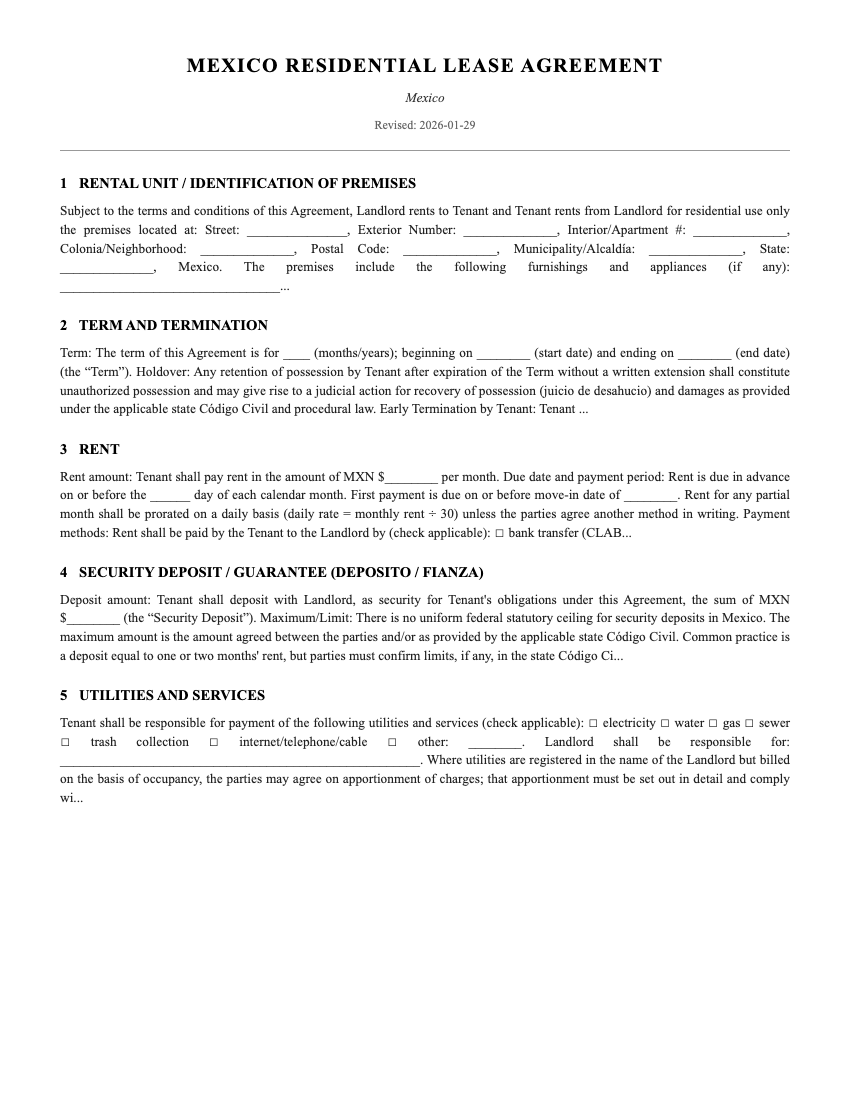
- Main contract in Spanish, ready to adapt with editable fields (parties, address, rent amount, deposit, dates).
- Model clause for Aviso de Privacidad (LFPDPPP) for lessors who process tenants’ personal data.
- Sample initial inventory and delivery / return format.
- Clause for early termination and automatic renewals with instructions to adapt to the Código Civil estatal.
- Recommended clauses for dispute resolution and mediation prior to desahucio.
- Filling guide with notes on what to review in the local Código Civil and Código de Procedimientos Civiles.
Download options
- Print-ready PDF: /downloads/mexico-lease-agreement-2026.pdf
- Editable DOCX version (includes author comments to adapt to state legislation) — available in the same location upon request.
- Additional legal checklist for the landlord and for the tenant (included in the PDF).
How to finalize your lease agreement
- Complete all fields (full names, addresses, RFC if applicable for invoicing, amount and date).
- Attach the initial inventory signed by both parties.
- Deliver and have the tenant sign the Aviso de Privacidad; obtain their consent for data processing when necessary.
- Request identity documents and, if applicable, references or a guarantor according to your policy.
- Upload the final contract to an AI contract review tool for a federal compliance check and detection of risky clauses.
- Sign in the presence of witnesses or a notary public if required by local practice (not federally mandatory, but recommended for stronger documentary evidence).
- Keep physical and digital copies; log important communications (payment notices, repair requests).
Practical recommendations
- Adapt the deposit clause and the refund period to the Código Civil of the state where the property is located.
- Do not use automatic increases without stating the calculation basis (index or percentage) and respect local practices.
- For evictions due to nonpayment, agree a cure period that is reasonable and consistent with the state’s civil procedure; remember that desahucio is generally a judicial process.
- Maintain the privacy and security of personal data: record the Aviso de Privacidad and the technical/organizational measures you adopt.
Related Lease Agreement Templates
Frequently asked questions (see the FAQs section for more detail)
See the frequently asked questions section below about deposits, rent increases, mandatory notices, desahucio, visitation policies and local requirements.
Sources and further reading
Consult the official sources and recommended links at the end of the article to review the legal texts and official guides.
<div class="ml-embedded" data-form="bBZ9zR"></div>
Frequently Asked Questions

About Designer Content
Designer Content creates practical legal document resources for landlords, contractors, and small business owners. We simplify complex legal concepts into actionable guidance. Connect with us on LinkedIn.