
Introduction
A properly drafted residential lease protects both landlord and tenant. In Suriname, lease relationships are principally governed by the Surinaams Burgerlijk Wetboek (Civil Code) together with ordinary contract law. Because Suriname does not have a single national rent-control regime or a statutory cap on deposits, the terms you put into the written lease — security deposit amount, notice and cure periods, inventory and return procedures — determine the parties' rights and obligations.
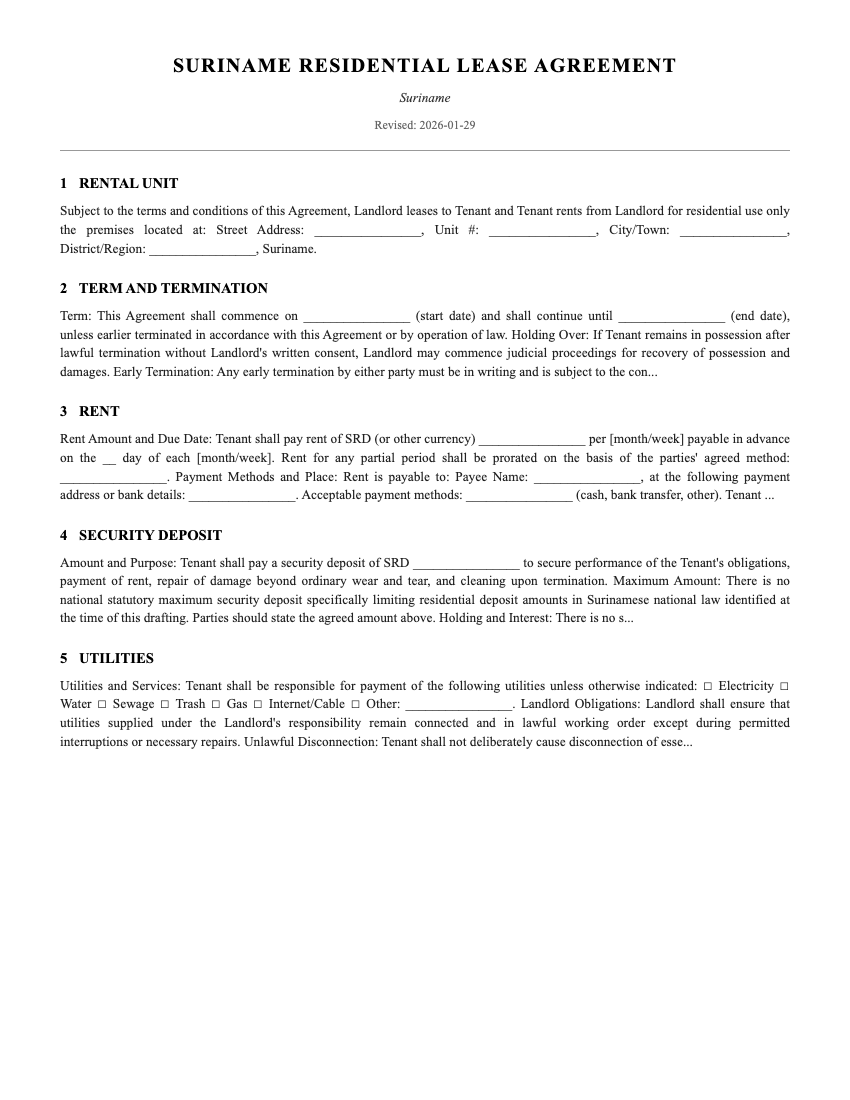
This template is drafted for use in Suriname and includes provisions that reflect local legal realities: allowance for freely agreed rent and deposit amounts, contractual specification of deposit return timing and itemization, compliance notes regarding the Wet Bescherming Persoonsgegevens (data protection law), and guidance about judicial eviction under the Gerechtelijk Wetboek. Use the template as a starting point and finalize it with the parties' specific terms.
For a comprehensive lease review checklist covering residential and commercial terms, see our Lease Agreement Review Guide.
Wat is een Surinaams huurovereenkomst?
Een residential lease (huurcontract) in Suriname is een schriftelijke overeenkomst tussen verhuurder en huurder waarin de partijen de voorwaarden voor tijdelijk genot van woonruimte vastleggen, zoals huurprijs, borgsom, looptijd, opzegtermijn en onderhoudsverplichtingen. De relatie valt onder het Surinaams Burgerlijk Wetboek en algemene contractuele beginselen; geschillen over ontruiming worden beslecht volgens het Gerechtelijk Wetboek.
Why Old Templates Are Dangerous (Suriname-Specific Traps)
- No statutory defaults for many terms: Surinamese law does not set nationwide caps on deposits or fixed notice periods for residential leases. Old templates that assume a statutory deposit cap or fixed notice period (from another country) can give a false sense of security.
- Missing deposit itemization rules: The Civil Code requires restitution and permits claims for damages, but parties should expressly require itemized statements and a clear return timeline (commonly 14–30 days) in the lease. Old forms that omit itemization invite disputes.
- Data protection noncompliance: The Wet Bescherming Persoonsgegevens governs processing of tenant personal data. Using templates that collect unnecessary personal data or lack a privacy notice may violate local data-protection obligations.
- Incorrect eviction procedures: Eviction in Suriname is a judicial process under the Gerechtelijk Wetboek. Templates that describe administrative or self-help repossession (lockouts, utility shutoff) are unlawful and risky.
- Inapplicable foreign disclosures: Some older templates include U.S.-style mandatory disclosures (for example, lead-based paint forms required under 42 U.S.C. § 4852d). These only apply if federal U.S. law is implicated (e.g., U.S.-funded housing); otherwise they create confusion.
- Municipal requirements: Municipalities may have local hazard disclosures or building requirements. Older, generic templates may miss those local obligations.
What's Included in This Template
- Parties and property identification (owner, manager, tenant, full address)
- Lease term options: fixed-term and periodic tenancy language
- Rent and payment terms: rent amount, due date, accepted payment methods, late fees (reasonable and itemized)
- Security deposit clause: amount (negotiable), requirement for itemized deductions, proposed return period (default suggested 14–30 days), accounting obligations
- Inventory and condition report annex: recommended check-in/out procedure and photo evidence
- Repairs and maintenance: landlord vs. tenant obligations and notice procedures for urgent repairs
- Entry and inspection: landlord access with reasonable notice clause
- Notices and delivery rules: how to serve written notices and addresses for notices
- Termination and eviction process: cure periods, breach notices, and statement that eviction remedies require judicial action under the Gerechtelijk Wetboek
- Required disclosures checklist: data protection/privacy notice, known local hazards/flooding, lead-based paint applicability note, and other municipal disclosures
- Dispute resolution and governing law: Surinaams Burgerlijk Wetboek and local courts (reference to Gerechtelijk Wetboek)
- Optional clauses: subletting rules, pets, guests and long-term visitors, utilities allocation
Download Options
- Single-file PDF (print-ready): /downloads/suriname-lease-agreement-2026.pdf
- Editable DOCX (customize parties and specific terms): available on request or via the download page
- Bilingual annex: Dutch/English glossary of key legal terms for international landlords and tenants
How to Finalize Your Lease
- Fill in all blank fields: names, property address, rent amount, deposit amount and specific return period.
- Attach an inventory/condition report and photos signed by both parties at move-in.
- Include a clear privacy notice consistent with Wet Bescherming Persoonsgegevens covering collection, storage and permitted use of tenant data.
- Specify cure periods for nonpayment and breaches; do not rely on unstated or informal notice periods.
- Sign and date the lease; each party should receive a fully executed copy.
- Optionally have the lease reviewed by an AI contract review tool and, if desired, a local Surinamese attorney for jurisdiction-specific nuances.
Practical Tips for Landlords and Tenants
- Security deposit best practice: even though no statutory cap exists, many local landlords request 1–3 months' rent. Agree on an explicit return period (e.g., 14–30 days) and require an itemized statement for deductions.
- Keep records: receipts for repairs, communications about breaches, and photos of property condition reduce disputes at move-out.
- Respect judicial eviction: do not attempt self-help evictions; use the courts as set out in the Gerechtelijk Wetboek.
- Data minimization: collect only necessary personal data and explain retention and deletion policies in writing to comply with Wet Bescherming Persoonsgegevens.
Related Lease Agreement Templates
Frequently Asked Questions
(See the FAQ section below for full answers.)
Additional Resources
Review the sources below and consult a Suriname-licensed attorney if your situation involves complex title issues, commercial tenancy, or foreign law implications.
<div class="ml-embedded" data-form="bBZ9zR"></div>
Frequently Asked Questions

About Designer Content
Designer Content creates practical legal document resources for landlords, contractors, and small business owners. We simplify complex legal concepts into actionable guidance. Connect with us on LinkedIn.