
Introduction
Complying with applicable regulations when entering into a residential lease contract in Venezuela is not just good practice: it reduces litigation risk, facilitates recovering possession and protects both the landlord and the tenant. In the absence of a single national rent-control regime or a statutory cap on security deposits, contracts are drafted and interpreted in accordance with the Código Civil, the Ley de Defensa de las Personas en el Acceso de los Bienes y Servicios (protección al consumidor) and the procedural rules for enforcing obligations and evictions (Código de Procedimiento Civil).
Before signing, confirm the accepted currency of payment (consider exchange controls and foreign-exchange regulations), agree timelines for returning the deposit and the procedure for handing over possession. If in doubt, use a contract review service (see the section "Pre-Signing Safety Check") and obtain local advice.
What is a residential lease contract in Venezuela?
A residential lease contract is an agreement between an owner (arrendador) and a person (arrendatario) by which the owner grants the use of a property for housing for an agreed price and for a determined term or an indeterminate term, governed mainly by the Código Civil venezolano and complemented by consumer-protection rules and civil procedures for enforcement and eviction.
Why old templates are dangerous (specific pitfalls in Venezuela)
- Currency and exchange controls: Old templates that do not address the currency of payment (bolívares vs. foreign currency) and conversion in case of devaluation create contractual conflicts and regulatory risks. Exchange controls or administrative measures can affect the practical enforceability of foreign-currency clauses.
- Deposits without a detailed inventory: Not requiring a delivery record with inventory and photographs makes disputes about the scope of damages and improper deposit withholdings easier. Old templates that do not require itemization when returning the deposit fail to meet evidentiary principles in procedural law.
- Excessive penalty clauses: Contracts with disproportionate penalties can be voided or reduced by the courts under the principle of proportionality of the Código Civil and consumer protection.
- Lack of consumer/habitability notices: Failing to include disclosures about habitability conditions and consumer rights can generate administrative sanctions and give procedural advantage to the tenant.
- Poorly described eviction procedures: Templates that describe extrajudicial evictions or automatic effects without reference to the judicial process (acción de desalojo) encourage invalid or illegal practices.
- Failing to provide reasonable cure periods for breaches: Drafting unreasonable or absent cure periods for breaches can be sanctioned by courts when reviewing contractual good faith.
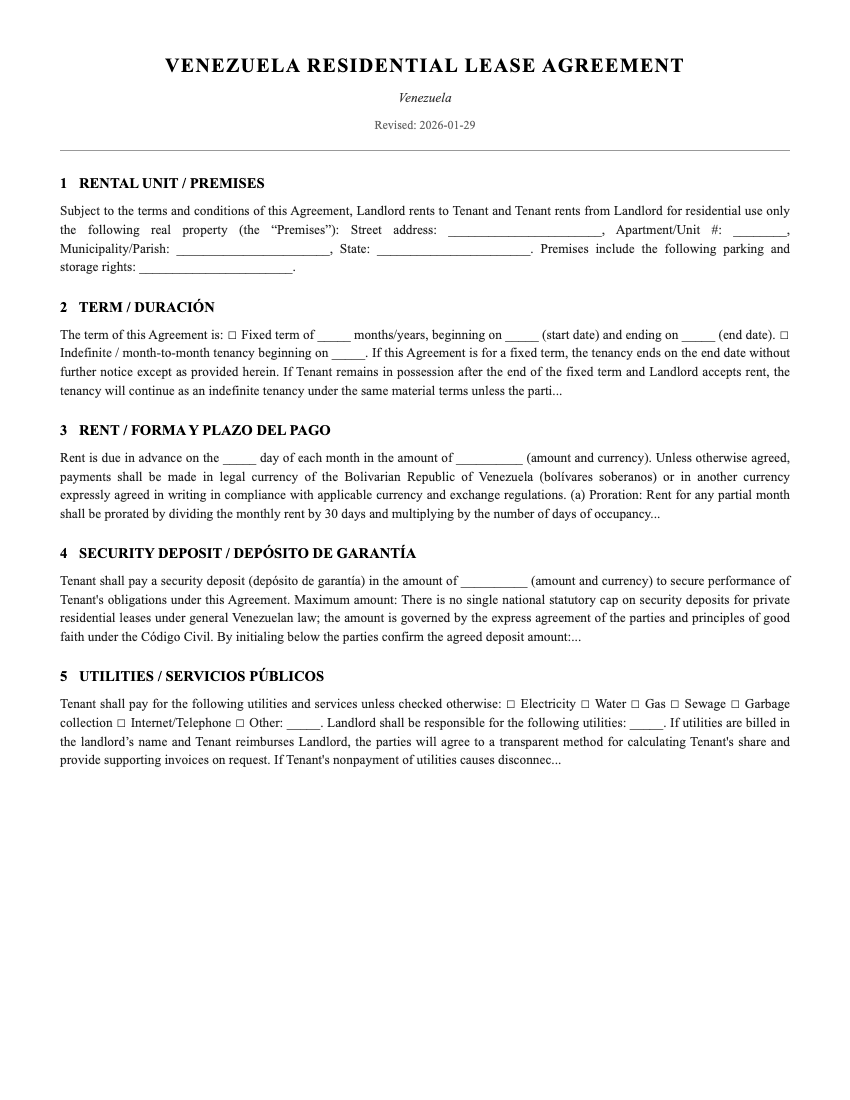
What this template includes
- Full details of the parties and the property (address, boundaries when applicable).
- Contract duration and conditions for renewal or early termination.
- Rent: amount, payment date, accepted currency and adjustment mechanism (if the parties agree).
- Security deposit: agreed amount, timeline for return at termination (space to insert a number of days), obligation to provide a detailed inventory at the start and end, and the procedure for calculating withholdings.
- Inventory and handover/receipt protocol (includes space for photographs or annexes).
- Maintenance and repairs: allocation of responsibilities between landlord and tenant.
- Permitted use (residential), subletting and guest policies.
- Default clauses and procedure for payment demand and for initiating eviction action (desalojo judicial).
- Dispute-resolution clauses and choice of jurisdiction (regarding local civil courts).
- Mandatory disclosures: habitability conditions, consumer rights, method of payment and warning about currency/exchange requirements.
- Space for signatures, identity cards or RIF, and witnesses; suggestion to legalize or notarize signatures if the parties wish.
Download options
- Print-ready PDF version: /downloads/venezuela-lease-agreement-2026.pdf
- Editable (Word) version to customize: available when downloading the package (will include instructions to complete variable clauses).
- Signing checklist and handover record (separate PDF) to document inventory and handover condition.
How to finalize your lease agreement
- Complete the parties' and property's details: identification numbers, full addresses and updated contacts.
- Choose and draft the payment currency and adjustment mechanism (if applicable). Consider wording for conversion in case of exchange controls.
- Fill in the agreed timeline for returning the deposit and ensure you describe the itemization procedure for deductions.
- Attach a signed inventory and photographs at the time of delivery to avoid later disputes.
- Sign in the presence of witnesses and, if desired, notarize the signature before a notary public for greater evidentiary weight.
- Upload the final contract to an AI contract review tool for an automated check; correct observations before printing and signing.
Related Lease Agreement Templates
Frequently Asked Questions (FAQ)
- What is the legal cap on the security deposit in Venezuela?
There is no national statutory cap applicable to all residential contracts. The amount is agreed between the parties according to the principle of autonomy of will and contractual good faith of the Código Civil. However, abusive clauses or manifestly disproportionate amounts can be challenged before a judge. The template requires itemization of the deposit and sets a timeline for its return.
- Must I pay interest on the security deposit?
There is no uniform national obligation to pay interest on deposits. Parties may agree to interest and the methodology for its calculation; if they do, include the annual rate, the compounding period and the currency. If not agreed, there is no automatic legal rate.
- Is there rent control in Venezuela that limits increases?
There is no general national rent-control regime applicable to all private leases. Rent and its adjustments are governed by the contract and the principles of the Código Civil. There are, however, special programs and municipal ordinances that may affect certain housing or social projects; consult local regulations before agreeing increases.
- How is an eviction for non-payment initiated?
Recovery of possession is processed through the judicial eviction action (procedimiento civil). It is common practice to send a written demand with a cure period (commonly 5–15 days as agreed) before taking the matter to court. Do not attempt forcible evictions or evict without a judicial ruling, as you may incur criminal or civil liability.
- What disclosures are mandatory in the contract?
The template includes: (1) disclosure about habitability conditions and known material defects; (2) a warning about consumer-protection rights (Ley para la Defensa de las Personas en el Acceso de los Bienes y Servicios (Protección al Consumidor)) when applicable; (3) a declaration about the currency and accepted payment methods (important because of exchange controls); (4) an explanatory note that federal disclosure about lead-based paint is not an obligation in Venezuela but appears as a reference for those renting properties occupied by U.S. citizens or residents or in case similar compliance is contractually required.
- Can I limit the tenant’s visitors or guests?
Yes, the contract can establish reasonable rules about guests and stays longer than a certain number of days; these restrictions must be proportionate and explicit to avoid conflicts. Rules that trigger immediate eviction for brief visits may be considered disproportionate; it is better to set a maximum period (for example, 7–15 days) before requiring written authorization from the landlord.
Practical tips
- Document everything: deliveries, repairs and communications should be in writing.
- Use an inventory with photographs for the security deposit.
- Clarify the payment currency and how the rent will be adjusted against exchange-rate fluctuations.
- Avoid disproportionate penalty clauses; draft proportional and graduated remedies.
- Check municipal ordinances and special housing programs applicable to the property.
Sources
- Constitución de la República Bolivariana de Venezuela (1999). http://www.constitucion.gob.ve — Última consulta 2026.
- Código Civil (Venezuela). Tribunal Supremo de Justicia / recopilaciones oficiales. http://www.tsj.gob.ve/legislacion — Consulte títulos sobre obligaciones y contratos.
- Código de Procedimiento Civil (Venezuela). Tribunal Supremo de Justicia / recopilaciones oficiales. http://www.tsj.gob.ve/legislacion — Normas de ejecución y procesos civiles (desalojo).
- Ley para la Defensa de las Personas en el Acceso de los Bienes y Servicios (Protección al Consumidor). Ministerio Público / gaceta oficial. http://www.mpprijp.gob.ve — Consulte textos consolidados y gacetas oficiales.
- Gaceta Oficial de la República Bolivariana de Venezuela (portal de publicación normativa). http://www.gacetaoficial.gob.ve — Para verificar decretos y ordenanzas locales.
(Always consult the consolidated and up-to-date version of each regulation and obtain local advice before signing.)
<div class="ml-embedded" data-form="bBZ9zR"></div>
Frequently Asked Questions

About Designer Content
Designer Content creates practical legal document resources for landlords, contractors, and small business owners. We simplify complex legal concepts into actionable guidance. Connect with us on LinkedIn.