
Introduction
Complying with local legal rules when entering into a residential lease agreement in the Dominican Republic reduces the risk of disputes, facilitates judicial enforcement of rights and protects both the landlord and the tenant. In the Dominican Republic lease agreements are governed mainly by the Código Civil (general contractual rules), complemented by consumer protection rules (Ley No. 358-05) and obligations regarding the processing of personal data (Ley No. 172-13). There is no general national rent control regime: rent, duration and termination are negotiated contractually, within the framework of public order and good faith.
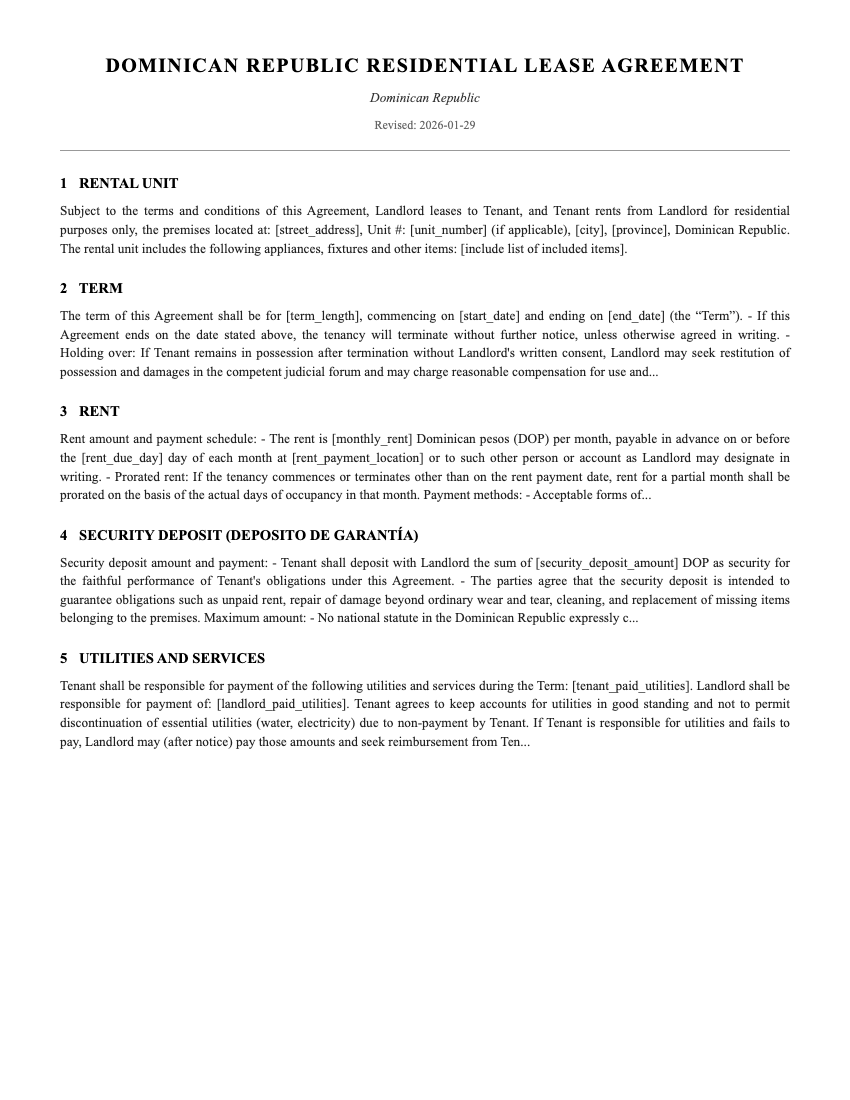
This template is designed to be practical and in accordance with Dominican legal principles: it sets recommended deposits and terms, requires inventory and descriptions, and contains clauses that facilitate judicial eviction proceedings (acción de desalojo) if necessary. It also includes mandatory and suggested notices to minimize regulatory and consumer risks.
For a comprehensive lease review checklist covering residential and commercial terms, see our Lease Agreement Review Guide.
What is a residential lease agreement in the Dominican Republic?
A residential lease agreement is an agreement of wills between a landlord and a tenant by which the landlord grants the use and enjoyment of a property intended for housing in exchange for payment of rent. It is regulated by the general rules of the Código Civil on contracts and obligations, and is conditioned by principles of good faith, consumer protection (when applicable) and the provisions on personal data protection.
Why old templates are dangerous (specific RD risks)
- Foreign templates (e.g., based on US or California models) often assume terms, remedies and administrative procedures that do not exist in RD; e.g., grant powers of extrajudicial eviction or “self-help” provisions that are inapplicable and may be declared null.
- Omission of mandatory notices: Ley No. 172-13 requires clauses about the processing of personal data; Ley No. 358-05 imposes limits on abusive clauses in adhesion contracts.
- Poorly regulated deposits: failing to establish a clear deadline for return or lack of detailed inventory facilitates claims and judicial penalties.
- Unrealistic notice periods: in RD eviction enforcement requires judicial action (Código de Procedimiento Civil); relying on informal notices or short deadlines can leave the owner unprotected.
- Excessive penalty or indemnity clauses can be considered contrary to public order or abusive when the tenant is a consumer.
What this template includes
- Titles and details of the parties (landlord and tenant), identification and real domicile.
- Detailed description of the property and its condition (inventory and recommended photographs).
- Contract duration, option to extend and renewal conditions.
- Rent: amount, method and payment date; late payment charges (limited by the principle of proportionality).
- Security deposit: negotiable amount (recommended 1–2 months), obligation of inventory, recommended return period (30 days after delivery of keys and inspection), obligation to detail deductions.
- Expenses and utilities: public services, maintenance, contributions, and who assumes ordinary/extraordinary repairs.
- Use of the property and guest/visitor policy.
- Termination and notices: suggested timeframes and procedure for contract termination.
- Clauses on force majeure, assignment and subletting (subject to written consent).
- Data protection notice (Ley No. 172-13) and reference to ARCO rights where applicable.
- Declaration of compliance with Ley No. 358-05 regarding abusive clauses and the right to information.
- Inventory and delivery/receipt record attached.
- Dispute resolution procedure and choice of jurisdiction (note: eviction enforcement requires the competent judicial route).
Downloads and options
- Standard version (fillable PDF): /downloads/dominican-republic-lease-agreement-2026.pdf
- Suggested versions: pet clause, additional deposit clause for furniture, photographic inventory annex (both available in the main download).
- Available formats: Fillable PDF and Word (.docx) for local editing (see the download page to choose format).
How to finalize your lease agreement
- Fill in all fields and attach an up-to-date photographic inventory.
- Include the mandatory Data Protection clauses (Ley No. 172-13) and a declaration of consumer rights (Ley No. 358-05).
- Determine and document the deadline and conditions for returning the deposit (recommended: 30 days after delivery of keys and inspection).
- Review with an AI contract review tool: upload the final contract for analysis of risky clauses and drafting recommendations.
- Sign before witnesses or a notary if the parties want greater evidentiary security (not always mandatory, but recommended to facilitate judicial enforcement).
- Register or file physical and electronic copies; give a copy to the tenant and keep the signed inventory.
Who should use this template?
This document serves for residential contracts between private parties and also for professional landlords operating in the Dominican Republic. It does not replace legal advice in complex situations (for example, special municipal programs, protected properties or contracts with atypical clauses). Use this template as a basis and customize it to your situation.
Related Lease Agreement Templates
Frequently asked questions (summary, see below for details)
- What is the legal cap for deposits? (There is no national legal cap; common practice 1–2 months)
- Is there rent control? (No at the national level)
- What disclosures are mandatory? (Data protection, consumer rights, known risks)
- How is an eviction carried out? (judicial eviction action — acción de desalojo judicial)
- How long to return the deposit? (recommended 30 days; specify in the contract)
- Can I limit visits or guests? (yes, but it must be reasonable and not abusive)
Final tips
- Write clear deadlines (dates, calendar days vs. business days).
- Attach a signed inventory to avoid disputes over damages.
- Avoid clauses that allow eviction by "self-help"; Dominican law requires the judicial route for evictions.
- Use an AI contract review tool for a final review and consult a local lawyer if you anticipate litigation.
<div class="ml-embedded" data-form="bBZ9zR"></div>
Frequently Asked Questions

About Designer Content
Designer Content creates practical legal document resources for landlords, contractors, and small business owners. We simplify complex legal concepts into actionable guidance. Connect with us on LinkedIn.