
Why compliance matters in Washington
A properly drafted lease protects both landlords and tenants. In Washington state, the Residential Landlord-Tenant Act (RCW Title 59.18) sets mandatory rules for written rental agreements, move-in checklists, security deposit itemization and return, landlord/agent contact information, and required disclosures. Municipal just-cause termination rules under RCW 59.18.650 apply in many cities and can impose specific reasons and notice periods for ending tenancies. Using a template that explicitly references these statutes reduces the risk of invalid notices, deposit disputes, and costly litigation.
What is a Washington residential lease?
A Washington residential lease is a written contract between a landlord and a tenant covering rental of a dwelling within Washington state. Under RCW 59.18.260 and related provisions, the lease must address rent, term, tenant and landlord duties, and include a signed move-in condition checklist. The lease also must permit security deposit accounting and set forth required disclosures (mold/dampness, lead-based paint where applicable, and owner/agent contact information). This template is designed to be consistent with RCW Title 59.18 but does not substitute for legal advice.
For a comprehensive lease review checklist covering residential and commercial terms, see our Lease Agreement Review Guide.
Why old templates are dangerous (Washington-specific traps)
- Missing move-in checklist: RCW 59.18.260 requires a move-in checklist and a signed copy; failure to provide one can lead to deposit and habitability disputes.
- Incorrect security deposit handling: Washington has no statutory cap on deposit amounts, but strict timing and itemization rules apply (RCW 59.18.280). Old forms often omit the 21/14-day deadlines and itemized accounting language.
- Ignoring just-cause requirements: RCW 59.18.650 imposes just-cause termination rules in many municipalities. Using a generic termination clause can invalidate notices in those cities.
- Rent control statements: Some outdated templates include language attempting local rent-control terms. RCW 35.21.830 generally prohibits municipal rent control; such clauses can create legal conflicts.
- Inadequate disclosures: Federal lead-based paint disclosure and state-recommended mold/dampness disclosures are required; omission can create liability.
What's included in this template
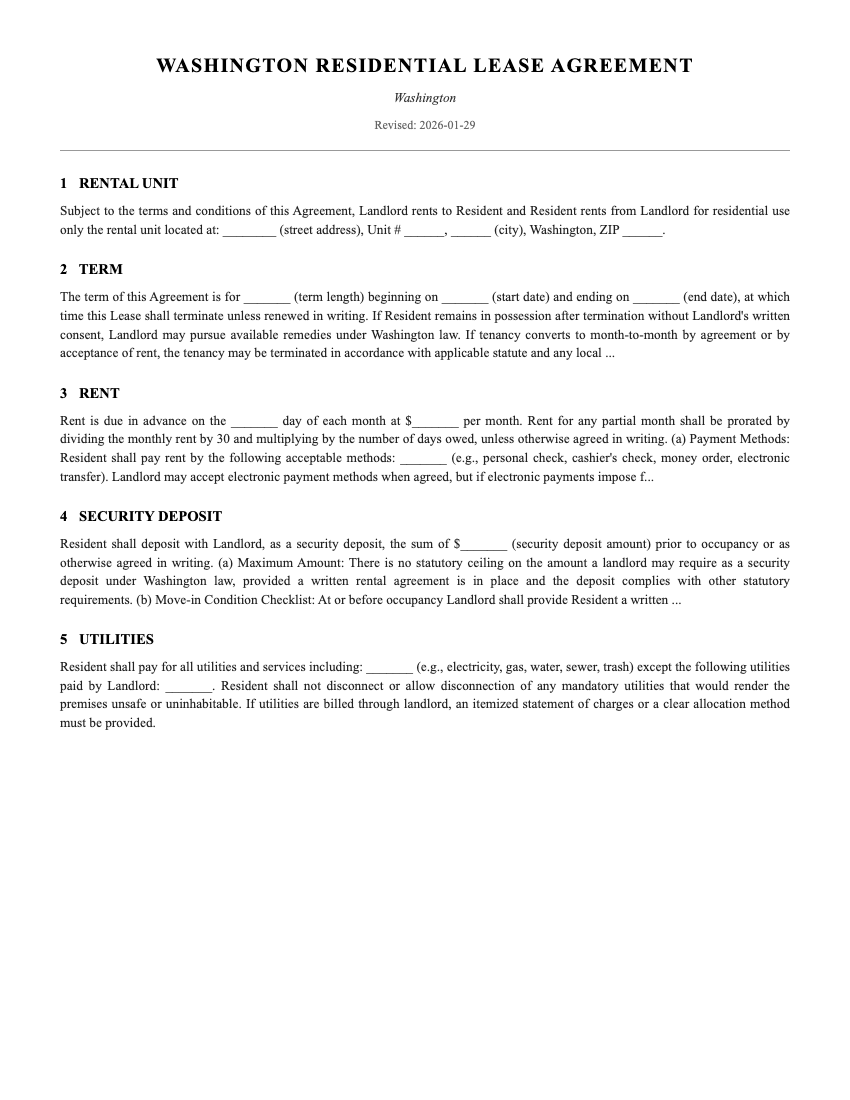
- Fillable lease header (parties, premises, term, rent, security deposit amount).
- Move-in condition checklist fields and signature lines (RCW 59.18.260 compliance).
- Security deposit clause with itemization and return deadlines consistent with RCW 59.18.280 (21 days after termination and delivery of possession; 14 days if tenant provided a forwarding address).
- Notice provisions aligned with Washington defaults and references to RCW 59.18.650 for just-cause termination.
- Required disclosures: move-in checklist, security deposit accounting notice, mold/dampness disclosure, owner/agent contact information, and lead-based paint disclosure (federal).
- Habitability and repair obligations referencing RCW 59.18.060.
- Optional addenda: pet addendum, smoking policy, parking rules, and a mediation/arbitration clause (check local enforceability).
- Statutory citations and plain-language explanations to help both parties understand obligations.
Download Options
- Single PDF (fillable): /downloads/washington-lease-agreement-2026.pdf
- Word (.docx) editable version: Contact our support or use the PDF to Word conversion to edit fields.
- Addenda pack: Pet, subletting, and lead-based paint acknowledgment pages available in the download bundle.
Who needs this document
This template is designed for use throughout Washington state, but landlords should verify any additional city or county requirements (for example, local just-cause or relocation assistance ordinances). If your property is in Seattle, Tacoma, Spokane, or any city that has adopted local tenant protections, review local ordinances and run the final lease through an AI contract review tool.
How to finalize your lease
- Complete all required fields (landlord/owner name, agent contact, premises, term, rent amount, security deposit amount).
- Walk the unit with the tenant and complete the move-in condition checklist; both parties sign and retain a copy — required under RCW 59.18.260.
- Provide required disclosures (lead-based paint form when applicable, mold/dampness disclosure, security deposit notice) and keep proof of delivery.
- If the tenancy falls within a municipality subject to RCW 59.18.650, include the specific just-cause language and notice periods applicable to that jurisdiction.
- Run the final executed lease through an AI contract review tool for a safety check and corrections. Save the AI contract review tool report with the lease file.
- Keep originals and provide copies to tenants; document any payments and repairs.
Common clauses to customize (but not remove)
- Security deposit amount and mailing/address instructions for returning deposit (tie to RCW 59.18.280 timelines).
- Late-fee language (must be reasonable and not punitive — Washington courts will examine enforceability).
- Guest and subletting policy (be explicit about approval process and consequences for unauthorized sublets).
- Pet addendum terms and any allowed pet deposit or fee (note: check local ordinances for limitations).
Related Lease Agreement Templates
FAQs
- Q: Is there a maximum security deposit in Washington?
A: No statewide statutory cap exists for security deposits. However, landlords must provide an itemized statement and return any unused portion within 21 days after termination and delivery of possession, or 14 days if the tenant provided a forwarding address (RCW 59.18.280). Local ordinances may impose additional rules. - Q: Can a landlord increase rent at any time?
A: For fixed-term leases, rent increases generally cannot occur until the lease term ends unless the lease expressly allows an increase. For month-to-month tenancies, landlords may increase rent by providing appropriate written notice as required by statute or local ordinance. Note that comprehensive municipal rent control is generally prohibited under RCW 35.21.830, but local tenant-protection measures (including just-cause rules) may affect how and when rent increases can be implemented. Always check local ordinances. - Q: What disclosures must I give a tenant in Washington?
A: Required disclosures include: a signed move-in condition checklist (RCW 59.18.260), security deposit accounting and return notice (RCW 59.18.280), owner/agent contact information, mold/dampness information (recommended and often required by local guidance), and the federal lead-based paint disclosure for properties built before 1978. Include these disclosures in the lease packet. - Q: How long does a landlord have to give a tenant notice for nonpayment or lease violations?
A: For nonpayment of rent, the statutory notice commonly used is 14 days to pay or vacate, where applicable. For material lease violations, a 10-day notice to comply or vacate is standard in many Washington contexts. Municipal just-cause rules under RCW 59.18.650 may add or change required notices; landlords must follow both state and applicable local rules. - Q: Can a landlord evict a tenant without cause?
A: In municipalities where RCW 59.18.650 applies, landlords generally must state a just cause to terminate a tenancy; certain no-fault reasons require extended notice periods (for example, some no-fault terminations require 90 days’ notice). Outside such municipalities, termination rules depend on the lease type and statutory notice periods. Always check RCW 59.18.650 and local ordinances. - Q: Are there special rules about guests or subletting in Washington?
A: The lease should clearly define guest vs. occupant and include a subletting and assignment clause. Landlords may require written consent for subletting or long-term guests. However, enforcement of occupancy and guest restrictions must be reasonable and consistent with local tenant-protection rules. Include a defined approval process and time limits for guest stays to avoid disputes.
Additional notes and best practices
- Document everything: receipts for security deposits, dated notices, and copies of the move-in checklist reduce disputes.
- Local ordinances: cities such as Seattle, Tacoma, and others may have additional tenant protections — always confirm local code before sending notices.
- Small claims and damages: wrongful retention of a security deposit can expose a landlord to statutory damages, attorney fees, and court costs under RCW chapter 59.18.
Sources
- Washington State Legislature — RCW Title 59.18 (Residential Landlord-Tenant Act): https://apps.leg.wa.gov/rcw/default.aspx?Cite=59.18
- RCW 59.18.650 — Just Cause for Termination (Residential Tenancies): https://apps.leg.wa.gov/rcw/default.aspx?cite=59.18.650
- RCW 59.18.260 — Move-in Checklist and Rental Agreement Requirements: https://apps.leg.wa.gov/rcw/default.aspx?cite=59.18.260
- RCW 59.18.280 — Security Deposit Accounting and Return: https://apps.leg.wa.gov/rcw/default.aspx?cite=59.18.280
- RCW 35.21.830 — Prohibition on Municipal Rent Control: https://apps.leg.wa.gov/rcw/default.aspx?cite=35.21.830
- U.S. EPA — Lead: Protect Your Family from Lead in Your Home (federal disclosure guidance): https://www.epa.gov/lead/real-estate-disclosure
How this template should be used
This template is a starting point drafted for Washington state requirements. It is not a substitute for legal advice. For complex situations—such as tenant requests for reasonable accommodation, claims under local tenant-protection ordinances, or contested evictions—consult an attorney.
<div class="ml-embedded" data-form="bBZ9zR"></div>
Frequently Asked Questions

About Designer Content
Designer Content creates practical legal document resources for landlords, contractors, and small business owners. We simplify complex legal concepts into actionable guidance. Connect with us on LinkedIn.