
Introduction
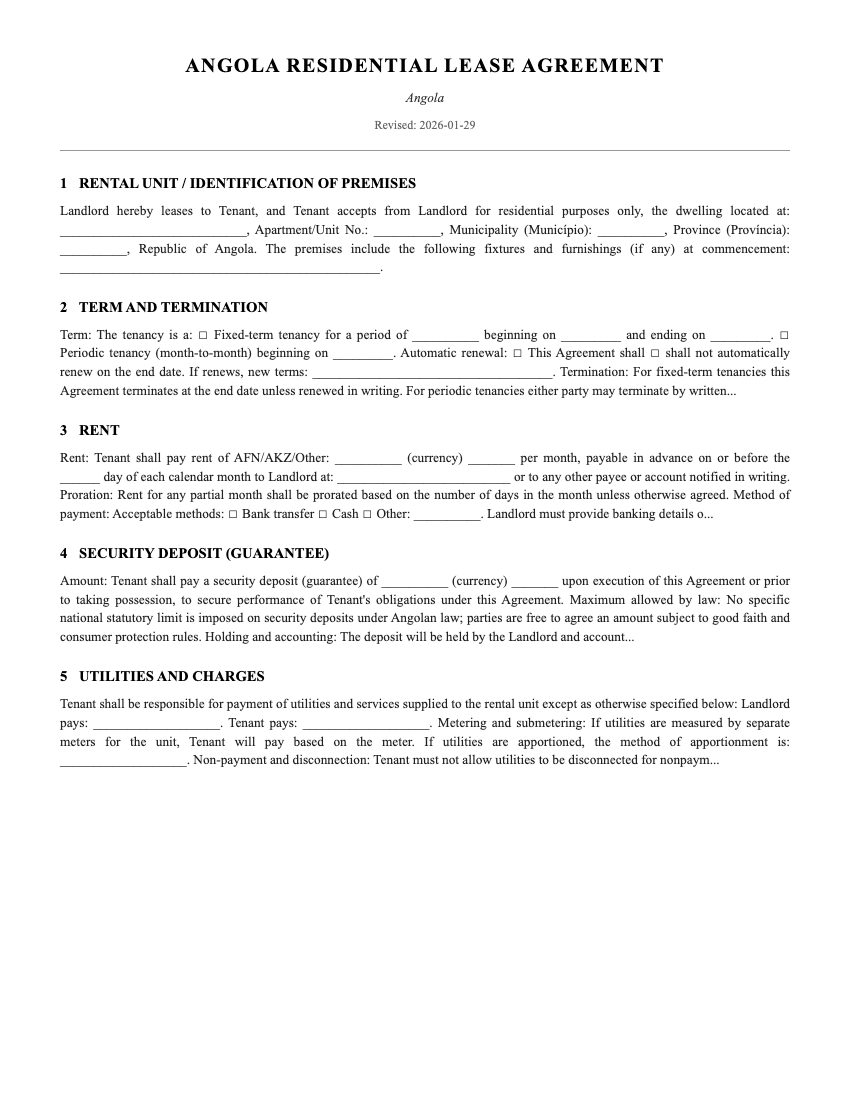
This free Residential Lease Agreement template was drafted to reflect the legal principles applicable in Angola (civil law). Although there is no national rent control regime or fixed statutory limits for security deposits, lease agreements in Angola must comply with the Código Civil (contractual principles and good faith), the eviction procedural rules of the Código de Processo Civil, the obligations provided in the Lei de Defesa do Consumidor and the rules on personal data protection (Lei de Proteção de Dados Pessoais).
Complying with formal requirements and disclosure obligations reduces litigation risks: correctly identify the landlord or its representative, deliver a Termo de Entrega (inventory/condition report), obtain consent for processing personal data and provide reasonable contractual deadlines for cure and return of the security deposit are essential measures.
For a comprehensive lease review checklist covering residential and commercial terms, see our Lease Agreement Review Guide.
Definition: What is a residential lease agreement in Angola?
A residential lease agreement is a private contract between a landlord and a tenant by which the landlord grants the use of a property for residential purposes in exchange for rent. In Angola the contractual aspects are governed by the Código Civil, breach and eviction proceedings by the Código de Processo Civil and commercial and consumer practices by the Lei de Defesa do Consumidor. The contract should include identification of the parties, a Termo de Entrega (inventory/condition report), the security deposit regime, payment conditions and clauses on the processing of personal data.
Why old templates are dangerous
- Legislation and practices change: templates based on foreign laws (e.g., Portugal, Brazil) or outdated versions may refer to deadlines, percentages and procedures not applicable in Angola.
- Lack of inventory/Termo de Entrega (inventory/condition report): without a signed Termo de Entrega, disputes over damage and deposit retention become harder to prove in court.
- Privacy and data protection: the Lei de Proteção de Dados Pessoais requires information and often consent for processing tenants' data; old templates do not foresee these clauses.
- Notices and eviction: evictions in Angola normally require judicial proceedings (Código de Processo Civil). Templates that assume administrative eviction or self-help eviction expose the landlord to the risk of committing unlawful eviction.
- Consumer rights: the Lei de Defesa do Consumidor imposes duties of information and boa‑fé in consumer relations; abusive clauses may be annulled and subject to compensation claims.
What is included in this template
- Full identification of the Landlord / Representative and the Tenant with contacts.
- Object clause and residential purpose.
- Term of the contract (fixed or indefinite) and rules for extension/renewal.
- Rent amount, payment date and method, contractual adjustments and indexation if applicable (defined between the parties).
- Security deposit clause: agreed amount, mandatory itemization of deductions, contractual period for return (recommended 15–30 days) and consequences for wrongful retention.
- Termo de Entrega (inventory and condition report) signed at the start and at the end of the lease.
- Clauses on maintenance, repairs and liability for damages.
- Conditions for subletting and for inspection visits.
- Cure/notice periods for breaches (e.g., 8–30 days for non‑payment; 15 days for other violations, as negotiated).
- Contractual notice procedure (valid means for written communication) and reference to the need for judicial proceedings for vacation.
- Personal data processing clause: legal basis, purpose, duration, data subject rights and consent when necessary (in accordance with the Lei de Proteção de Dados Pessoais).
- Mandatory statements and disclosures: information about known risks (when applicable), waste/disposal instructions, and information on consumer rights.
- Dispute resolution clause and applicable forum (Angolan courts; reference to the Código de Processo Civil for eviction procedures).
Download Options
- PDF version (print‑ready): /downloads/angola-lease-agreement-2026.pdf
- DOCX version (editable): available upon request to adapt terms and amounts to the specific case.
- Complementary checklist: Termo de Entrega template and consent form for personal data processing.
How to Finalize Your Lease
- Fill in all essential information (full identification of the parties, rent amount, security deposit amount and term).
- Prepare and sign the Termo de Entrega (inventory/condition report) at the start of occupation — document with dated photographs.
- Include the personal data processing clause and obtain written consent for necessary operations (references, collections, electronic communications).
- Agree in writing the cure periods and the notice procedure (valid means: registered letter, confirmed email, hand delivery with receipt).
- Sign the contract in duplicate; each party should retain an original copy.
- Optional: run the automated review with an AI contract review tool and, if necessary, seek review by a local lawyer before signing.
Related Lease Agreement Templates
FAQs
Q: What is the maximum legal amount for the security deposit in Angola?
A: There is no national legal limit for the amount of the security deposit in Angola. The parties are free to agree the amount, taking into account principles of good faith and consumer protection. It is common practice to set 1 to 3 months' rent, but the contract should provide for itemization of deductions and a deadline for return.
Q: How long does the landlord have to return the security deposit after delivery of the property?
A: There is no fixed statutory deadline. The deposit must be returned together with an accounting statement and itemization of deductions within a reasonable period agreed between the parties (common: 15–30 days). In case of dispute, return may be sought through judicial proceedings under the Código de Processo Civil.
Q: Is there rent control or a legal limit on increases in Angola?
A: There is no national rent control regime in Angola. Rents and increases are contractually regulated and by the principles of the Código Civil (freedom of contract and good faith). Check whether there is municipal legislation or housing programs that impose specific rules.
Q: What mandatory disclosures must the landlord make?
A: At minimum, the following information should appear in the contract or be delivered to the tenant: identification of the landlord/representative; Termo de Entrega (inventory and condition report); information on personal data processing and consent when applicable; information on consumer rights; and disclosure of known risks/hazards (e.g., hazardous materials, when applicable).
Q: How does eviction for rent default work?
A: In Angola eviction for non‑payment normally requires judicial proceedings based on the Código de Processo Civil. The contract can provide for a cure period (for example, 8–30 days) before initiating court action. The landlord should not carry out forced removal of the tenant on their own.
Q: Can I prohibit visitors and long stays in the contract?
A: Yes, the contract can set rules on subletting, guests' stays and limitations on prolonged stays without prior consent. However, excessively restrictive clauses or those that prevent basic tenant rights may be challenged based on contractual good faith and the Lei de Defesa do Consumidor. It is recommended to define clear limits (e.g.: number of days per month) and procedures for authorization.
Sources and legal references
- Constituição da República de Angola (2010). Consulte publicações oficiais: https://www.justica.gov.ao/ — Governo da República de Angola. (2010).
- Código Civil (Angola). Texto consolidado e publicações oficiais disponíveis no Diário da República: https://www.diariooficial.gov.ao/ — Governo da República de Angola.
- Código de Processo Civil (Angola). Regras de procedimento para ações de despejo e execução: publicações oficiais via Diário da República e Ministério da Justiça: https://www.justica.gov.ao/ — Governo da República de Angola.
- Lei de Proteção de Dados Pessoais (Angola). Regulamentação sobre tratamento de dados pessoais e direitos dos titulares — consulte o Ministério competente e publicações oficiais: https://www.justica.gov.ao/.
- Lei de Defesa do Consumidor (Angola). Disposições sobre informação ao consumidor e práticas comerciais leais: publicações oficiais via Diário da República: https://www.diariooficial.gov.ao/.
(Always consult the updated versions in the Diário da República and seek advice from a local lawyer to adapt clauses to specific municipal or sectoral contexts.)
<div class="ml-embedded" data-form="bBZ9zR"></div>
Frequently Asked Questions

About Designer Content
Designer Content creates practical legal document resources for landlords, contractors, and small business owners. We simplify complex legal concepts into actionable guidance. Connect with us on LinkedIn.