Sample Residential Lease Agreement (Brazil) — Compatible with Lei do Inquilinato & LGPD

## Residential Lease Agreement This Residential Lease Agreement ("Agreement") is entered into on this ___ day of __________, 20__, by and between: - **Lessor (Landlord):** _______________________________, CPF/CNPJ: ______________________, address: _______________________________________________________; - **Lessee (Tenant):** _______________________________, CPF/CNPJ: ______________________, address: _______________________________________________________; Collectively referred to as the "Parties." ## 1. Object of the Lease The Lessor hereby leases to the Lessee, who accepts, the residential property located at: _______________________________________________________, described as _______________________________________________________ (the "Property"), together with the fixtures, fittings and accessories listed in Annex I (Inventory). ## 2. Term The term of this Agreement shall be for a period of ______ (__) months/years, commencing on __/__/____ and ending on __/__/____, unless earlier terminated in accordance with this Agreement or applicable law. ## 3. Rent and Charges - The monthly rent shall be R$ __________ (__________ reais), payable in advance on or before the ___ day of each month to the following account or as otherwise directed by the Lessor: _______________________________________________________. - Late payment shall incur interest of ___% per month and a late fee of ___% on the overdue amount, plus any costs of collection. - The Parties may agree on an annual rent adjustment index or method. Absent such agreement, adjustments shall follow legally permitted indices. ## 4. Security Deposit (Caução) - As security for the obligations herein, the Lessee shall provide a security deposit (caução) in the amount of up to three (3) months' rent, corresponding to R$ __________, payable on or before delivery of the Property. - The deposit shall be held by the Lessor without interest and may be used to cover unpaid rent, utilities, repairs for damages beyond normal wear and tear, or other amounts due under this Agreement. - The balance, if any, shall be returned to the Lessee within thirty (30) days after termination and delivery of the Property, subject to the inspection and deduction of lawful amounts. ## 5. Alternative Guarantees In lieu of or in addition to the security deposit, the Parties may choose one or more of the following alternative guarantees: - **Guarantor (Fiador):** A third party guarantor acceptable to the Lessor shall sign a guaranty instrument. - **Rent Guarantee Insurance (Seguro-fiança):** A rent guarantee insurance policy in favor of the Lessor. - **Bank Guarantee/Letter of Guarantee:** A bank-issued guarantee or letter of guarantee. - **Other:** _______________________________________________________. The form and execution of any alternative guarantee shall be subject to the Lessor's approval and to the conditions agreed in Annex II (Guarantee Terms). ## 6. Taxes, Rates and Utilities (IPTU and Others) - Unless otherwise agreed in writing, the Lessee shall be responsible for payment of municipal property tax (IPTU), condominium fees, water, electricity, gas, telephone, internet, and other utility charges or taxes related to the Lessee’s use of the Property during the Lease term. - The Lessee shall pay IPTU (if billed to the Lessee) or reimburse the Lessor for IPTU and other property taxes if such are billed to the Lessor. When IPTU installments are in the name of the Lessor, the Lessee shall reimburse the corresponding portion within ___ days of presentation of proof of payment or billing. - Failure to pay utilities or taxes that result in liens or penalties shall be the Lessee's responsibility; the Lessor may remedy defaults and seek reimbursement with interest and costs. ## 7. Use and Maintenance - The Property shall be used exclusively for residential purposes by the named Lessee and occupants listed in Annex I. Commercial activities are prohibited without the Lessor’s prior written consent. - The Lessee shall keep the Property in good condition, perform ordinary maintenance, and promptly notify the Lessor of any need for major repairs. The Lessor shall be responsible for structural repairs and other major repairs not caused by the Lessee’s misuse or negligence. - The Lessee shall not make alterations, renovations or improvements without the Lessor’s prior written consent. Approved improvements may, by agreement, be compensated or remain with the Property. ## 8. Subletting and Assignment The Lessee shall not sublet, assign, or transfer this Agreement or allow third parties to occupy the Property without the Lessor's prior written consent. Any unauthorized subletting or assignment shall constitute a breach of this Agreement and may result in termination and initiation of eviction proceedings (despejo judicial). ## 9. Entry and Inspection The Lessor may enter the Property for inspection, repairs, or showings upon reasonable prior notice to the Lessee, except in cases of emergency where no prior notice is required. ## 10. Insurance - The Lessee is encouraged to obtain renter’s insurance to cover personal property and liability. - The Lessor may maintain insurance on the building. The Lessee shall not take actions that jeopardize the Lessor’s insurance coverage. ## 11. Personal Data and Privacy (LGPD) - The Parties acknowledge that, for the purposes of executing and performing this Agreement, personal data will be collected, processed and stored in accordance with applicable data protection legislation, particularly LGPD. - The Lessee authorizes the Lessor and its agents to process personal data necessary for tenant selection, credit checks, execution of guarantees, billing, communication, and compliance with legal obligations. Data may be shared with guarantors, insurers, service providers, and public authorities when necessary for the performance of this Agreement. - The Lessor shall adopt appropriate technical and organizational measures to protect personal data and shall respect the Lessee’s rights under LGPD regarding access, correction, portability, deletion, and objection, pursuant to applicable legal procedures. - Further details on data processing are provided in Annex III (Data Processing and Privacy Terms). ## 12. Default, Remedies and Despejo Judicial (Eviction) - If the Lessee fails to pay rent or other amounts due within the period stipulated in this Agreement, or otherwise breaches any material term, the Lessor may, after formal notice and lapse of any applicable cure period, exercise rights hereunder, including: - charging late fees and interest; - using the security deposit to cure defaults (with accounting and replenishment as agreed); and - terminating the Agreement and seeking eviction and recovery of possession through judicial means (despejo judicial), as provided by law. - The Parties expressly acknowledge that, in the event of default, the Lessor may pursue extrajudicial collection and judicial remedies, including filing for despejo judicial under Lei nº 8.245/1991, pursuing collection of unpaid rents, charges and damages, and seeking costs, fees and legal interest as allowed by law. - The initiation of eviction (despejo judicial) does not preclude the Lessor from claiming monetary losses and other remedies. ## 13. Early Termination - If the Lessee terminates the Agreement before the agreed term without legal cause, the Lessee shall compensate the Lessor as provided by law or by agreement: typically an indemnity equivalent to three months’ rent or proportional amount if applicable, unless otherwise waived or reduced by the Lessor. - Early termination by mutual consent shall be documented in writing. ## 14. Delivery of the Property - At the end of the Lease term or upon earlier termination, the Lessee shall return the Property in the same condition as received, except for normal wear and tear, accompanied by all keys and access devices, and shall remove all personal property. - An inspection shall be conducted and an inventory signed by both Parties documenting the condition and any deductions from the security deposit. ## 15. Liability and Indemnity - The Lessee shall be liable for damages caused by misuse or negligence and shall indemnify the Lessor for losses, costs, and liabilities arising from the Lessee’s breach or from the actions of occupants and guests. - The Lessor shall not be liable for damages to the Lessee's personal property due to third parties, unless caused by the Lessor’s willful misconduct or gross negligence. ## 16. Notices All notices under this Agreement shall be given in writing and delivered to the addresses stated herein or to any other address subsequently indicated in writing by either Party. Notices may be served by registered mail, courier, email (if receipt is confirmed), or personal delivery. ## 17. Assignment by Lessor The Lessor may assign or transfer its rights and obligations under this Agreement, provided the assignee assumes such obligations in writing. The Lessee shall be notified of any change of ownership or management. ## 18. Dispute Resolution and Governing Law This Agreement shall be governed by and construed in accordance with Brazilian law, particularly Lei nº 8.245/1991, Código Civil, and LGPD. Any disputes arising from this Agreement shall be attempted to be resolved amicably; if not resolved, the Parties submit to the competent courts of the venue where the Property is located, waiving other forums to the extent permitted by law. ## 19. Miscellaneous - This Agreement constitutes the entire agreement between the Parties and supersedes prior agreements and understandings related to the Property. - Amendments shall be made in writing and signed by both Parties. - If any provision of this Agreement is found invalid or unenforceable, the remaining provisions shall remain in full force and effect. ## 20. Signatures IN WITNESS WHEREOF, the Parties have executed this Agreement in ___ (___) counterparts, on the date first above written. Lessor: ____________________________ Date: __/__/____ Lessee: ____________________________ Date: __/__/____ Witness 1: _________________________ CPF: ______________ Date: __/__/____ Witness 2: _________________________ CPF: ______________ Date: __/__/____ Annex I — Inventory and Occupants (Describe furniture, appliances, conditions, and list of occupants.) Annex II — Guarantee Terms (Detail form(s) of guarantee accepted: caução, fiador, seguro-fiança, bank guarantee, procedures and documentation required.) Annex III — Data Processing and Privacy Terms (Detail the categories of personal data processed, purposes, lawful bases, data retention periods, recipients, and procedures for exercising rights under LGPD.)

Free Brazil Residential Lease Agreement Template | 2026 Compliant

Designer Content

Designer Content

·Updated · 9 min read
Free Brazil Residential Lease Agreement Template | 2026 Compliant - professional legal document template

Introduction

Residential leasing in Brazil is governed primarily by Lei nº 8.245/1991 (Lei do Inquilinato) and by the Civil Code (Lei nº 10.406/2002), with complementary rules on data protection (Lei nº 13.709/2018 — LGPD) and consumer protection (Código de Defesa do Consumidor, Lei nº 8.078/1990). Complying with these legal requirements avoids litigation, administrative fines and the nullity of contractual clauses. This template was prepared to reflect the essential rules in 2026: common limit for cash security deposit (up to three months’ rent), guarantee alternatives (guarantor, surety bond insurance, bank guarantee), and transparency requirements regarding municipal taxes (IPTU) and condominium rules.

What is a residential lease agreement in Brazil?

A residential lease agreement is a written agreement between landlord and tenant that defines the exclusive use of an urban property for residence, the obligations of each party, tenancy guarantees (security deposit, guarantor, surety bond insurance), form of payment and the conditions for adjustment, termination and return of the property. It is subject to Lei nº 8.245/1991 (Lei do Inquilinato) and to the rules of the Civil Code and the LGPD when it involves personal data.
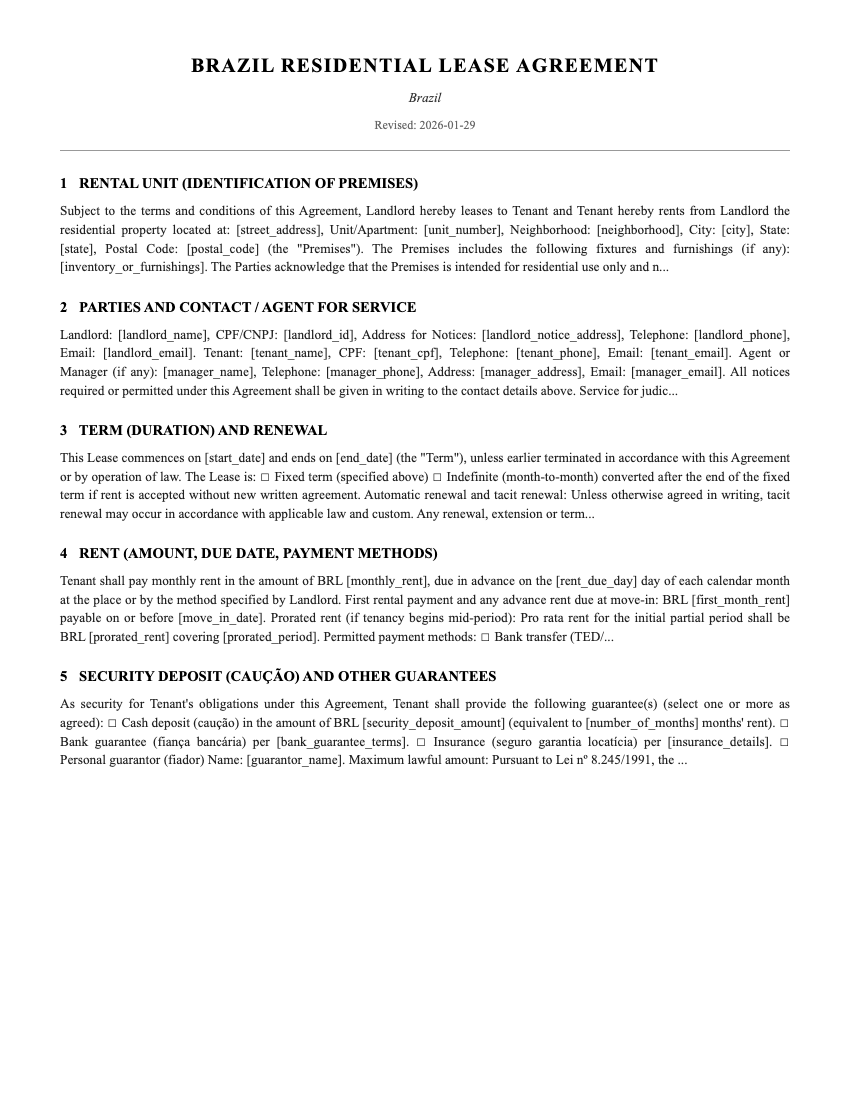
Lease Template Preview

Why old templates are dangerous (specific risks in Brazil)

  • Security deposit and guarantees: old templates may provide for a security deposit in amounts greater than three months in cash or omit legal guarantee options (guarantor, surety bond insurance, bank guarantee). The Lei do Inquilinato (Art. 38) provides the forms of guarantee; contrary clauses may be void or challenged.
  • Rent adjustment: indices and frequency of adjustment must be clear; use of prohibited indices or lack of periodicity may generate litigation. Although there is no federal rent control, the contract must stipulate the formula and periodicity of correction.
  • Eviction and procedural deadlines: procedures and deadlines have changed with the Civil Procedure Code. Old templates may suggest outdated practices about notices and tolerance periods for default.
  • LGPD: old contracts frequently process personal data without legal basis or without proper notice. This exposes landlords to administrative sanctions and civil actions.
  • Municipal and condominium provisions: many templates do not cover obligations to communicate condominium rules, rules for alterations, or allocation of IPTU/municipal charges.
  • Abusive clauses and consumer protection: clauses that impose excessive penalties on the tenant or limit rights provided by the Código de Defesa do Consumidor may be recognized as abusive by the Judiciary.

What this template includes

  • Essential clauses: identification of the parties, description of the property, term (fixed or indefinite), rent amount, due date and method of payment.
  • Tenancy guarantees: text for security deposit (security deposit in cash up to 3 months, with statement of itemization on return), guarantor, surety bond insurance and bank guarantee.
  • Adjustment: field for adjustment periodicity and index (IPCA, IGP-M, or another freely agreed index — we suggest IPCA for greater predictability; explain risks and variations).
  • Charges and taxes: clause on IPTU, condominium fees, utility bills (water, electricity, gas) and responsibility for renovations and minor repairs.
  • Entry and inspection: key handover forms, initial and final inspection report and procedure for checking items and charges.
  • Return and deposit: suggested contractual period for accounting (30 days) and requirement of a detailed list of deductions from the security deposit.
  • Termination and eviction: prior notice, cure period for defaults (contractual suggestion 10–30 days), and reference to the eviction procedure of Lei nº 8.245/1991 and the Civil Procedure Code.
  • Data protection (LGPD): clause that describes purposes of processing, legal basis, data sharing, retention period and data subject rights; instructions on secure storage.
  • Recommended clauses: fire insurance, guest policy, possibility of works and alterations, sublease and change of use.
  • Annexes: inspection form, guarantee agreement, security deposit receipt, proof of IPTU payment (if applicable) and LGPD checklist.

Download options

  • Ready-to-print PDF: /downloads/brazil-lease-agreement-2026.pdf (fillable template in English with legal notes in Portuguese).
  • Editable version (Word): available on the same download page for local customization.
  • Separate LGPD compliance checklist (recommended): accompany the contract with a privacy policy for tenant data processing.

How to finalize your lease agreement

  1. Complete all mandatory fields (name, CPF/CNPJ, full property address, amount and dates).
  2. Choose and document the tenancy guarantee (security deposit, guarantor, surety bond insurance, bank guarantee). For a cash security deposit, respect the practical limit of 3 months’ rent in accordance with Art. 38 da Lei nº 8.245/1991.
  3. Attach essential documents: copies of identification documents of the parties, proof of ownership of the landlord (or power of attorney), and proof of address.
  4. Conduct and attach the initial inspection signed by both parties.
  5. Include an LGPD clause and obtain formal consents where necessary; keep records of data processing.
  6. Sign the contract in at least two counterparts with witnesses; if required, register at a notary if the parties want publicity or clauses of fiduciary alienation.

Frequently Asked Questions (FAQ)

1. What is the maximum cash security deposit permitted in Brazil?

The Lei do Inquilinato (Lei nº 8.245/1991) allows a security deposit as one of the guarantee modalities, and the consolidated practice is up to three months’ rent when the security deposit is provided in cash. The parties may choose other guarantees (guarantor, surety bond insurance, bank guarantee). See: Lei nº 8.245/1991, Art. 38.

2. Is there rent control in Brazil?

There is no general federal regime of rent control. Rent and adjustment are matters of contract freedom, respecting public order norms, the Código de Defesa do Consumidor and any municipal rules. It is recommended to define the index and frequency of adjustment in the contract.

3. What disclosures must the landlord make to the tenant?

At minimum the following information should be included or provided: notice about the processing of personal data (LGPD), the form of guarantee, existence of condominium rules and any outstanding IPTU debts, as well as information about known defects or faults that may affect habitability.

4. What is the eviction procedure for non-payment?

The eviction action is filed based on Lei nº 8.245/1991 (eviction action) and follows the Civil Procedure Code (Lei nº 13.105/2015). Although the contract may provide for a cure period (for example, 10 to 30 days), eviction normally requires a judicial procedure (objections and deadlines provided by law). In cases of lease under the summary procedure or precautionary measures, the procedural route will be indicated by counsel.

5. Can I prohibit guests in the contract?

You can set reasonable rules regarding guests and subletting — for example, require prior notice and authorization for extended stays. However, clauses that violate fundamental rights or impose excessive penalties may be considered abusive by the Judiciary.

6. What do I need to do to ensure LGPD compliance?

Include a clause that explains which personal data will be collected, the purpose of the processing, the legal basis (contract execution, compliance with a legal obligation, legitimate interest, etc.), the retention period and the rights of the data subject. Keep records of processing operations and internal information security policies. Lei nº 13.709/2018 (LGPD).

Final remarks and practical recommendations

  • Consult a local lawyer before using the contract for atypical situations (property with special purpose, seasonal rental, commercial lease, complex guarantees).
  • Use an AI contract review tool for an automated double-check of the text, especially for LGPD and guarantee clauses.
  • Keep receipts and signed inspections; in litigation, documentation is crucial.

<div class="ml-embedded" data-form="bBZ9zR"></div>

Frequently Asked Questions

Designer Content

About Designer Content

Designer Content creates practical legal document resources for landlords, contractors, and small business owners. We simplify complex legal concepts into actionable guidance. Connect with us on LinkedIn.

Copyright © 2026 Designer Content. All rights reserved.

This site provides general legal information, not legal advice. Consult a qualified attorney for your specific situation.