
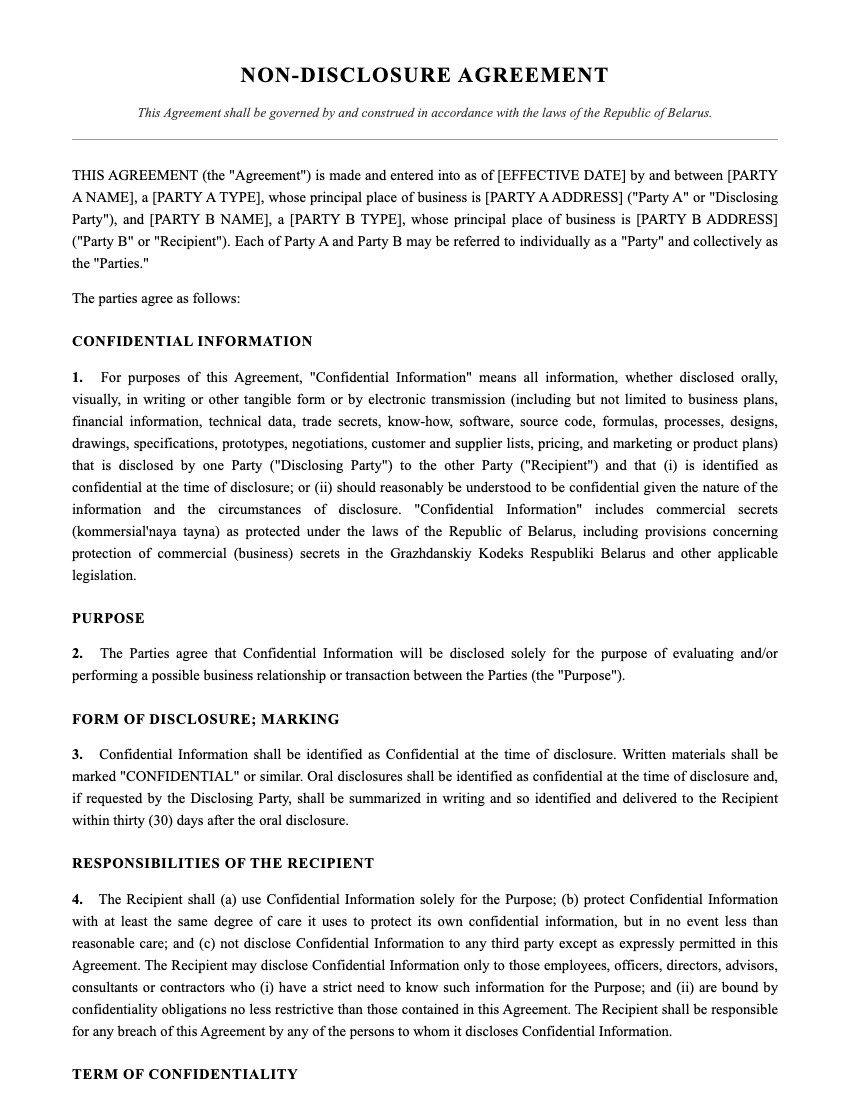
A Belarus Non-Disclosure Agreement (NDA) is a contract under the Grazhdanskiy Kodeks Respubliki Belarus that creates binding confidentiality obligations between parties. In Belarus, NDAs must be drafted with attention to civil-law formalities, personal data rules, language requirements, and the three-year statute of limitations (srok iskovoy davnosti).
What Is a Belarus NDA?
Definition: A Belarus NDA is a civil contract that obliges one or both parties to keep specific information secret and limits its use to a stated purpose. The Grazhdanskiy Kodeks and related sectoral laws (for example, the Law on Personal Data) inform how courts treat trade secrets, consent for personal data processing, and remedies for breach.
Because Belarus follows a codified civil-law approach, courts focus on the contract text and statutory compliance when enforcing confidentiality. Unlike some common-law jurisdictions, procedural formalities, lawful processing of personal data, and the agreed governing language can materially affect enforceability.
For a complete guide to NDA terms, duration, and standard exclusions, see our NDA Agreement Guide.
Why "Generic" NDAs Are Dangerous in Belarus
Many off-the-shelf NDAs are drafted for common-law jurisdictions and miss Belarus-specific legal traps. Using them can produce three major risks:
- Language & Governing Law Mismatch
Belarusian courts expect that contracts affecting Belarusian residents are clear in their applicable law and language. If your NDA is only in English and does not expressly designate Belarus law and a Russian-language operative text, a judge may interpret ambiguities against the drafter. Always include a Russian version (or state which language controls).
- Personal Data Compliance Trap (paradigm-shifting insight)
This jurisdictional insight is critical: Belarus places strict requirements on processing and transferring personal data. If your NDA contemplates receiving or transferring any personal data (names, contact details, CVs, employee records), you must comply with the Law on Personal Data (and related regulations). That means lawful basis (consent or statutory ground), appropriate data-security measures, and—when required—registration or notification with competent authorities. A confidentiality clause that assumes unrestricted transfer or use of personal data can be unenforceable and expose the disclosing party to administrative fines. In short: NDAs that ignore Belarus personal data law are not just poor drafting; they create compliance risk.
- Remedies & Time Limits
Belarusian civil remedies are governed by the Grazhdanskiy Kodeks and procedural rules; pecuniary damages and injunctive relief are available but governed by evidence and statutory limits. Importantly, the general statute of limitations for civil claims is three years (srok iskovoy davnosti). If you miss that window, recovery for disclosure may be time-barred.
Real case study: While Belarus has fewer publicly reported trade-secret court opinions than many jurisdictions, Belarusian practice increasingly enforces confidentiality where parties complied with contract formalities and data rules. Recent guidance from local legal commentators (2022–2024) emphasizes that NDAs must expressly cover personal data handling and security measures to be persuasive in litigation and administrative reviews.
Key Clauses — Adapted for Belarus Practice
- Purpose & Scope: Narrow, objective statement of why information is shared. Use project names, deals, or specific services.
- Definitions: Distinguish between "Confidential Information" (business data) and "Personal Data" (names, CVs). Require compliance with the Law on Personal Data for any processing or transfer.
- Obligations of Receiving Party: Keep information secret, limit access, implement technical & organizational measures consistent with Belarusian data-security expectations.
- Exclusions: Publicly available information; independently developed information; required disclosure to competent Belarusian authorities.
- Duration: Two-tier approach — time-limited protection (2–5 years) for general confidential information; indefinite protection for trade secrets while secrecy is maintained (subject to the three-year limitation for claims after disclosure).
- Remedies: Injunctive relief and damages; costs allocation; dispute resolution and Belarusian courts or agreed arbitration with seat specified.
- Language & Governing Law: State that Belarus law governs and declare which language controls (Russian recommended).
- Electronic Signatures & Formalities: Reference the Law on Electronic Document and Electronic Digital Signature (use an accepted local provider or notarization when foreign enforcement is anticipated).
Mutual vs. Unilateral Options
- One-Way (Unilateral): Use when only one side discloses (investor pitches, supplier disclosures).
- Mutual (Two-Way): Use for joint development, partnership talks, or M&A due diligence.
Choosing the wrong type creates either unnecessary burdens or gaps in protection.
Who Needs This Document?
| User Persona | Usage Scenario | Key Local Benefit |
|---|---|---|
| Belarusian startups | Pitching investors (local or foreign) | Protects know-how while ensuring personal data compliance |
| IT contractors | Service provision to Belarus clients | Clarifies code/IP, addresses data security expectations |
| Manufacturers | Outsourcing production | Preserves trade secrets; specifies Belarusian enforcement options |
| Recruiters | Sharing CVs with clients | Ensures lawful processing of personal data under Belarus rules |
How to Execute a Valid Belarus NDA
Step 1: Choose the right type (Unilateral vs Mutual) and draft a narrow Purpose.
Step 2: Include a clear Personal Data clause specifying legal basis, security measures, and transfer limits. If you will process employee data, obtain written consent or cite another lawful ground before transfer.
Step 3: Sign in Russian or include an officially certified translation; specify which language controls. For cross-border signings, consider notarization and Apostille where necessary for foreign courts.
Step 4: Use a recognized electronic signature platform that complies with Belarusian rules or obtain wet signatures when enforcement abroad is expected. Preserve execution evidence (timestamps, IP logs).
Already Receiving NDAs from Clients?
When asked to sign a counterparty NDA, check for: (1) unclear governing law/language, (2) sweeping personal data processing clauses, (3) overbroad purpose or perpetual confidentiality without specificity, and (4) dispute resolution that prevents access to Belarusian courts when you need local protection.
an AI contract review tool helps by flagging risky provisions, comparing terms against Belarus-specific concerns (language, personal data, statute of limitations), and suggesting redlines.
Related NDA Templates
Get the Template
Sign up for our newsletter to receive the template.
Frequently Asked Questions

About Designer Content
Designer Content creates practical legal document resources for landlords, contractors, and small business owners. We simplify complex legal concepts into actionable guidance. Connect with us on LinkedIn.