
Introduction
Creating a legally sound residential lease in Canada starts with knowing which rules apply. Ordinary residential tenancies are governed almost entirely by provincial and territorial statutes (for example, Ontario's Residential Tenancies Act or British Columbia's Residential Tenancy Act). At the federal level there is no single residential tenancy code — however, several federal laws and national standards still affect how leases are drafted and enforced (especially around privacy, discrimination in federally regulated housing, health and safety, and criminal activity).
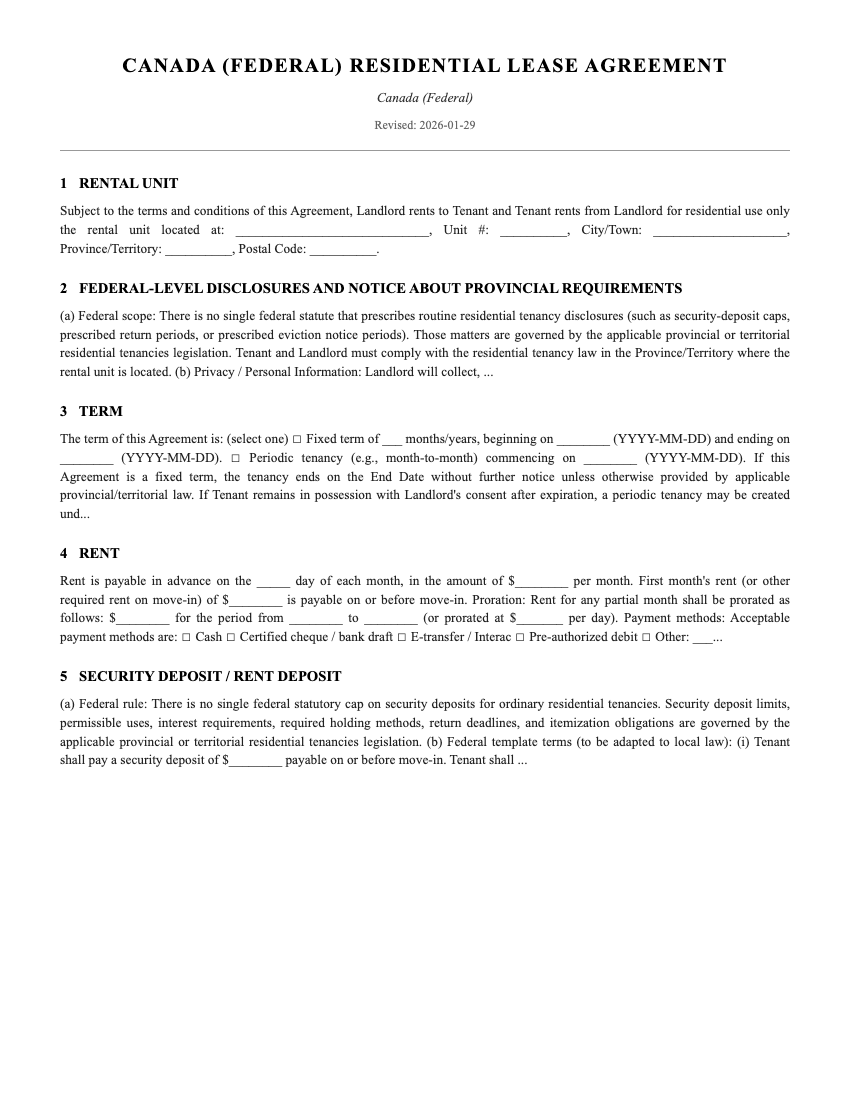
This template is a federal-level framework: it states federal requirements where they exist, identifies where provincial/territorial law controls, and includes fillable local addenda so you can insert the correct statutory citations, deposit limits, notice periods and other jurisdiction-specific terms.
For a comprehensive lease review checklist covering residential and commercial terms, see our Lease Agreement Review Guide.
What is a Canada (Federal) residential lease?
A Canada (Federal) residential lease is a model lease document structured to reflect federal law constraints and to flag the precise provincial or territorial tenancy rules that actually govern a rental relationship. It is not a substitute for the local residential tenancy statute; instead it provides a compliant federal baseline, privacy protections (PIPEDA), non‑discrimination guidance for federally regulated housing (Canadian Human Rights Act), and notes where to insert local statutory provisions.
Why compliance matters
Using an out-of-date or out-of-jurisdiction lease can cost landlords and tenants time and money. Provincial and territorial rules determine key issues — security deposit types and caps, the deadline for returning deposits, required notices for termination or nonpayment, and statutory remedies for unlawful evictions. Federal rules can impose separate obligations (for example, PIPEDA requirements for collecting and storing tenant personal information). This template helps you combine federal obligations with the right provincial/territorial clauses.
Why Old Templates Are Dangerous (Federal perspective + jurisdiction traps)
- Provincial rules change frequently. A lease that ignores the current provincial Residential Tenancies Act may include illegal terms (e.g., unlawful deposit amounts, incorrect notice periods).
- Privacy mistakes. Collecting tenant personal information without a PIPEDA-compliant notice or secure handling procedures can create legal exposure at the federal level for businesses and landlords operating in federally regulated sectors.
- Discrimination risks. For housing under federal jurisdiction (e.g., certain co-ops, Indigenous housing on reserve under federal programs, or workplaces with employer-provided housing that is federally regulated), the Canadian Human Rights Act applies and blanket rules that exclude protected groups can be unlawful.
- Eviction process errors. Incorrect notice periods or attempts to evict without following local tribunal processes can result in a tenant remaining in possession and the landlord facing costs and delays.
- Incomplete safety disclosures. Municipal or provincial requirements for disclosing lead, mould, flood risks, or energy retrofits are often missed by generic templates.
Examples of common provincial traps to watch for (insert the correct local rule in the addendum):
- Security deposit type: some provinces allow only "last month's rent"; others permit a refundable damage deposit up to one month's rent.
- Return deadlines: provinces set varying deadlines and may require itemized statements; federal law does not set a uniform deadline.
- Notice periods for nonpayment or termination: ranges commonly run from 5 to 14 days for nonpayment and longer for no-fault terminations — but local statutes control.
What's Included in This Template
- Federal baseline lease clauses (parties, term, rent, utilities, permitted uses)
- Privacy / Personal Information Collection Notice (PIPEDA-aware language)
- Placeholders and a dedicated provincial/territorial addendum for:
- Security deposit type and maximum amount (if any)
- Deposit return deadline and itemization requirements
- Interest obligations on deposits (if applicable locally)
- Notice periods for nonpayment, breach, and periodic-tenancy termination
- Local rent-increase notice and rent-control disclosures (if applicable)
- Required local health & safety or environmental hazard disclosures - Clauses addressing criminal activity, illegal subletting, and property damage referencing the Criminal Code where appropriate
- Standard repair, maintenance and entry provisions with notes to align with local landlord entry rules
- Sample signatures and witness lines
This template also contains inline notes that remind you to insert the exact provincial/territorial statutory citation (for example, "Residential Tenancies Act, 2006 (Ontario) — s. XXX") when you complete the addendum.
Download Options
- Single PDF: Canada (Federal) Residential Lease Agreement Template — /downloads/canada-federal-lease-agreement-2026.pdf
- Fillable Word (DOCX) and fillable PDF versions are available from the download page for local editing.
- Provincial/Territorial Addendum pack: an optional bundle with drafted local wording for each province/territory (available separately) — recommended if you are unsure of local statutory language.
How to Finalize Your Lease
- Identify the property's province or territory. Open the provincial/territorial addendum and insert the local statutory citations and numeric limits (deposit caps, notice periods).
- Complete the privacy notice section with your data-handling contact and retention period. If you are collecting sensitive personal information, ensure a PIPEDA-compliant lawful basis and security measures.
- Check local disclosure rules: add required health & safety or environmental disclosures mandated by municipal or provincial law.
- Run an AI contract review tool Safety Check on the completed lease (upload the full document) to flag missing statutory references and ambiguous clauses.
- Consider a local tribunal or lawyer review for high-risk situations (student housing, subsidized housing, commercial/residential hybrids, or if eviction is likely).
- Execute the lease with witnesses or notarization if required by local practice; provide a copy to the tenant and retain records per your privacy notice.
Practical Tips
- Always attach the provincial/territorial addendum and cite the exact statute and section numbers used to set deposit limits, notice periods and rent-increase rules.
- Keep a dated record of all disclosures and the tenant's signed receipt for those disclosures.
- Use clear language for payment methods and what constitutes late payment or NSF; ambiguous penalty clauses may be unenforceable.
Related Lease Agreement Templates
FAQs
(See the dedicated FAQ section below for quick answers to common federal and cross-jurisdictional questions.)
Final note
This federal template is a starting point designed for use across Canada. It does not replace the residential tenancy statute that applies where the rental unit is located. Use the provincial/territorial addendum to insert local limits and then run the completed lease through an AI contract review tool and, if necessary, local counsel before signing.
<div class="ml-embedded" data-form="bBZ9zR"></div>
Frequently Asked Questions

About Designer Content
Designer Content creates practical legal document resources for landlords, contractors, and small business owners. We simplify complex legal concepts into actionable guidance. Connect with us on LinkedIn.