
Why compliance matters
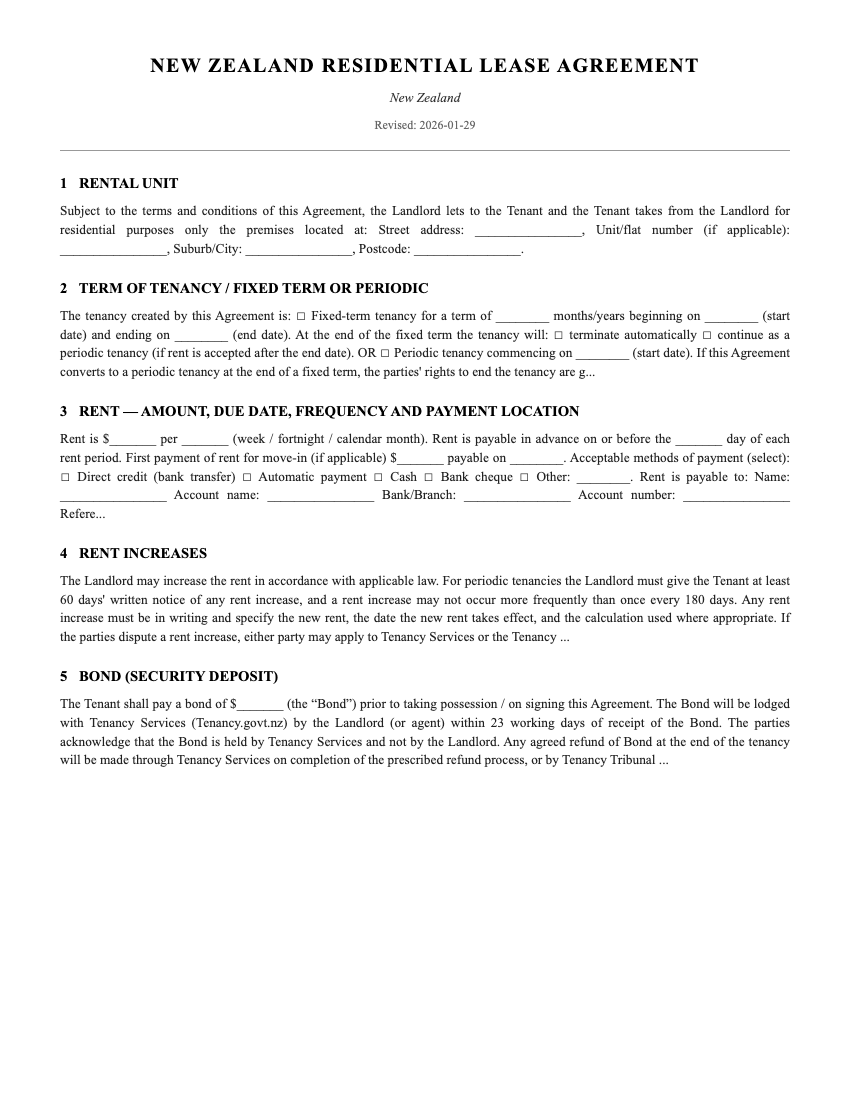
In New Zealand, a residential tenancy agreement is governed principally by the Residential Tenancies Act 1986 and associated regulations, including the Residential Tenancies (Healthy Homes Standards) Regulations 2019. Non-compliant leases can lead to Tenancy Tribunal claims, penalties, forced bond refunds, compensation orders, and invalid termination notices. This template is drafted to reflect key statutory requirements — bond lodgement rules, Healthy Homes Standards, smoke alarm and insulation statements, notice periods for rent increases, and the proper process for ending a tenancy through Tenancy Services and the Tenancy Tribunal.
Important: This article summarises legal requirements for New Zealand residential tenancies. It is not a substitute for legal advice. Always check Tenancy Services (https://www.tenancy.govt.nz/) and the cited statutes for updates.
What is a New Zealand residential lease?
A residential lease (tenancy agreement) in New Zealand is a written or oral contract between a landlord and a tenant that sets the terms for occupation of residential premises. It is governed by the Residential Tenancies Act 1986 (RTA) and related regulations such as the Residential Tenancies (Healthy Homes Standards) Regulations 2019. The agreement must be consistent with statutory duties (for example bond lodgement and Healthy Homes compliance) and cannot contract out of mandatory legal protections.
For a comprehensive lease review checklist covering residential and commercial terms, see our Lease Agreement Review Guide.
Why old templates are dangerous (New Zealand traps)
- Bond lodgement timing: Landlords must lodge any bond received with Tenancy Services within 23 working days. Older templates may not state this or may leave lodgement to an informal process — failing to lodge can lead to Tribunal orders and penalties.
- Healthy Homes Standards: Since the Healthy Homes Regulations (2019) took effect, landlords must meet minimum standards for heating, insulation, ventilation, moisture and drainage, and draught stopping. Outdated forms often lack the required compliance statements and remedial timelines.
- Rent-increase rules: There is no rent-control cap nationwide, but statutory notice periods are strict: at least 60 days' written notice for increases to periodic tenancies and no more than one increase every 180 days. Older forms may reference incorrect periods or permit more frequent increases.
- Termination and eviction procedure: You cannot lawfully evict a tenant without following statutory processes and, frequently, a Tenancy Tribunal order. Old templates sometimes include improper 'instant' termination clauses or 'no-cause' end provisions that are unenforceable.
- Required disclosures: New Zealand law requires specific disclosures (bond lodgement, Healthy Homes, smoke alarms and insulation, asbestos/hazardous materials, privacy use of tenant data, and legacy contaminants). Missing these can render parts of a landlord’s claim weaker at the Tribunal.
- Bond amount confusion: There is no statutory nationwide cap on bond amounts in the RTA. However, Tenancy Tribunal practice may reduce excessive bonds; common market practice is 2–4 weeks' rent. Old forms that demand arbitrary large sums can be challenged.
What's included in this template
- Clear identification of landlord, tenant(s), premises, and permitted occupants
- Rent amount, payment frequency, accepted payment methods, and late payment process
- Bond clause: amount, lodgement process, Tenancy Services information, and rules for deductions (itemisation requirement)
- Fixed-term and periodic tenancy options with correct default rules
- Rent-increase clause aligned with statutory notice (60 days, not more than once per 180 days)
- Required statutory disclosures: bond lodgement disclosure; Healthy Homes Standards compliance statement; smoke alarm and insulation statement; asbestos and hazardous materials disclosure; privacy and use of tenant personal information; information on legacy contaminants (lead-based paint where applicable)
- Repairs and maintenance obligations, including Healthy Homes remedial duties and access for necessary work
- Termination procedures: notice templates and guidance for applying to the Tenancy Tribunal for breach or termination
- Entry and guest/occupancy rules consistent with tenant rights and privacy obligations
- Signature blocks and recommended checklist for signing, witnessing, and electronic signing guidance
Download Options
- Free PDF: /downloads/new-zealand-lease-agreement-2026.pdf (printer-friendly, finalised language)
- Editable DOCX: Available to paid subscribers for customization (includes commentary and optional clause drafts)
- an AI contract review tool Review: Upload your completed lease to an AI contract review tool for automated statutory checks and suggested edits
How to Finalize Your Lease
- Review statutory disclosures: Ensure the template’s six required disclosures are completed and accurate for the property (bond lodgement, Healthy Homes compliance, smoke alarms and insulation, asbestos/hazardous materials, privacy use, legacy contaminants).
- Choose fixed-term or periodic: Confirm whether the tenancy is fixed-term (ends on a date) or periodic and ensure the selected termination clauses match the choice.
- Agree rent and bond: Confirm rent frequency, payment method, bond amount (commonly 2–4 weeks' rent) and that the clause states the landlord will lodge the bond with Tenancy Services within 23 working days of receipt.
- Run an AI contract review tool review: Upload the completed draft to an AI contract review tool for automated checks against NZ statutes and Tenancy Services guidance. Implement an AI contract review tool’s suggested corrections.
- Sign and retain copies: Signatures can be electronic or handwritten; keep a signed copy for each party. Provide the tenant with tenancy information and Tenancy Services forms (eg bond lodgement receipt and information on how to dispute bond claims).
- Lodge bond: Lodge the bond online with Tenancy Services within 23 working days and provide the tenant with the lodgement confirmation.
Related Lease Agreement Templates
FAQs
- Q: How much bond can a landlord charge in New Zealand?
A: The Residential Tenancies Act 1986 does not set a statutory nationwide cap on bond amounts. Market practice is commonly 2–4 weeks' rent. The Tenancy Tribunal may reduce unusually large bonds if they are judged excessive. Any bond received must be lodged with Tenancy Services within 23 working days. - Q: Are rent controls in effect in New Zealand? How do rent increases work?
A: There is no nationwide rent-control regime in New Zealand. Parties are free to agree rent levels. For periodic tenancies, landlords must give at least 60 days' written notice for a rent increase and cannot increase rent more frequently than once every 180 days. Local emergency restrictions can apply in rare circumstances — check Tenancy Services for current guidance. - Q: What disclosures must a landlord make before or at the start of a tenancy?
A: Required disclosures include: (1) bond lodgement disclosure and process; (2) Healthy Homes Standards compliance statement; (3) smoke alarm and insulation statement; (4) disclosure of known asbestos or hazardous materials; (5) statement on the use and handling of tenant personal information (Privacy Act 2020); and (6) information on legacy contaminants (such as lead-based paint where reasonably suspected). - Q: How does eviction (termination for breach or nonpayment) work in NZ?
A: Landlords must follow statutory processes under the Residential Tenancies Act 1986. For unpaid rent or other breaches, landlords commonly issue a written notice specifying the breach and the time to remedy (Tribunal practice often uses 14 days for remedial breaches). A landlord may apply to the Tenancy Tribunal for termination and recovery of arrears. For serious breaches, a landlord may apply immediately for termination. A Tribunal order is generally required to lawfully remove a tenant. - Q: Can a tenancy agreement limit guests or subletting?
A: Yes — tenancy agreements can set reasonable rules on guests, occupancy and subletting, provided those rules do not unreasonably interfere with the tenant’s right to quiet enjoyment. Any restriction should be clear, reasonable, and consistent with the RTA; disputes over unfair restrictions can be taken to the Tenancy Tribunal. - Q: Are electronic signatures valid on a New Zealand tenancy agreement?
A: Yes. Electronic signatures are generally accepted in New Zealand under relevant statutes (for example, the Contract and Commercial Law Act and the Electronic Transactions framework). Ensure both parties keep a copy of the signed document and that identification for the parties is clear. For contentious tenancies, consider witnessing or additional verification.
Final notes and an AI contract review tool reminder
This template is aligned with the Residential Tenancies Act 1986, the Residential Tenancies (Healthy Homes Standards) Regulations 2019, and common Tenancy Services practice. Before you finalise the agreement, upload the completed document to an AI contract review tool to verify statutory language, detect missing disclosures, and help avoid common Tenancy Tribunal pitfalls. For complex disputes or unusual facts (eg significant asbestos, major redevelopment, or multiple occupant arrangements), seek legal advice.
For statutory texts and official guidance see Sources below.
<div class="ml-embedded" data-form="bBZ9zR"></div>
Frequently Asked Questions

About Designer Content
Designer Content creates practical legal document resources for landlords, contractors, and small business owners. We simplify complex legal concepts into actionable guidance. Connect with us on LinkedIn.