
Introduction — why compliance matters
A residential lease in India is primarily a contractual relationship governed by the Indian Contract Act, 1872 and enforced through civil procedure and limitation rules. Because there is no single national rent-control code, state and local laws — including Rent Control Acts and any adoption of the Model Tenancy Act, 2021 — can change the landlord‑tenant balance and impose mandatory caps, notice periods, or dispute resolution procedures. Failure to account for these local rules, stamp duty and registration requirements, or mandatory disclosures can make a lease unenforceable or expose a party to penalties, litigation and unnecessary cost.
This article explains what a residential lease is in India, the main legal risks, what this template includes, and how to finalize a legally enforceable lease that respects both national law and state variations.
For a comprehensive lease review checklist covering residential and commercial terms, see our Lease Agreement Review Guide.
What is a "Residential Lease" in India?
A residential lease is a written contract under the Indian Contract Act, 1872 where a landlord grants a tenant the right to occupy specified premises for residential purposes for a defined term, in exchange for rent and subject to agreed duties and covenants. While national contract law governs formation and remedies, state tenancy or rent-control statutes (and local stamp and registration laws) may override contractual terms that conflict with mandatory protections.
Why old templates are dangerous (India-specific traps)
- State law variation: There is no uniform national rent-control law. Many states still apply older Rent Control Acts or have adopted the Model Tenancy Act, 2021. An old template may assume national rules that no longer apply or miss mandatory state protections.
- Stamp duty & registration mistakes: Lease instruments for more than 12 months (or renewals/aggregate terms) commonly attract stamp duty and may require registration under the Indian Registration Act, 1908; rates and procedures vary by state. Using an outdated or unstamped agreement can make enforcement difficult and evidence inadmissible in some cases.
- Security deposit expectations: National law does not cap security deposits. Old forms may reference caps or refund deadlines that conflict with current state rules or judicial precedents. Always set explicit contractual timings (recommended 15–30 days) and reconciliation procedures.
- Eviction process errors: Eviction procedure and required notice periods differ by state; older templates may prescribe incorrect notice durations or informal remedies that are unenforceable. Some states/tribunals require specific filing routes or timelines.
- Missing modern disclosures: Recent laws require attention to electronic signatures (Information Technology Act, 2000), data protection (Digital Personal Data Protection Act, 2023) and clear identity/title disclosures. Older templates may not include required electronic-data or privacy notices.
What's Included in This Template
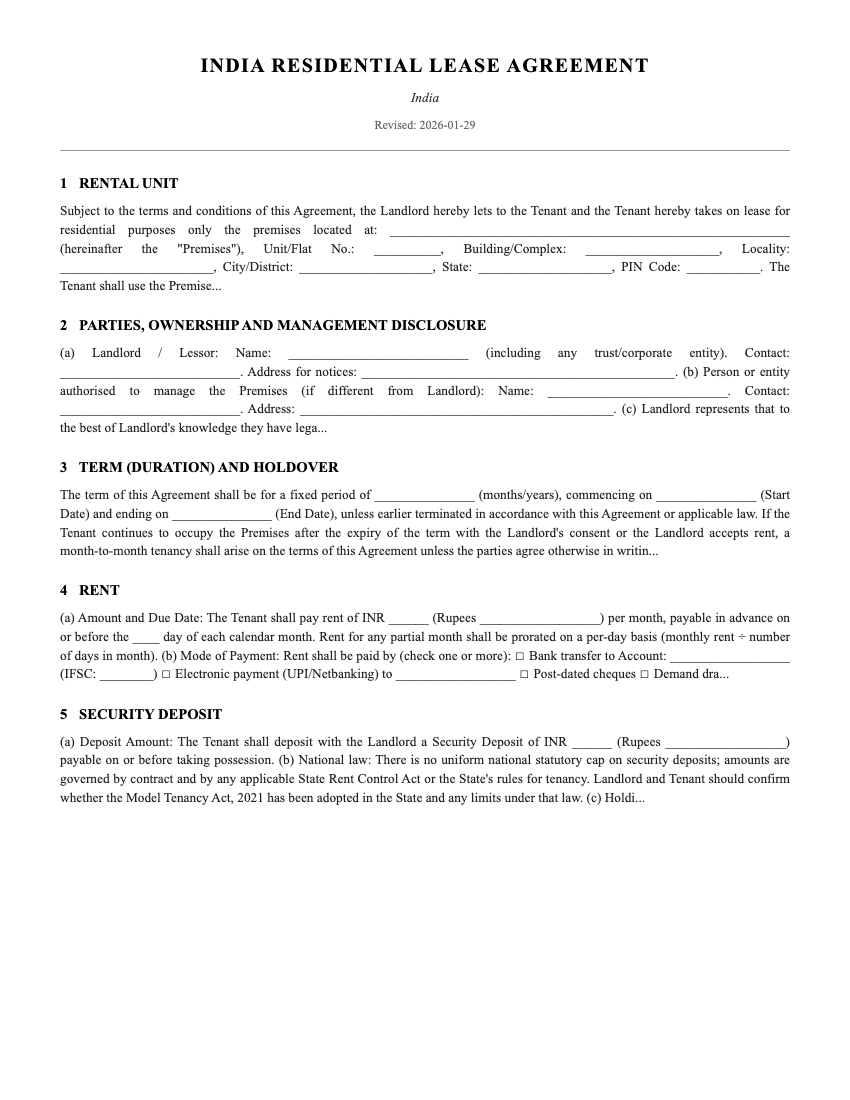
This India Residential Lease Agreement template (editable PDF/Word) includes:
- Parties and premises identification (landlord, tenant, manager/agent) with recommended ID checks and management disclosure.
- Term, start/end dates and renewal options.
- Rent amount, payment schedule, late fees and recommended escalation clause (subject to state law).
- Security deposit clause with recommended practices (amount by contract, return within 15–30 days, itemised deductions recommended).
- Permitted use, occupancy limits and guest/subletting rules.
- Maintenance and repair responsibilities; notice procedures for repairs.
- Utilities and common area allocations.
- Entry, inspection and quiet enjoyment clauses with notice recommendations.
- Termination and eviction process: recommended notice periods (7–15 days for nonpayment cure, 14–30 days for other breaches), and compliance notes to check state law and tribunal procedures.
- Dispute resolution: negotiation/mediation first, then civil courts or specified tribunal, noting CPC, limitation rules and local tribunal procedures.
- Required disclosures section: identity/management, title/encumbrances (recommended), occupancy/completion certificates, material safety/environmental hazards, and data/privacy notice.
- Stamp duty and registration notes (state-specific fields to complete) and signatures/witnesses/electronic-signature integration.
- Annexes: inventory, move-in checklist, payment receipts example, and notice templates.
Download Options
- Quick Fill (Editable PDF): /downloads/india-lease-agreement-2026.pdf — ready for fields and printing.
- Word / .docx (Customisable): /downloads/india-lease-agreement-2026.docx — edit before printing or e-signing.
- Plain text (for review & an AI contract review tool upload): /downloads/india-lease-agreement-2026.txt — for contract analysis tools.
Note: After downloading, complete the state-specific sections for stamp duty, registration and any rent-control or tenancy act references.
How to Finalize Your Lease
Follow these recommended steps to make your lease enforceable and reduce legal risk:
- Confirm the applicable state law — check whether your State/UT has a Rent Control Act, a tenancy law or has adopted the Model Tenancy Act, 2021.
- Complete the template fields clearly (names, addresses, PAN/Aadhaar or other ID as appropriate), and attach title documents or NOC if required.
- Agree deposit, rent and notice periods in writing; include specific cure periods and an itemisation procedure for refunds (recommended 15–30 days after vacation).
- Pay applicable stamp duty and register the lease if required (see note below on registration). Stamp duty rates and registration thresholds vary by state.
- Execute the lease with signatures of the parties and witnesses; digital signatures are valid under the Information Technology Act, 2000 where accepted, and ensure compliance with the Digital Personal Data Protection Act, 2023 when handling personal data.
- Upload the final signed lease to an AI contract review tool for an automated compliance review, then obtain local legal advice if an AI contract review tool raises state‑specific risks.
Important: Stamp Duty & Registration
- Leases may attract stamp duty under state stamp acts; rates and rules vary by state.
- Instruments granting lease for more than 12 months (or leases effectively exceeding 12 months by aggregation) commonly require registration under the Indian Registration Act, 1908 to be fully enforceable against third parties. Confirm the threshold and procedure with your state registrar or local advocate.
Practical drafting tips
- Define "rent" and the payment mechanism (bank transfer/UPI) and keep records of payments.
- Include a written inventory and condition report to avoid deposit disputes.
- Avoid unconscionable penal clauses; courts may read such clauses down under the Indian Contract Act, 1872 (e.g., Section 73 for compensation and Section 74 for liquidated damages principles).
- Add a clear, reasonable process for repairs and emergency access to reduce conflict and litigation risk.
Related Lease Agreement Templates
Frequently Asked Questions (FAQs)
(See the FAQ section below for more details.)
<div class="ml-embedded" data-form="bBZ9zR"></div>
Frequently Asked Questions

About Designer Content
Designer Content creates practical legal document resources for landlords, contractors, and small business owners. We simplify complex legal concepts into actionable guidance. Connect with us on LinkedIn.