
Introduction
If you're renting in Singapore—whether you're a private landlord, an HDB flat owner, a tenant in a condominium, or a property manager—your written lease is the primary legal document that defines rights and responsibilities. Singaporean residential tenancies are governed largely by contract law (common law) and intersect with specialist statutes and administrative rules such as the Personal Data Protection Act 2012 (PDPA), Housing & Development Board (HDB) subletting rules for public housing, the Building Maintenance and Strata Management Act 2004 (BMSMA) and strata by‑laws for condominiums, and stamp duty requirements administered by the Inland Revenue Authority of Singapore (IRAS). There is no national rent‑control regime and no statutory cap on security deposits for private leases, so the lease should clearly state deposit amounts, return procedures and any agreed interest.
A thoughtfully drafted lease reduces disputes and positions both parties to enforce their rights (for example, by proving contract terms in court where necessary). This template is designed for 2026 compliance with Singapore practice: it includes PDPA language, HDB and strata disclosure prompts, stamp duty notice language, recommended deposit handling and an express process for notices and termination.
For a comprehensive lease review checklist covering residential and commercial terms, see our Lease Agreement Review Guide.
What is a Singapore residential lease?
A residential lease in Singapore is a written or oral contract under common law that sets out the terms for letting a dwelling to a tenant for a fixed or periodic term. For private housing the parties enjoy contractual freedom (subject to laws like the PDPA and strata by‑laws). HDB flats, however, are subject to statutory subletting restrictions and HDB approval requirements. Key legal interfaces include the Personal Data Protection Act 2012 (PDPA), the Building Maintenance and Strata Management Act 2004 (BMSMA) for strata developments, HDB rules for public housing, and stamp duty rules under IRAS.
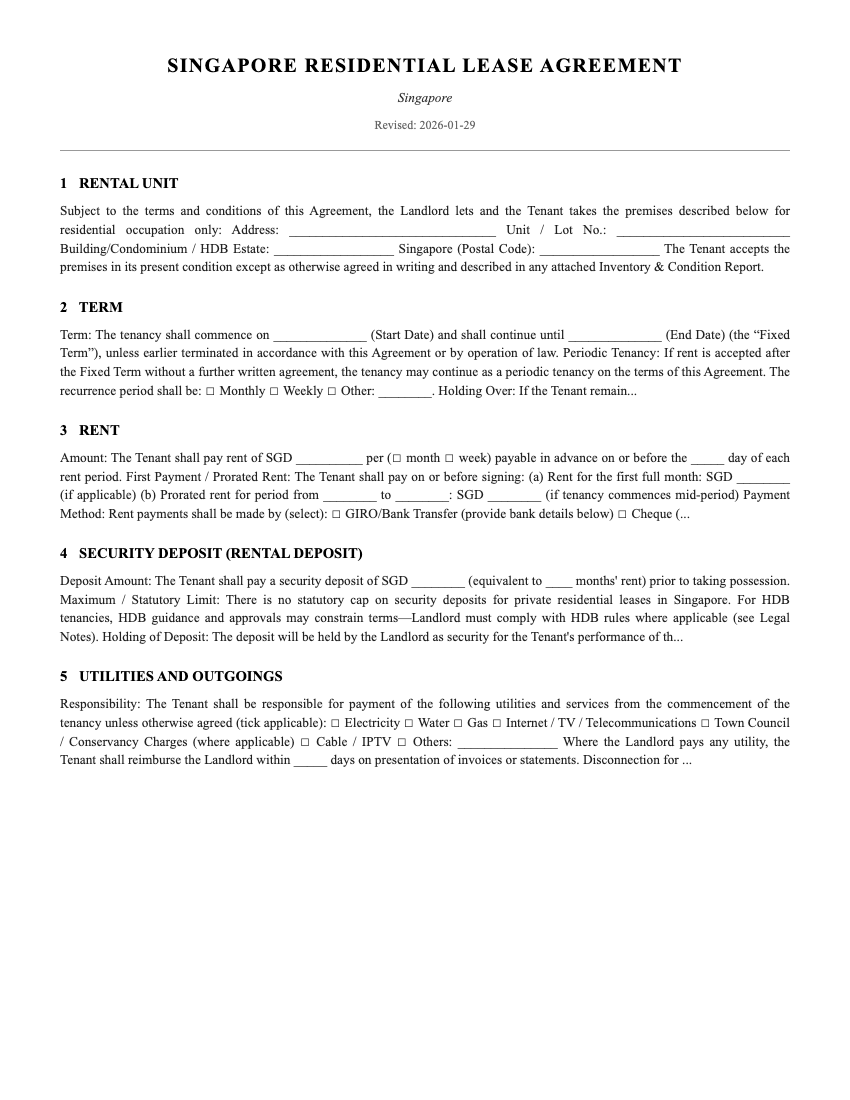
Why Old Templates Are Dangerous (Singapore traps to avoid)
- Stamp duty omissions: IRAS requires certain tenancy instruments and agreements to be stamped. An unstamped lease may affect admissibility of certain evidence and can attract penalties. Always check IRAS guidance and stamp the document promptly. (See IRAS stamp duty guidance below.)
- Missing PDPA consent: Collecting tenant personal data (identity, contact, guarantor details) without PDPA-compliant notice and consent can attract regulatory attention and penalties from the Personal Data Protection Commission (PDPC).
- Ignoring HDB rules: Subletting an HDB flat without HDB approval breaches statutory rules and can result in fines, revocation of tenancy approval, or other sanctions. Old private‑tenancy templates that don't include the HDB approval condition are risky for HDB landlords and tenants.
- Strata by‑laws and management rules: Condominium MCST by‑laws frequently restrict short‑term letting (e.g., minimum lease durations) or require registration/permit. A generic lease that ignores MCST rules can put the landlord in breach of strata by‑laws and expose them to fines.
- Inadequate deposit clauses: Because there is no statutory cap for private leases, the market custom (1–2 months for private, HDB-specific practice for public flats) should be spelled out with an itemised return procedure and a deadline (we recommend 14 days) to avoid disputes.
- Self-help eviction language: Singapore law requires court process for possession; any clause encouraging "self-help" (changing locks, removing belongings without a court order) is unlawful and dangerous for landlords.
What's Included in This Template
- Parties & premises: Clear identification of landlord and tenant (name, NRIC/FIN/Passport), and full address of the property.
- Term: Fixed-term and periodic tenancy clauses with options to renew/terminate and automatic holdover terms.
- Rent and payment terms: Rent amount, due date, permitted payment methods, late fees (commercially reasonable), utilities allocation.
- Security deposit: Recommended market default wording (1–2 months' rent for private properties), permitted deductions, itemisation requirement, recommended return timeframe (contractual: within 14 days with itemised statement) and Limitation Act reference for recovery time bar.
- PDPA clause: Notice and consent for collection, use and disclosure of tenant personal data, retained for tenancy purposes only, and deletion/return procedures on termination.
- HDB / strata disclosure triggers: Special conditional clauses for HDB approval and compliance with MCST by‑laws/house rules.
- Stamp duty clause: Notice that the lease may attract stamp duty and that parties must ensure stamping with IRAS; allocation of responsibility for paying and evidencing stamping.
- Repairs & maintenance: Landlord/tenant repair obligations, reporting timeline, and authority for emergency repairs.
- Inventory & condition report: Handover checklist and photographs to limit disputes on deposit deductions.
- Notices & service: Agreed methods of giving notices (registered post, email if consented, in‑person), and specific notice periods for breaches and termination.
- Termination & possession: Permitted grounds for termination, notice to remedy periods (recommended 7–14 days for remediable breaches), and confirmation that possession must be obtained through court process.
- Subletting & guests: Express rules for subletting and long‑term guests; for HDB flats include conditional subletting subject to HDB approval.
- Dispute resolution: Option for mediation/negotiation and recourse to the courts, and jurisdiction (Singapore courts).
- Miscellaneous: No waiver clause, severability, stamp duty cooperation, and governing law (Singapore).
Related Lease Agreement Templates
Download Options
- PDF (print-ready): /downloads/singapore-lease-agreement-2026.pdf — recommended for signing and stamping.
- Editable Word version (DOCX): Available on request for customization.
- Checklist & Handover Inventory (XLSX): Template for move-in/move-out condition report.
Each download package includes a short "What to do after signing" checklist to help with stamping, PDPA record-keeping, and (if relevant) HDB approval applications.
How to Finalize Your Lease
- Customize the template to reflect the agreed rent, term, and deposit. Keep language clear and consistent about dates and notice periods.
- Complete the inventory and take dated photographs at handover; attach the inventory as a schedule to the lease.
- Both parties should sign/execute the lease. Keep original signed copies; each party should retain at least one original executed copy.
- Stamp the lease with IRAS where applicable; check IRAS guidance for the deadline and penalties. Retain the stamped document as evidence.
- If the property is an HDB flat, apply for HDB approval for subletting (if required) before allowing occupation.
- Run the executed lease through an AI contract review tool for an automated verification of clause consistency, missing disclosures, and suggested improvements.
Final note on enforcement
Possession and deposit recovery issues are civil matters: landlords normally must apply to the courts for possession (landlord and tenant actions at the State Courts or High Court depending on claim value), and tenants may sue for wrongful withholding of deposits. The Limitation Act (contract claims are typically subject to a six‑year limitation period) and usual rules of evidence apply, so preserve all documents, bank transfers and correspondence.
<div class="ml-embedded" data-form="bBZ9zR"></div>
Frequently Asked Questions

About Designer Content
Designer Content creates practical legal document resources for landlords, contractors, and small business owners. We simplify complex legal concepts into actionable guidance. Connect with us on LinkedIn.