
Introduction
If you're leasing residential property in South Korea, it's essential that your contract reflects both general contract law under the Civil Act and tenant protections under the Housing Lease Protection Act. Mistakes in deposit handling, failure to provide required disclosures, or omission of registration steps (obtaining a certified date and filing a move-in registration) can cost landlords and tenants time and money — and can affect the priority of a tenant's security deposit.
This article explains what a South Korea residential lease must contain, why older or foreign templates are risky, and how to finalize a robust lease that complies with local law. Use the downloadable 2026-compliant lease template and run a final check with an AI contract review tool for contract analysis and verification.
For a comprehensive lease review checklist covering residential and commercial terms, see our Lease Agreement Review Guide.
Definition — What is a South Korea residential lease?
A residential lease in South Korea is a contract governed by the Civil Act in which the lessor grants the lessee exclusive use of residential premises for habitation in exchange for rent or a security deposit. The Housing Lease Protection Act provides special protections for residential tenants, including mechanisms for deposit priority (when the lease is registered or protected by a confirmed date and move-in registration), statutory remedies, and certain disclosure requirements.
Why Old Templates Are Dangerous (South Korea-specific traps)
- Deposit priority mistakes: A tenant's priority over other creditors for the security deposit often depends on obtaining a confirmed date (date certification) and completing move-in registration (move-in notification) or other registration steps. Older templates that don't instruct parties on these steps leave tenants unprotected.
- Missing required disclosures: The Housing Lease Protection Act and related practice expect disclosure of existing registered rights and encumbrances. Failure to disclose mortgages or lease registrations may expose landlords to claims.
- Personal data non-compliance: The Personal Information Protection Act requires that landlords provide a personal information processing notice when collecting tenant information. Old forms may lack a compliant notice or lawful basis for processing.
- Eviction procedure errors: Eviction and recovery of possession require judicial remedies under the Civil Procedure Act and Civil Execution Act. Templates that imply self-help eviction (changing locks, removing belongings) can expose landlords to criminal and civil liability.
- International/translated forms: Foreign templates may presume rent-control or deposit-interest rules that do not exist in South Korea (there is no nationwide rent-control regime or statutory deposit interest requirement). Using those forms can create unenforceable or misleading clauses.
- No itemization clause: South Korean practice requires that landlords provide an itemized accounting for deductions from deposits. Templates without an explicit itemization and return deadline increase dispute risk.
What's Included in This Template
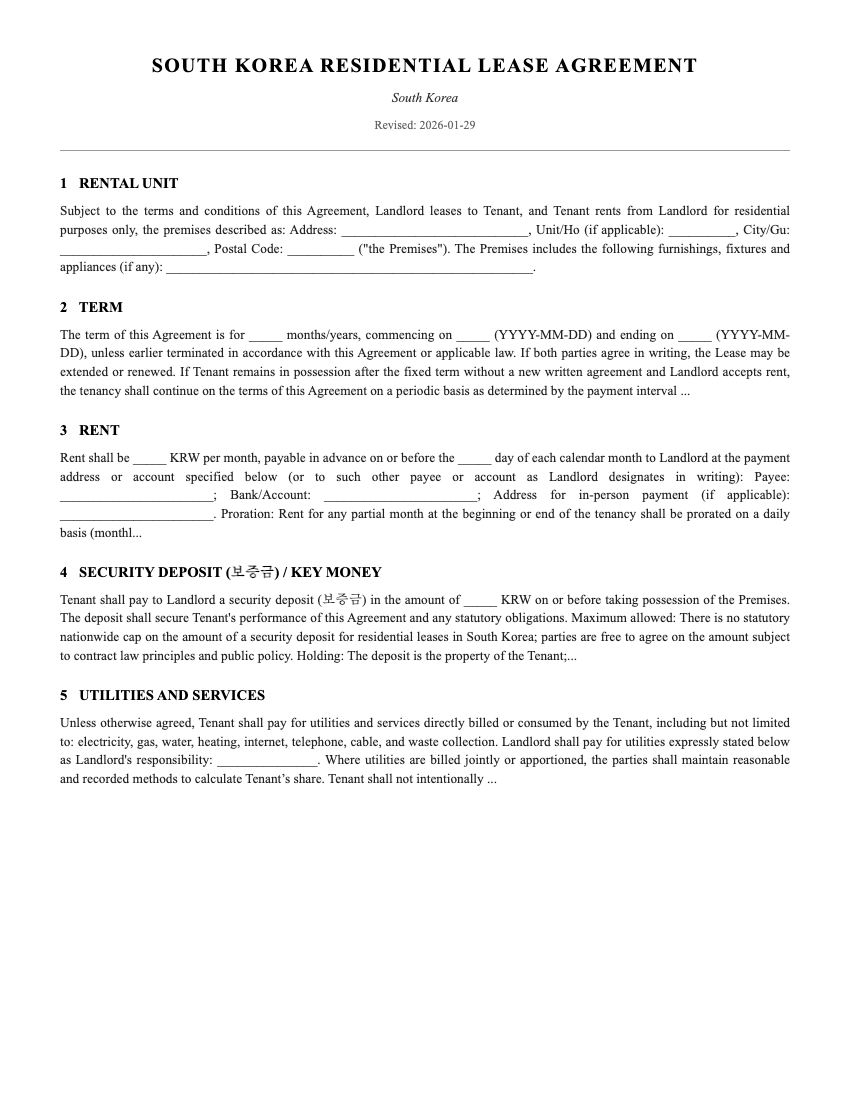
- Parties and property identification (Korean address, building registration number where available)
- Lease term (fixed-term or periodic), start and end dates
- Rent and deposit terms (security deposit), payment schedule, and permitted method(s)
- Itemized deposit deduction and return procedure, timing, and requirement to provide an itemized statement
- Required disclosures: existing registered rights/encumbrances, personal information processing notice, and known environmental/health hazards
- Utilities and maintenance responsibilities
- Use and guest/subletting provisions
- Early termination, cure periods, and remedies for breach (including judicial procedures for eviction)
- Lease registration guidance — steps for obtaining a certified date and making a move‑in registration, and recommendation to secure priority of deposit
Purpose
- To help secure priority for the tenant’s deposit in the event of the landlord’s bankruptcy or enforcement actions, obtain a certified date on the lease and complete move‑in registration as promptly as possible.
Step A — Obtain a certified date (date certification)
1. Why: A certified date on the written lease records the date of the agreement; it is a key element for establishing the tenant’s priority over competing claims.
2. Where to apply: the local community service center (eup/myeon/dong office) or other municipal office that issues certified dates; some localities also offer online issuance through official government portals.
3. Documents to bring:
- The original signed lease agreement (signed by landlord and tenant)
- Tenant’s ID (resident registration card, passport, etc.)
- Power of attorney, if applying on behalf of the tenant
- Any required fees
4. Procedure: submit the lease and ID at the counter (or online), pay the fee, and receive the lease stamped or otherwise marked with the certified date. Keep the original certified document and copies.
Step B — Make move‑in registration (resident move‑in report)
1. Why: Registering your residence at the leased address supports the tenant’s claim to occupancy and is required, together with a certified date, to strengthen priority for the deposit.
2. Where to apply: the local community service center (eup/myeon/dong office) of the address where you are moving in; many municipalities also allow online filing via Government24 or equivalent e‑services.
3. Documents to bring:
- Tenant’s ID
- Lease agreement (original or copy showing the certified date)
- Completed move‑in report form (provided at the office or online)
4. Procedure: submit the form and documents; the office will update resident registration records and issue confirmation of the move‑in registration. Retain the confirmation.
Recommended order and timing
- Obtain the certified date first, then complete move‑in registration immediately after occupying the property. Doing both promptly maximizes legal protection for the deposit.
Additional recommendations to further secure deposit priority
- Keep originals and multiple copies of the lease, certified date stamping, and move‑in confirmation.
- Consider applying for an order to register the leasehold (application for an order to register leasehold) at the court or arranging formal registration of leasehold rights at the Real Estate Registry where available; these measures can provide stronger protection against third‑party claims.
- If there is any doubt about priority or unusual circumstances (e.g., existing mortgages, the landlord’s financial difficulties), consult a lawyer or qualified real estate professional promptly.
Practical tips
- Request that the landlord sign and date the lease in ink and supply full contact details.
- If applying on behalf of the tenant, prepare a notarized power of attorney if required.
- Make time‑stamped copies and consider registered mail or other methods that create verifiable evidence of dates and delivery.
Keep all documents and confirmations safe; they are essential if you need to assert priority of the deposit later. - Confidentiality and personal data-processing clauses compliant with 개인정보보호법
- Signature blocks and witness/notarization recommendations where helpful
Related Lease Agreement Templates
Download Options
- Single PDF (Korean language): [Download](
<div class="ml-embedded" data-form="bBZ9zR"></div>
Frequently Asked Questions

About Designer Content
Designer Content creates practical legal document resources for landlords, contractors, and small business owners. We simplify complex legal concepts into actionable guidance. Connect with us on LinkedIn.