
Introduction
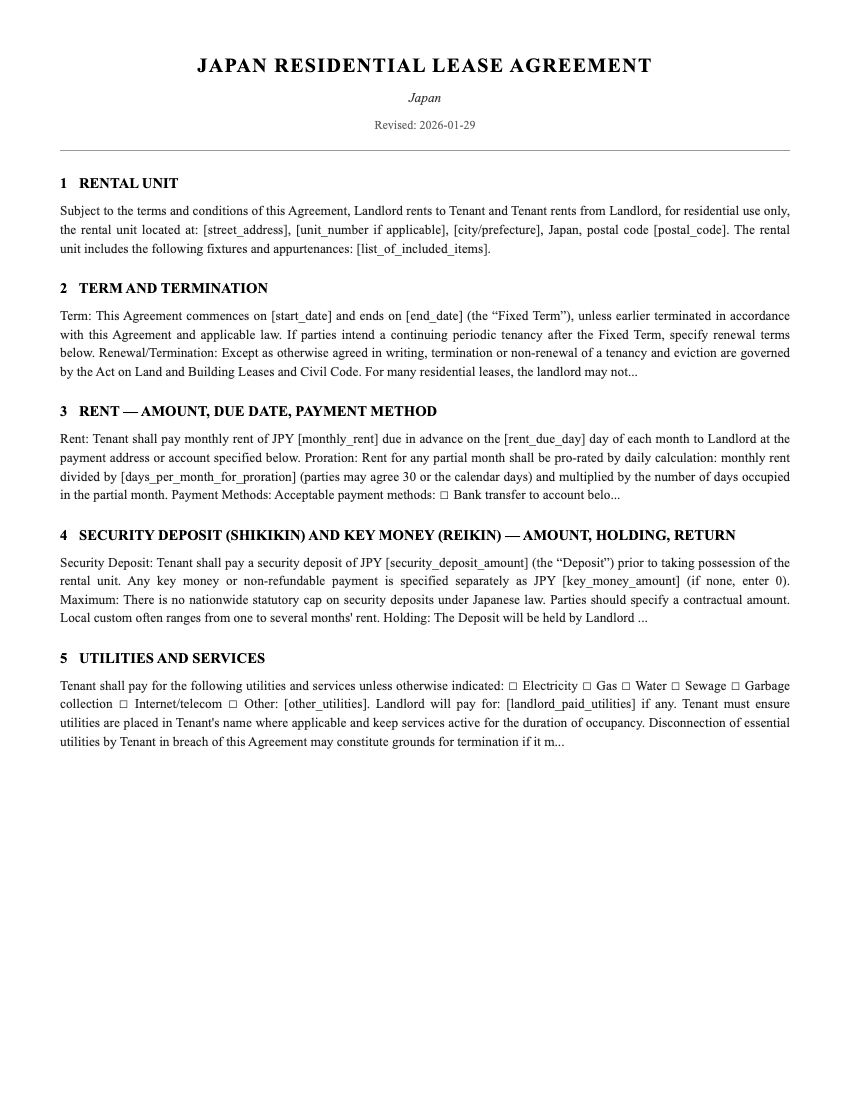
When creating a legally effective lease agreement in Japan, simply copying a template carries risks. This template is based on 民法(民法第601–642条) and 借地借家法(借地借家法), and reflects Japan-specific rules such as handling of security deposits (shikikin), "just cause" for contract renewal and refusal to renew, and tenant personal information protection (個人情報の保護に関する法律=APPI). In particular, for residential rentals tenant protection under 借地借家法(借地借家法) is strong, and refusing renewal without clear grounds or unlawfully deducting from the security deposit can leave the landlord at a disadvantage in court.
This template aims to:
- Cover the main items the parties (landlord and tenant) should agree on
- Clarify in the contract the method, deadline, and itemized statement for returning the security deposit
- Present renewal and surrender clauses mindful of the Act on Land and Building Leases (借地借家法)
- Include disclosures on personal information handling in line with APPI
Definition (What a residential lease in Japan means)
A residential lease in Japan refers to a contract where, in exchange for rent, the landlord permits the tenant to use and enjoy a building for residential purposes. The general legal basis is the lease provisions of the Civil Code (民法第601–642条) and, for residential buildings, the special protections under the Act on Land and Building Leases (借地借家法) (such as restrictions on eviction and renewal).
Why old templates are dangerous (Japan-specific traps)
- Incorrect wording on refusal to renew / surrender
The Act on Land and Building Leases grants strong protection to residential tenants, and courts scrutinize whether "justifiable grounds" exist when a landlord refuses renewal. Simply writing "no renewal" is insufficient.
- Deficiencies in handling of security deposits
Japan does not set a statutory cap on security deposits, but failing to specify the reasons for deductions and not providing an itemized statement can result in claims for restitution of unjust enrichment or damages. The contract should specify the return deadline (this template recommends 30 days after vacating) and require presentation of an itemized statement.
- Missing personal information (APPI) provisions
If tenant personal information is provided to brokers or guarantor companies, the purposes of use must be disclosed and the data must be managed appropriately under the Act on the Protection of Personal Information = APPI. Failure to disclose may result in administrative guidance or claims for damages.
- Ignoring minpaku / use restrictions
If the property is used for short-term rentals or minpaku, confirm compliance with the Residential Lodging Business Act (Minpaku Law) and local ordinances. Violations can result in administrative action or penalties.
- Inconsistencies in brokerage fees and important property explanations
Errors in the handling of important property explanations and fees under the Real Estate Brokerage Act can lead to administrative penalties or contract rescission.
Key items included in this template
- Parties (landlord and tenant) information and emergency contacts
- Property identification (address, layout, equipment list)
- Contract term (fixed-term lease or ordinary tenancy) and renewal rules (taking the Act on Land and Building Leases into account)
- Rent, payment method, payment due date, and default interest rate
- Security deposit (amount), key money (if set), and settlement method (itemized statement, return deadline: 30 days after vacating)
- Guarantor (guarantee company) clauses and scope of joint and several guarantee
- Restoration to original condition, treatment of ordinary wear and tear, and standards for calculating damages
- Repair obligations (landlord’s repair duties, tenant’s minor repairs, etc.)
- Prohibited acts (subletting, change of use, pets, noise, etc.) and remedies for breaches
- Entry, inspection, and emergency procedures and notice requirements (with APPI considerations)
- Move-out procedures, surrender, security deposit settlement, and walkthrough process
- Disclosure of and consent to personal information handling in accordance with APPI
- Disclosures required for natural disasters, defects, termites/pests (as necessary)
- Representations regarding compliance with fire regulations, building standards, the Act on Private Lodging Business (Minpaku Act), etc.
- Dispute resolution clause (negotiation → litigation and jurisdiction) and notes on enforcement
- Signature blocks (landlord, tenant, guarantor, intermediary)
Download options
- PDF (non-editable): /downloads/japan-lease-agreement-2026.pdf
- Word (.docx) editable: /downloads/japan-lease-agreement-2026.docx
- AI Contract Review Tool upload for review: https://app.pact.ai/upload (Upload to AI Contract Review Tool for a legal risk check)
How to finalize a lease agreement (key points)
- Identify and verify the parties (tenant ID, immigration status, etc., as required)
- Create a property condition report (photos recommended)
- Disclose the purposes for using personal information and obtain consent (APPI compliant)
- State in the contract the security deposit return method, deadline, and settlement criteria
- 1. Renewal
- Unless otherwise agreed in writing, this Agreement shall be renewed for successive periods of [one (1) year] on the same terms and conditions only upon mutual written agreement of the Parties executed at least thirty (30) days prior to the expiration of the then-current Term.
- If automatic renewal is agreed, this Agreement shall be automatically extended for successive periods of [one (1) year] unless either Party delivers written notice of non-renewal to the other Party at least sixty (60) days prior to the then-current Term expiration.
2. Refusal of Renewal; Procedure
- If a Party intends to refuse renewal, it shall give written notice of non-renewal to the other Party in accordance with the notice provisions of this Agreement. Such notice shall be given at least sixty (60) days prior to the expiration of the then-current Term, and, where applicable, shall specify the grounds for refusal.
- Where the refusal of renewal is based on justifiable grounds (正当事由), the notifying Party shall describe the specific facts and provide supporting evidence. If the justifiable grounds are curable, the receiving Party shall have thirty (30) days from receipt of the notice to cure the identified breach or deficiency. If the receiving Party timely and satisfactorily cures the breach within such cure period, the notifying Party shall withdraw the notice of non-renewal and the Parties shall proceed with renewal in accordance with Section 1.
- If the justifiable grounds are non-curable (for example, bankruptcy or revocation of a required license), no cure period shall be required and the notice of non-renewal shall take effect as provided in this Agreement.
- Upon the effective date of non-renewal, the Parties shall: (a) settle all outstanding obligations accrued through the effective date; (b) return or destroy confidential information and materials as required by this Agreement; and (c) comply with any transition obligations set forth herein.
3. Examples of justifiable grounds (正当事由) (non-exhaustive)
- Material breach of the Agreement that remains uncured after written notice and the applicable cure period (e.g., repeated failure to provide contracted services, systemic quality defects).
- Repeated minor breaches of contractual obligations after prior written warnings and opportunity to cure.
- Failure to pay fees, charges or other amounts due under this Agreement within the agreed payment terms, or repeated late payments.
- Insolvency, commencement of bankruptcy, reorganization or similar insolvency proceeding by or against a Party, or appointment of a receiver over a Party’s assets.
- Revocation, suspension or failure to obtain or maintain any license, permit or authorization required by applicable law or regulation for performance under this Agreement.
- Conviction of, or plea of nolo contendere to, a crime by a Party or an individual responsible for performance under this Agreement that materially impairs or is reasonably likely to materially impair the performing Party’s ability to perform or that materially damages the other Party’s reputation.
- Assignment or change in control of a Party without the other Party’s prior written consent where such assignment or change materially affects performance or commercial expectations under the Agreement.
- Repeated or willful violations of applicable laws, regulations or industry standards that materially affect performance or create regulatory risk.
- Serious damage to the other Party’s business, brand or goodwill caused by the performing Party’s conduct.
- Prolonged force majeure event that renders performance impossible or commercially impracticable for a period of [ninety (90) days] or more.
4. Miscellaneous
- The Parties agree that the above examples are illustrative and not exhaustive. Whether particular facts constitute justifiable grounds shall be determined in accordance with this Agreement and applicable law.
- Any dispute arising from a refusal of renewal or the characterization of justifiable grounds shall be resolved in accordance with the Dispute Resolution provisions of this Agreement. - Run the final version through an AI contract review tool and, if necessary, have it reviewed by a Japanese lawyer.
Note: Fixed-term lease agreement (fixed-term tenancy)
Under the Act on Land and House Leases (借地借家法), entering into a fixed-term lease agreement (定期借家契約) is subject to special requirements. Accordingly, the contract should expressly state that it is a fixed-term lease (定期借家), set out the procedures for surrender upon expiration, and specify whether renewal is permitted. Because fixed-term leases generally do not renew, procedural mistakes can lead to disputes in court.
Related Lease Agreement Templates
FAQ (Frequently Asked Questions)
(Also described in the FAQ section below)
<div class="ml-embedded" data-form="bBZ9zR"></div>
Frequently Asked Questions

About Designer Content
Designer Content creates practical legal document resources for landlords, contractors, and small business owners. We simplify complex legal concepts into actionable guidance. Connect with us on LinkedIn.