
Louisiana Residential Lease Agreement — Why compliance matters
A lease that is legally enforceable in Louisiana must account for the state's civil‑law rules, applicable statutes, and federal disclosure requirements. Leases are principally governed by the Louisiana Civil Code and supplemented by procedural rules when a landlord seeks possession. Common pitfalls include incorrectly applying common-law concepts from other states, mishandling security deposits, failing to provide federal lead‑paint disclosures for pre‑1978 housing, and not following the Louisiana Code of Civil Procedure when pursuing eviction (possession).
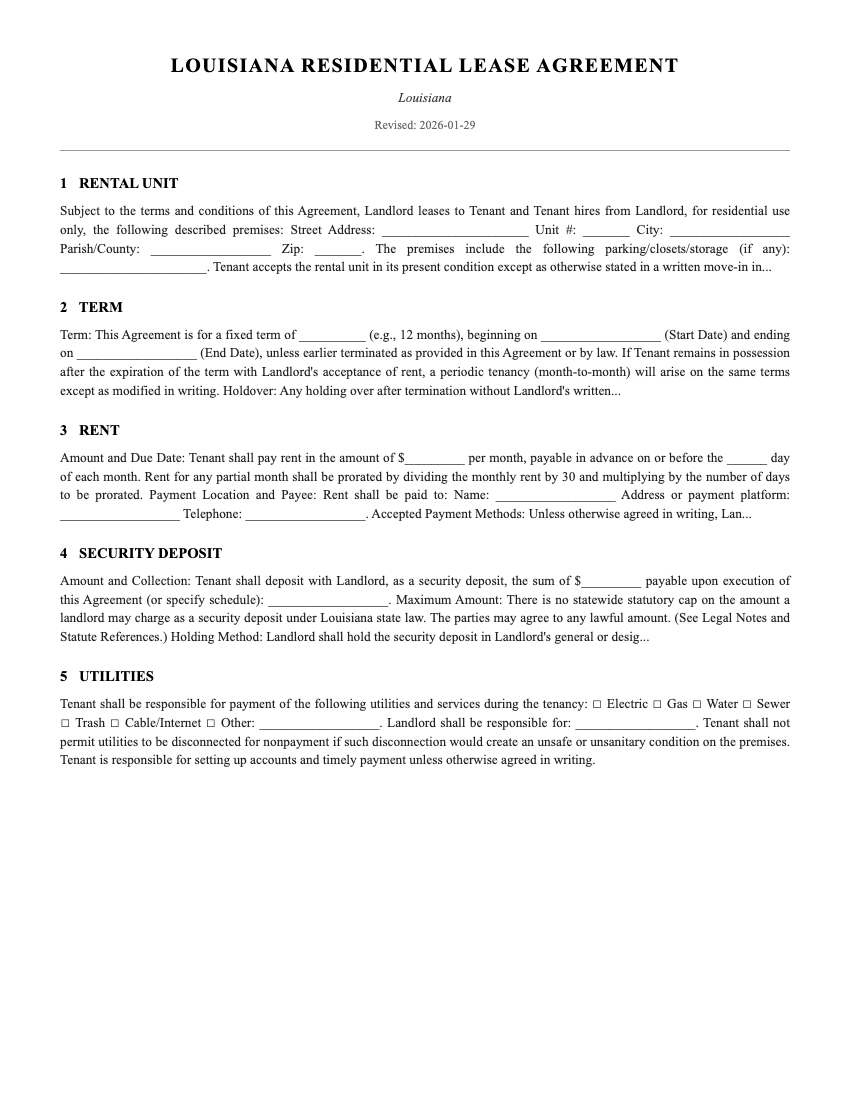
This template is drafted to reflect Louisiana's framework (La. Civ. Code art. 2668 et seq.; La. Civ. Code art. 3499 on prescription) and incorporates recommended clauses for deposit handling, termination notice periods, remedies, and standard disclosures. Use the template as a starting point and finalize with an AI contract review tool or an attorney to ensure it fits your property, city/parish rules, and facts.
For a comprehensive lease review checklist covering residential and commercial terms, see our Lease Agreement Review Guide.
What is a Louisiana residential lease?
A Louisiana residential lease is a consensual contract between landlord and tenant that grants possession of dwelling space for a stated term in exchange for rent. Leases in Louisiana are governed by the Louisiana Civil Code (lease provisions) and related statutes and rules; they may be subject to local parish or municipal ordinances for registration, safety devices, or floodplain notices. (See La. Civ. Code art. 2668 et seq.; La. Civ. Code art. 3499.)
Why old templates are dangerous (Louisiana-specific pitfalls)
- Misapplied common‑law terminology: Louisiana follows a civil‑law code. Templates written for common‑law states may use language or remedies that don't align with La. Civ. Code concepts (e.g., misconstruing contractual prescription or obligations).
- Security deposit misunderstandings: Louisiana has no statewide cap on deposits. Old forms that state a statutory cap or require interest may be wrong for most Louisiana parishes; conversely, some municipalities may add requirements that an older statewide form will miss.
- Eviction/possession errors: Louisiana uses a summary possession procedure under the Louisiana Code of Civil Procedure. Using an out‑of‑state form can lead to incorrect cure periods, improper notice requirements, or procedural errors that delay possession actions.
- Missing federal/state disclosures: Older templates may omit the federal Lead‑Based Paint Disclosure (42 U.S.C. § 4852d; 24 C.F.R. pt. 35) or not reference publicly available sex‑offender registry notices required for tenant awareness.
- Local ordinance omissions: Parish or city rules can require local registration, smoke/CO alarm standards, or floodplain advisories. An old generic template may not prompt you to check or include these local requirements.
What's included in this template
- Parties, premises description, and lease term (fixed‑term and periodic options)
- Rent amount, due date, permitted payment methods, late fees, and returned check handling
- Security deposit clause with itemization requirement and recommended return timing (commonly within 30 days unless local law requires otherwise)
- Utilities, maintenance, and repair obligations (including tenant notice requirements for defects)
- Habitability and landlord's repair obligations consistent with La. Civ. Code obligations
- Use and occupancy restrictions (occupants, pets, guest limits)
- Entry by landlord and notice expectations
- Default, cure periods, termination rights, and remedies (including reference to Louisiana summary possession procedures)
- Required disclosures: Lead‑Based Paint (federal), sex‑offender registry notice, flood hazard advisory
- Optional addenda: parking/stored vehicle rules, pet addendum, lead‑paint addendum, local parish/city addendum
- Signature blocks and witness/notary placeholders when desired
Related Lease Agreement Templates
Download Options
- Single‑unit lease (PDF): /downloads/louisiana-lease-agreement-2026.pdf
- Fillable Word version (editable): Available on request or via download page
- Addenda pack: Pet addendum, parking addendum, move‑in checklist, move‑out condition form
Tip: Download the PDF, complete all blanks, and then upload the signed copy to an AI contract review tool for contract analysis before final signatures.
How to Finalize Your Lease
- Customize: Fill the template with accurate property and party details. Insert any agreed special terms (e.g., rent concession, early termination fee).
- Local check: Verify parish/city requirements (registration, alarm standards, flood disclosures). Add any local addenda required by the municipality.
- Disclosures: Attach and deliver the federal Lead‑Based Paint Disclosure for pre‑1978 housing and provide sex‑offender registry and flood hazard advisory notices where applicable.
- Security deposit handling: State the deposit amount, how it will be held, the deadline and process for return, and provide an itemization requirement for deductions.
- Signatures: Execute the lease with all adult tenants and the landlord or authorized manager. Keep a copy for each party.
- an AI contract review tool review: Upload the final executed lease to an AI contract review tool for an automated safety check and risk report. Consider attorney review for any flagged issues.
Sample clauses to watch (examples in the template)
- Deposit: "Landlord will hold the security deposit in a separate account. Landlord shall return the deposit or provide an itemized statement of lawful deductions and payment of the balance within 30 days after Tenant vacates and returns possession, unless a local ordinance requires a different period." (No statewide statutory cap; parties may contractually set amount.)
- Cure period: "For non‑monetary breaches, Tenant shall have ___ days after written notice to cure, unless the breach is incurable or a threat to safety, in which event Landlord may proceed with termination and possession under La. Code Civ. Proc. rules." (Customize cure days — commonly 5–10 days for nonpayment cure periods.)
- Possession: "If Tenant fails to vacate after termination, Landlord may seek possession through the Louisiana rule for possession process under the Louisiana Code of Civil Procedure." (See La. Code Civ. Proc. arts. 4701 et seq.)
When to consult an attorney
- Complex tenant history or alleged habitability defects
- Large security deposits or disputes about interest/local escrow rules
- Tenant served with eviction or landlord confronted with holdover issues
- Properties subject to public housing, subsidy programs, or unique local ordinances
For final verification, upload your completed lease into an AI contract review tool to flag legal and drafting risks, then follow up with a Louisiana‑licensed attorney for high‑risk matters.
<div class="ml-embedded" data-form="bBZ9zR"></div>
Frequently Asked Questions

About Designer Content
Designer Content creates practical legal document resources for landlords, contractors, and small business owners. We simplify complex legal concepts into actionable guidance. Connect with us on LinkedIn.