
A Master Services Agreement (MSA) in France is a master services framework agreement that establishes the legal framework for all your future engagements—covering price, liability, intellectual property, data, disputes—without renegotiating for each project. For SMEs, freelancers, and consulting firms, it serves as a “foundation,” and each engagement is described in a Statement of Work (SOW) or purchase order. In France, a good MSA must also incorporate mandatory rules on payment terms, contractual liability, and data protection.
Definition: A French MSA (often called a contrat-cadre de prestations de services) is a written agreement between a Service Provider and a Client that governs the commercial relationship over time. It defines the general terms and conditions (scope, obligations, invoicing, late payment penalties, confidentiality, data processing, intellectual property, limitation of liability, termination, governing law). The specific services are then detailed in SOWs (appendices) stating deliverables, timeline, and price. The MSA avoids rewriting the contract for each engagement and secures compliance with the Code civil, the Code de commerce and the RGPD.
Why You Cannot Use a Generic MSA in France
A generic template (often inspired by Anglo-Saxon law) can create real risks in France, because certain topics are governed by public policy rules, and because French contracting practice does not always use the same concepts (e.g., “work made for hire”). Three points are particularly sensitive for small businesses and independents: reclassification as an employment contract, the enforceability of non-compete clauses, and the assignment of intellectual property.
3a. Worker Classification Rules
In France, the question is not an “ABC test,” but legal subordination. A service provider can be reclassified as an employee if, in reality, they work under the client’s authority (instructions, control, sanctions): this is the criterion of the relationship of subordination long adopted by the Cour de cassation (key reference: Cass. soc., 13 nov. 1996, Société Générale). The structuring provisions include in particular the Code du travail, article L.8221-6 (presumption of non-employee status for certain registered persons) and article L.8221-5 (concealed work), which governs situations where a relationship is artificially disguised as a service arrangement.
For a comprehensive guide to structuring MSAs and SOWs that protect your business, see our Freelancer Contracts Guide.
A generic MSA can increase the risk if it imposes working hours, overly intrusive reporting, total exclusivity, or if it describes the service provider as integrated into the client’s internal organization. In the event of reclassification, the consequences can be severe: back pay and paid leave, social security contributions, and potentially sanctions related to concealed work depending on the circumstances. Your French MSA must therefore clearly frame independence (free organization, no default exclusivity, appropriate obligations of result/means) and refer operational details to the SOW, without reproducing employee management mechanisms.
3b. Non-Compete Enforceability
Unlike certain jurisdictions where non-competes are prohibited, a clause de non-concurrence can be valid in France in B2B, but it is strictly controlled: it must be justified by the protection of a legitimate interest, proportionate (duration, geographic area, prohibited activities) and must not excessively prevent professional activity. In practice, courts strike down overly broad clauses in the name of the principle of freedom of trade and industry and the control of undertakings. The Code civil also provides tools: article 1102 enshrines freedom of contract, but it does not allow imposing unbalanced obligations contrary to public policy; and article 1171 (adhesion contracts) allows setting aside a clause creating a significant imbalance in certain contexts.
An Anglo-Saxon template often copies a “global” non-compete (worldwide, 24 or 36 months, all activities). In France, this type of clause is fragile and may be deemed unwritten or reduced. For a French MSA, one prefers: (1) a short non-compete (e.g., 6–12 months), targeted to an identified sector/clients, and justified by access to sensitive information; (2) more robust alternatives: confidentiality, non-solicitation of clients, protection of trade secrets (consistent with the regime resulting from transposition of the directive, via the Code de commerce). The goal is to protect your portfolio and your data without abusively blocking a service provider’s activity.
3c. IP/Work-for-Hire Considerations
In France, the “work made for hire” logic is not a legal reflex. By default, the author of a work of the mind holds the rights, and an assignment must be written and specific. The Code de la propriété intellectuelle, article L.131-3 requires that the transfer of rights be mentioned separately and that the scope of exploitation be defined (duration, territory, modes of exploitation). A generic MSA that simply says “all IP belongs to Client” may therefore be insufficient. Your French MSA must provide for a clear assignment or license, ideally per deliverable in the SOW, and may condition the assignment on full payment.
What's Included in This Template
Flexible SOW Structure
The MSA serves as a contractual “umbrella”: you sign it once, then you add an SOW per engagement (scope, milestones, price, acceptance criteria). This avoids scope creep, speeds up client-side approval, and clarifies what is included or billable as additional work.
France-Specific Indemnification
Contractual liability in France is assessed around breach and harm. The template provides a limitation of liability consistent with the Code civil, article 1231-1 (compensation for harm resulting from non-performance), with standard exclusions (faute lourde/dol) and a clear allocation of risks (data provided by the client, third-party content, regulatory compliance).
Dispute Resolution and Venue
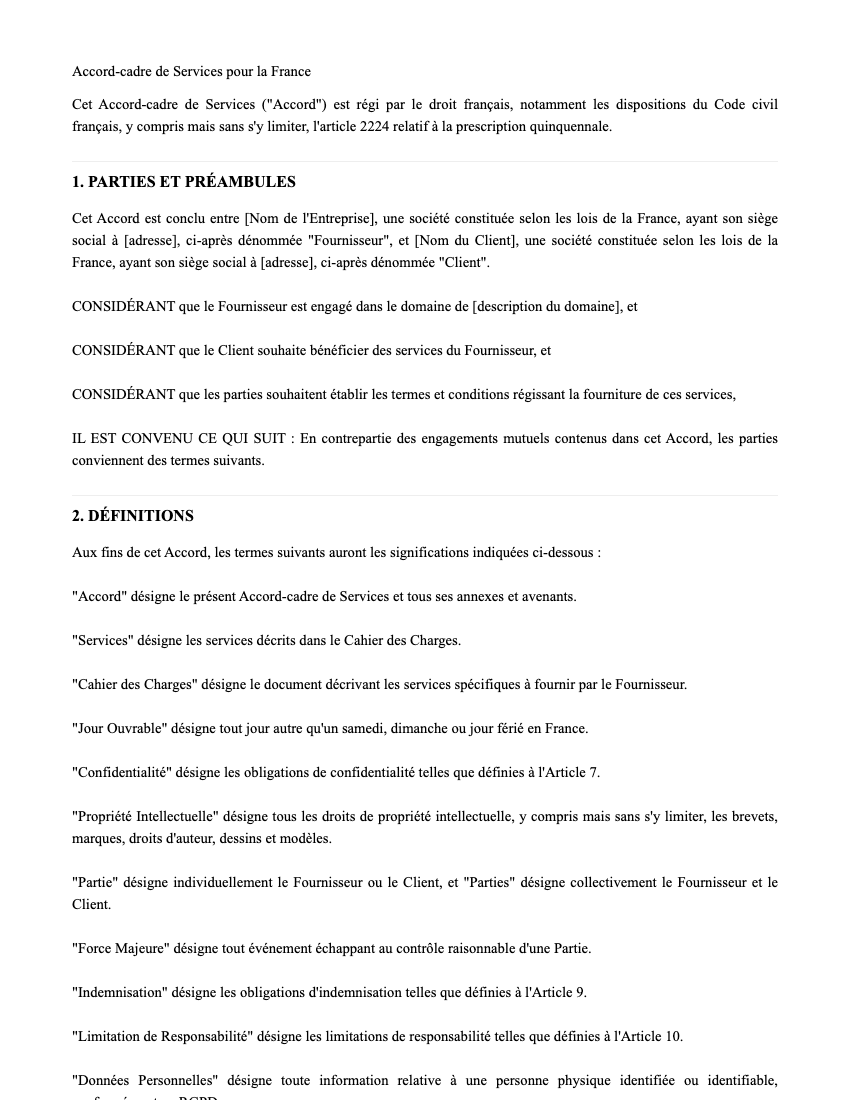
The template sets a French governing law clause and a jurisdiction clause oriented toward “Tribunaux de Paris” for B2B disputes, in order to avoid distant forums. It also recalls the ordinary law five-year limitation period (Code civil, article 2224) to secure claim management over time.
Other included provisions (with references):
- Late payment interest and fixed recovery costs indemnity: Code de commerce, article L.441-10.
- Data protection and subcontracting: RGPD (UE) 2016/679, art. 28 et s., and Loi Informatique et Libertés n° 78-17.
- Confidentiality clauses and handling of sensitive information (including trade secrets, under the Code de commerce).
- Deliverables acceptance mechanism and change management (change order in the SOW).
Who Needs This Document?
| User Type | Relationship | Key Benefit |
|---|---|---|
| Marketing/communications agencies | Recurring engagements with SMEs/mid-sized companies | Fast SOWs + anti-scope-creep framing |
| Consultants (strategy, finance, ops) | Fixed-fee or time-and-materials consulting | Invoicing, deliverables, liability clarified |
| Developers / ESN | Software projects in phases | IP framed (assignment/license) + RGPD |
| Creative freelancers (design, video) | Multi-client services | Payment, copyright, deliverables approval |
How to Use This MSA Template
Step 1: Correctly identify the parties
Provide the company name, SIREN/SIRET, address, and authorized representative. In French B2B, this information facilitates invoicing and proof.
Step 2: Set the term and termination
Choose a term (12 months) or an indefinite-term agreement with notice. Provide for termination for breach with formal notice and a cure period.
Step 3: Draft one SOW per engagement
Put the deliverables, deadlines, acceptance criteria, price, and dependencies in the SOW. Add a change clause (change order) for any out-of-scope request.
Step 4: Organize compliance (payment, data, IP)
Insert payment terms, penalties and recovery indemnity under L.441-10, and the RGPD appendices (roles, instructions, subprocessors). Define the IP assignment/license and its trigger (often upon payment).
Related MSA Templates
Get the Template
Sign up for our newsletter to receive the template.
Frequently Asked Questions

About Designer Content
Designer Content creates practical legal document resources for landlords, contractors, and small business owners. We simplify complex legal concepts into actionable guidance. Connect with us on LinkedIn.