
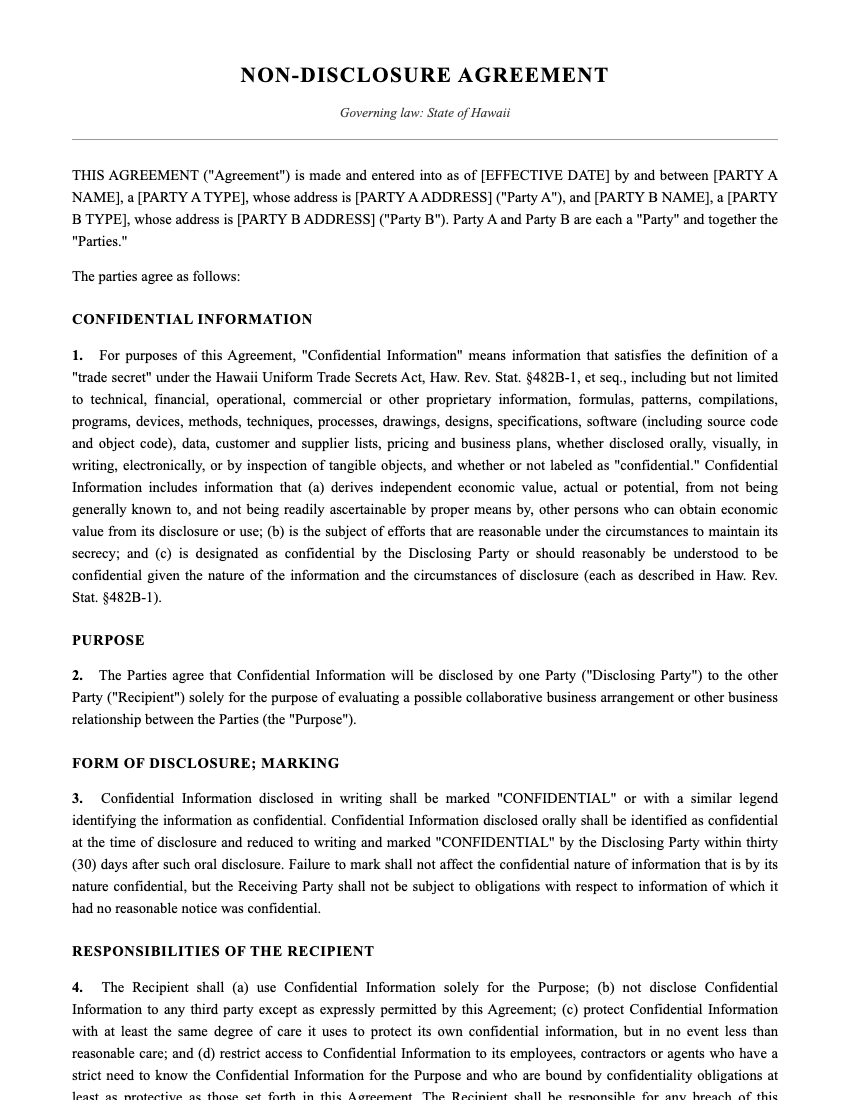
A Hawaii Non-Disclosure Agreement (NDA) is a contract designed to protect confidential business information and trade secrets in a way that fits Hawaii’s legal landscape: enforceable restrictive covenants are judged under a reasonableness standard, trade secrets are governed by state and federal law, and breach claims can be subject to a six-year written-contract statute of limitations.
What is a Hawaii NDA?
Definition: A Hawaii NDA is a legally binding agreement that limits the recipient’s use and disclosure of confidential information. Trade secret protection in Hawaii follows the state’s adoption of the Uniform Trade Secrets Act (codified in HRS chapter 482B), while federal remedies may be available under the Defend Trade Secrets Act (18 U.S.C. § 1836). The agreement should also account for Hawaii’s consumer and business protections under HRS §480-2 (unfair and deceptive acts or practices) and the six‑year statute of limitations for written contracts (HRS §657‑1).
Unlike jurisdictions that categorically ban non-competes, Hawaii enforces post‑employment restrictions if they are reasonable in scope, duration, and geography. That enforcement stance changes how you draft confidentiality, non‑solicit, and related clauses: a poorly written NDA in Hawaii can be interpreted by a court as an unreasonable restraint on trade or, conversely, as insufficient to protect trade secrets.
For a complete guide to NDA terms, duration, and standard exclusions, see our NDA Agreement Guide.
Why "Generic" NDAs Are Dangerous in Hawaii
Many off‑the‑shelf templates are written for large continental markets and assume broad geographic scope or common-law defaults. In Hawaii, three local traps appear frequently:
- Island-market “de facto” non-competes. Hawaii’s limited employer pool and geographic constraints mean broad prohibitions on using confidential information can operate as a practical ban on working in a field. Courts apply a reasonableness test; if your NDA effectively prevents the recipient from working anywhere in the state, a court may refuse to enforce it or recharacterize the provision.
- Overbroad trade-secret labels. Under HRS chapter 482B, only information that (a) derives independent economic value from not being generally known and (b) is subject to reasonable efforts to maintain secrecy qualifies as a trade secret. Labeling everything as a “trade secret” weakens your claim and risks claims under HRS §480‑2 for deceptive practices if you misrepresent protections to counterparties.
- Statute-of-limitations and remedy planning. Hawaii’s written-contract statute of limitations is six years (HRS §657‑1). That is longer than the three-year period many businesses expect. Draft your NDA to track discovery expectations, preservation obligations, and evidence retention accordingly.
Paradigm-shifting insight: Because Hawaii is an island economy, courts are especially sensitive to geographic and duration restraints that, while modest on the mainland, function as total career bars here. In practice, reasonable NDAs in Hawaii often favor narrowly tailored use restrictions and explicit non‑compete carve‑outs to avoid being treated as unlawful restraints on employment.
Real-world development
Trade secret claims in Hawaii are litigated under HRS chapter 482B and can also invoke federal DTSA remedies. When you intend to seek enhanced damages under the DTSA, include the DTSA’s whistleblower immunity notice (18 U.S.C. §1833(b)) in your NDA so you preserve the possibility of exemplary damages and attorney’s fees in federal court.
Key Clauses (what this template gives you)
- Purpose and narrow use limitations: spells out why information is shared and restricts use to that purpose only.
- Precise definitions: separates general confidential information (time‑limited) from trade secrets (protected as long as secrecy is maintained) consistent with HRS chapter 482B.
- Duration and geography: recommends short, reasonable durations (e.g., 12–24 months for non‑trade‑secret confidential info) and narrowly drawn geographic language (island‑specific where appropriate).
- Residuals clause (optional): permits unaided memory use of generalized ideas while protecting actual deliverables and trade secrets.
- Carve‑outs: publicly known info, prior knowledge, independently developed info, and compelled disclosure (with notice and limited scope).
- DTSA whistleblower clause: preserves eligibility for federal enhanced remedies by informing employees of their right to disclose to government officials.
- Choice of law and venue (Hawaii): recommends Hawaii law for agreements executed and performed in‑state, but warns against forum selection clauses that effectively eliminate statutory protections.
Who needs this document?
| User Persona | Usage Scenario | Key Hawaii Benefit |
|---|---|---|
| Local tech startups | Pitching to investors or hiring devs | Limits disclosure without creating island‑wide employment restrictions |
| Tourism & hospitality vendors | Sharing vendor standards or recipes | Protects trade secrets like proprietary formulas and guest lists under HRS 482B |
| Manufacturers on Oʻahu | Contracting overseas fabricators | Clarifies export restrictions and US federal DTSA protection |
| Small businesses selling locally | M&A due diligence | Enables secure document review within Hawaii’s small buyer pool |
How to execute a valid Hawaii NDA
- Choose the right type: One‑way if you alone disclose; mutual if both parties exchange information.
- Define the purpose specifically: Limit permitted uses to a named project or evaluation to avoid ambiguity.
- Mark your materials: Use watermarks, cover emails with “CONFIDENTIAL,” and keep records of who received what—evidence of reasonable secrecy efforts under HRS chapter 482B.
- Sign before sharing: Use a signed PDF or secure e‑signature (E‑SIGN/ UETA compliant) and confirm the date of execution—breaches relating to pre‑execution disclosures are hard to remedy.
Because Hawaii’s courts examine the real‑world impact of restrictions, tailor duration and geographic scope to be as narrow as feasible. For employment‑adjacent restrictions, aim for specificity about which activities are forbidden rather than blanket prohibitions.
Receiving an NDA from a client?
Don’t sign until you’ve vetted for: overly broad use restrictions that may function as de facto non‑competes in Hawaii’s market, missing DTSA notice (if trade secrets are involved), and unconscionable indemnity or forum‑selection clauses.
an AI contract review tool can instantly flag these Hawaii‑specific pitfalls, compare clauses against HRS 482B and HRS §480‑2, and produce negotiation notes to protect your rights.
Related NDA Templates
Get the Template
Sign up for our newsletter to receive the template.
Frequently Asked Questions

About Designer Content
Designer Content creates practical legal document resources for landlords, contractors, and small business owners. We simplify complex legal concepts into actionable guidance. Connect with us on LinkedIn.