
Free Oklahoma Residential Lease Agreement Template (2026)
A well-drafted lease reduces disputes, speeds resolution of problems, and protects both landlord and tenant rights in Oklahoma. Because Oklahoma has no statewide rent control or statutory cap on security deposits, these key terms are governed by the lease itself, while eviction proceedings and summary remedies follow the forcible entry and detainer rules in Title 12 O.S. and landlord-tenant rules in Title 41 O.S. This template includes recommended notice periods, itemized security-deposit handling, required disclosures, and sample cure/termination language designed to work with Oklahoma practice. Always confirm municipality-specific requirements (smoke/CO detectors, local registration, habitability codes) before finalizing.
What is an Oklahoma residential lease?
A residential lease in Oklahoma is a contract between a landlord and tenant governing occupancy of a dwelling. It sets rent, term, security deposit handling, maintenance obligations, required disclosures, notice periods, and remedies for breach. Key statutory guidance comes from Title 41 O.S. (Landlord and Tenant) and the forcible entry and detainer statutes in Title 12 O.S.; consumer-protection claims related to deposits may arise under the Oklahoma Consumer Protection Act (15 O.S. § 751 et seq.). Written leases bear a five-year statute of limitations under 12 O.S. § 95.
For a comprehensive lease review checklist covering residential and commercial terms, see our Lease Agreement Review Guide.
Why compliance matters
Oklahoma law leaves many practical details to the lease, which means a poorly drafted or outdated template can create exposure for both parties. Mistakes about deposit accounting, unclear notice periods, or missing federal/state disclosures can lead to contract claims, consumer-protection suits, or delays in eviction. This template is drafted with Oklahoma statutory references and commonly accepted notice practices to reduce litigation risk and make enforcement in county courts (forcible entry and detainer) smoother.
Why old templates are dangerous (Oklahoma-specific traps)
- Security deposit timing unspecified: Oklahoma does not prescribe a single statewide deadline for returning deposits. If a lease doesn’t state a return deadline and an itemized list of deductions, landlord risks contract claims and possible consumer-protection liability under 15 O.S. § 751 et seq.
- Local ordinances: Many Oklahoma cities and counties have local building, habitability, smoke/CO detector, or rental registration rules. An older statewide template may omit these local obligations and lead to fines or invalidative defenses.
- Eviction procedure mismatch: Evictions in Oklahoma proceed under forcible entry and detainer (Title 12 O.S.). Using a template that references procedural steps from other states or federal rules can mislead landlords about required notices and court filings.
- Ambiguous notice and cure periods: Oklahoma practice commonly uses short pay-or-quit notices (e.g., 3–5 days) and 30-day notices for month-to-month terminations, but these are contractual. Templates that fail to define reasonable cure periods risk being ineffective in court.
- Wrong disclosures: Federal lead-based paint and state sex-offender notices are required where applicable; omission may invalidate certain landlord defenses and expose the landlord to statutory penalties.
- Statute of limitations confusion: Written leases are subject to a five-year statute of limitations under 12 O.S. § 95 — older templates that reference different periods can lead to missed claims or incorrect advice.
What's included in this template
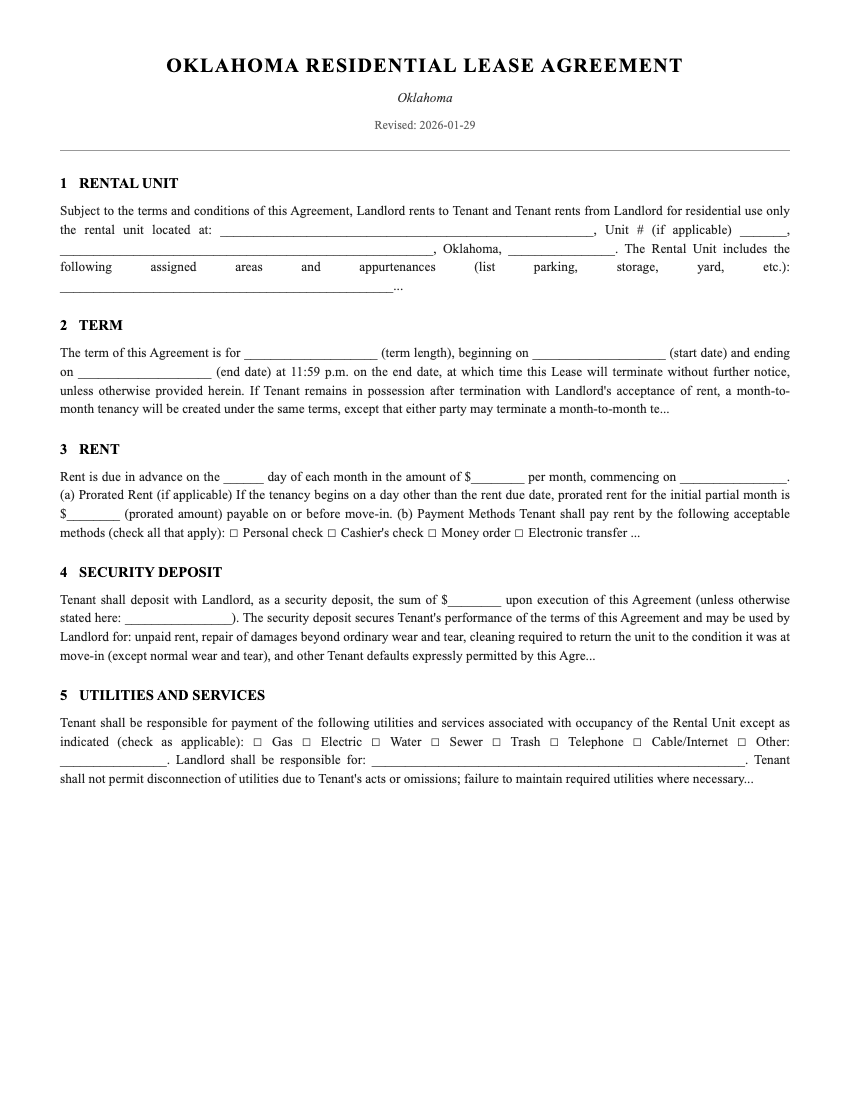
- Clear identification of parties and premises.
- Defined lease term: fixed-term and month-to-month options with sample renewal language.
- Rent amount, due date, acceptable payment methods, grace period and late-fee language (recommended to remain reasonable and contractual).
- Security deposit clause: amount (open field), itemization requirement, recommended return deadline (14–30 days), documentation requirement for deductions, and whether interest applies.
- Required disclosures: Lead-Based Paint (federally required for pre-1978 properties), Oklahoma sex-offender registry notice, and placeholders for municipal disclosures.
- Maintenance and habitability obligations, including tenant remedies for landlord noncompliance where applicable.
- Entry and inspection notice language consistent with Oklahoma practice (clear advance notice and emergency entry provisions).
- Default, cure periods and termination language tailored for Oklahoma summary eviction practice (forcible entry and detainer under Title 12 O.S.).
- Holdover and remedies, indemnity, subletting/assignment rules, and utility allocation.
- Signature blocks and witness/notary fields as recommended for added formality.
- Move-in condition checklist and sample itemized move-out accounting template.
Download options
- PDF (printer-ready): /downloads/oklahoma-lease-agreement-2026.pdf
- Editable DOCX: /downloads/oklahoma-lease-agreement-2026.docx (customize fields and local notices)
- an AI contract review tool review: Upload your finalized draft to an AI contract review tool for automated clause analysis and risk flags before signing.
How to Finalize Your Lease
- Customize the template fields: fill in rent, deposit amount, term, and any negotiated clauses.
- Add municipal disclosures: check city/county codes (smoke/CO detectors, rental registration) and add required text.
- Run the lease through an AI contract review tool for a clause-level analysis and incorporate recommended fixes.
- Execute the lease with signatures from all tenants and the landlord/agent; provide each party a signed copy.
- Conduct a move-in inspection and complete the move-in condition checklist; attach it to the lease and have both parties sign.
- Provide receipts for security deposits and keep itemized records for deductions and repairs.
Practical notes on security deposits in Oklahoma
- No statewide cap: Parties may agree on any amount. Best practice: limit deposit to a reasonable multiple of monthly rent and disclose in the lease.
- Itemization required: Lease should require an itemized list of deductions and supporting receipts or estimates. Lack of documentation makes deductions difficult to defend and creates potential liability under the Oklahoma Consumer Protection Act (15 O.S. § 751 et seq.).
- Return deadline: Because state law does not set a single deadline, specify one in the lease (commonly 14–30 days after termination and delivery of possession).
- Interest: Not required by state law unless agreed to in the lease; if agreed, specify rate and payment method.
Required disclosures (must be included where applicable)
- Lead-Based Paint Disclosure: Federal requirement for housing built before 1978 (Residential Lead-Based Paint Hazard Reduction Act / Title X; see 42 U.S.C. § 4852d et seq.). Attach the EPA/HUD lead pamphlet and signed acknowledgment.
- Sex Offender Registry Notice: Provide the state statute or link to the Oklahoma Sex Offender Registry and include the required notice language; tenants should be directed to https://sor.ok.gov/.
- Local Municipal Disclosures: Add city/county-specific disclosures such as smoke/CO detector compliance, rental registration, or short-term rental restrictions.
Common lease clauses and recommended Oklahoma language
- Nonpayment notice: Include a clear pay-or-vacate demand period (for example, a 3-day written notice) before filing for forcible entry and detainer; confirm local county clerk procedures first.
- Cure periods: Define reasonable cure periods for non-monetary breaches—customize by severity (e.g., 7–14 days for minor breaches; immediate for illegal activity).
- Month-to-month termination: Specify a 30-day written notice requirement unless the parties agree otherwise.
- Attorney's fees and costs: Oklahoma courts may enforce contractual attorney-fee provisions; include a clearly drafted fee-shifting clause but avoid unconscionable terms.
Related Lease Agreement Templates
Frequently asked questions (FAQ)
(See the FAQ section below for more detail and citations.)
<div class="ml-embedded" data-form="bBZ9zR"></div>
Frequently Asked Questions

About Designer Content
Designer Content creates practical legal document resources for landlords, contractors, and small business owners. We simplify complex legal concepts into actionable guidance. Connect with us on LinkedIn.