
Introduction
Creating a valid residential lease in Michigan means more than filling in names, dates and rent amounts. Michigan landlords and tenants must follow state landlord-tenant statutes (see MCL 554.601 et seq.), federal disclosure requirements (lead-based paint for units built before 1978 under 42 U.S.C. § 4852d and implementing regulations at 24 C.F.R. Part 35), and Michigan's summary eviction rules (MCL 600.5714 and related provisions). While Michigan does not impose statewide rent control, local ordinances and municipal rental licensing can affect terms. Using a template tailored to Michigan reduces legal risk and avoids the common pitfalls that come from generic or outdated forms.
What is a Michigan residential lease?
A Michigan residential lease is a written contract between a landlord and a tenant that sets the terms of occupancy for a dwelling located in Michigan. The lease governs rent, security deposits, maintenance and repair responsibilities, required disclosures (including federal lead-based paint notices for pre-1978 housing and Michigan sex-offender registry information), and the process for termination and eviction consistent with Michigan statutes (notably MCL 554.601 et seq. and MCL 600.5714). It may be for a fixed term or a periodic tenancy and must comply with applicable state and local law.
Why compliance matters
Noncompliant leases expose landlords to claims for statutory damages, delayed or invalid evictions, withheld remedies, and potential consumer protection claims under the Michigan Consumer Protection Act (MCL 445.901 et seq.). Tenants using an invalid or incomplete lease may lack clear remedies for repairs, security deposit disputes, or privacy violations. A Michigan-specific template helps both parties understand and allocate responsibilities consistent with state rules.
Why Old Templates Are Dangerous (Michigan-specific traps)
- Security deposit missteps: Michigan does not set a statewide maximum amount for deposits, but Michigan rules require timely return with itemized deductions. Old templates that specify incorrect return deadlines or omit the itemization requirement can cause costly disputes.
- Eviction procedure errors: Michigan evictions proceed via summary proceedings (MCL 600.5714). Using an older lease that references incorrect notice periods or flawed cure processes can result in dismissed eviction actions.
- Missing federal disclosures: Any unit built before 1978 requires the federal lead-based paint disclosure (42 U.S.C. § 4852d; 24 C.F.R. Part 35). Omitting this disclosure can trigger statutory penalties and defense to eviction in some circumstances.
- Local ordinance conflicts: Municipalities in Michigan may impose local rental licensing, inspection or deposit limits. A generic lease may violate city ordinances or fail to address required provisions for those jurisdictions.
- Consumer protection exposures: The Michigan Consumer Protection Act (MCL 445.901 et seq.) can apply to unfair or deceptive lease terms. Outdated forms sometimes include clauses interpreted as unconscionable or deceptive under Michigan law.
What's Included in This Template
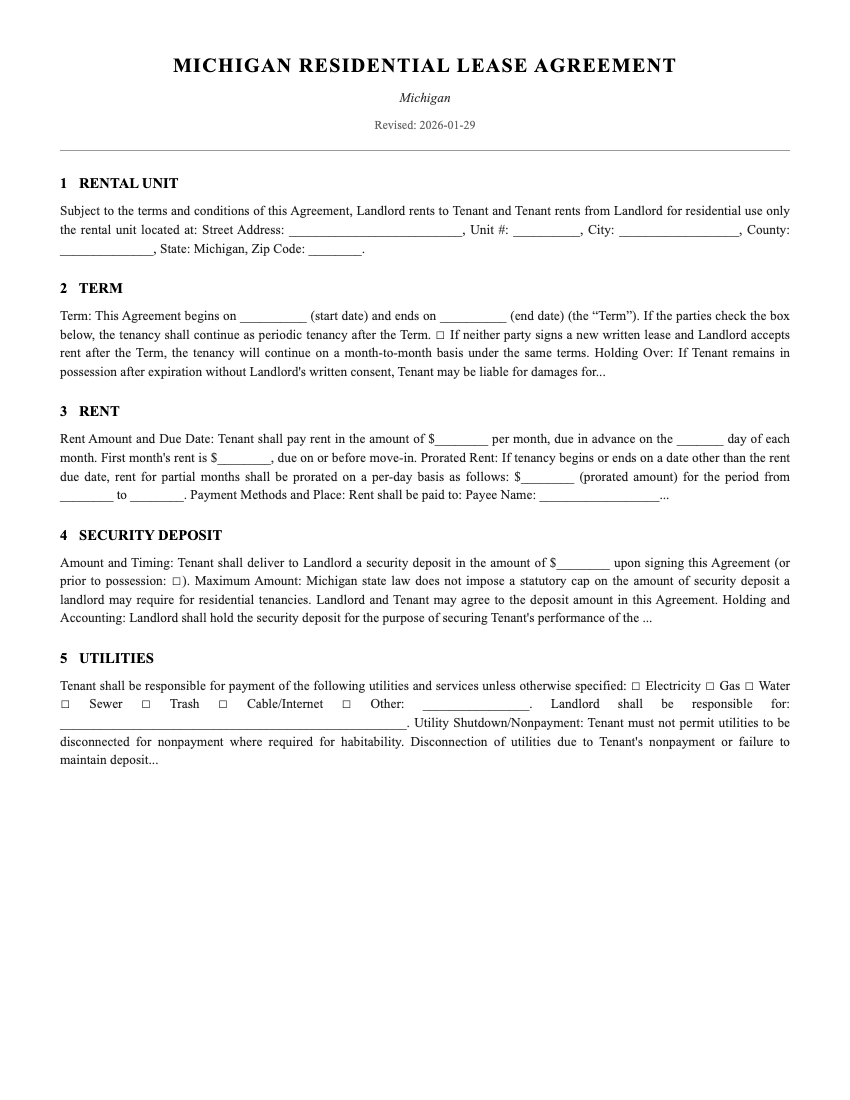
- Parties, property description, and term (fixed-term and month-to-month options)
- Rent amount, due date, late fees (carefully worded to comply with Michigan notice and unconscionability standards)
- Security deposit clause: amount (no statutory cap), where deposit will be held, required itemized statement of deductions, and 30-day return guidance after surrender of possession
- Required disclosures: federal lead-based paint notice for pre-1978 housing, Michigan sex-offender registry notice reference, and an explicit statement of landlord and tenant repair/habitability responsibilities
- Utilities, repairs, and maintenance: clear allocation of obligations and notice/cure process for breaches
- Entry and access: notice requirements for non-emergency entry consistent with Michigan expectations and case law
- Termination and eviction procedures: pay-or-quit guidance, cure periods for violations, and references to Michigan's summary proceedings (MCL 600.5714)
- Pet policy and guest policy templates
- Optional addenda: move-in checklist, parking, smoking policy, lead-paint addendum, local ordinance addendum
- Signatures section and guidance on execution (electronic signatures where agreed)
Related Lease Agreement Templates
Download Options
- Single-unit PDF (fillable): /downloads/michigan-lease-agreement-2026.pdf
- Editable Word/Google Docs version available on request (for customization)
- Addenda pack: lead-based paint disclosure, move-in checklist, local ordinance addendum
How to Finalize Your Lease
- Choose the correct term: pick fixed-term or month-to-month and confirm the start and end dates.
- Insert accurate party names and property address (including unit number where applicable).
- Specify the security deposit amount and where it will be held; include the itemization and 30-day return clause.
- Complete required disclosures: attach lead-based paint disclosure when applicable and include the sex-offender registry notice and habitability statement.
- Review notice and cure periods to ensure they are consistent with Michigan practice (7-day pay-or-quit for nonpayment is common; 30 days for month-to-month termination unless otherwise agreed).
- Run the draft through an AI contract review tool for automated contract checks and then, if needed, get local attorney review—especially for multi-unit properties or complex rules in municipalities.
Common Clauses Explained (quick notes)
- Security Deposit Handling: Michigan requires an itemized statement of deductions and return of the deposit (less lawful deductions) within 30 days after the tenant vacates and surrenders possession, subject to local ordinances and case law. Keep receipts and photographs to support deductions.
- Rent Increases: No statewide rent control in Michigan. Rent increases for a month-to-month tenancy should comply with the notice period agreed in the lease or local ordinance. For fixed-term leases, increases cannot occur until renewal unless the lease allows otherwise.
- Evictions: For nonpayment, landlords commonly issue a 7-day pay-or-quit demand before filing for possession in district court under Michigan's summary proceedings statutes (MCL 600.5714). Follow court rules and local requirements closely.
- Repairs & Habitability: Landlords must maintain premises in compliance with applicable building and health codes. Tenants should provide prompt written notice of defects and allow a reasonable time to cure.
Who Should Use This Template
This template is designed to be broadly useful but does not replace legal advice for complicated matters (e.g., subsidized housing, HUD rules, multi-family licensing). Use it when you want a Michigan-aware starting point that includes required disclosures and eviction-process guidance.
Final Tip
Always confirm local municipal requirements—cities like Ann Arbor, Detroit, Grand Rapids and others may have additional rental licensing, inspection or deposit rules. Where in doubt, run the document through an AI contract review tool and consult a Michigan-licensed attorney for legal certainty.
<div class="ml-embedded" data-form="bBZ9zR"></div>
Frequently Asked Questions

About Designer Content
Designer Content creates practical legal document resources for landlords, contractors, and small business owners. We simplify complex legal concepts into actionable guidance. Connect with us on LinkedIn.