
Introduction
Using an up-to-date lease in Ohio is critical. Ohio landlord-tenant law (ORC Chapter 5321) and forcible entry and detainer rules (ORC Chapter 1923) set procedures for security deposits, notices, and evictions. This template reflects key statutory requirements — including the 30-day security deposit return/statement rule, federal lead-based paint disclosure for pre-1978 housing, and Ohio's sex offender registry notice obligations — and is designed for clarity and enforceability in Ohio courts.
Accurate lease language reduces dispute risk, helps you comply with mandatory disclosures, and preserves contractual rights (written contracts in Ohio are governed by ORC § 2305.06 for statute of limitations). Local ordinances (city or county) can add requirements, so always check municipal rules where the property is located.
For a comprehensive lease review checklist covering residential and commercial terms, see our Lease Agreement Review Guide.
What is an Ohio residential lease?
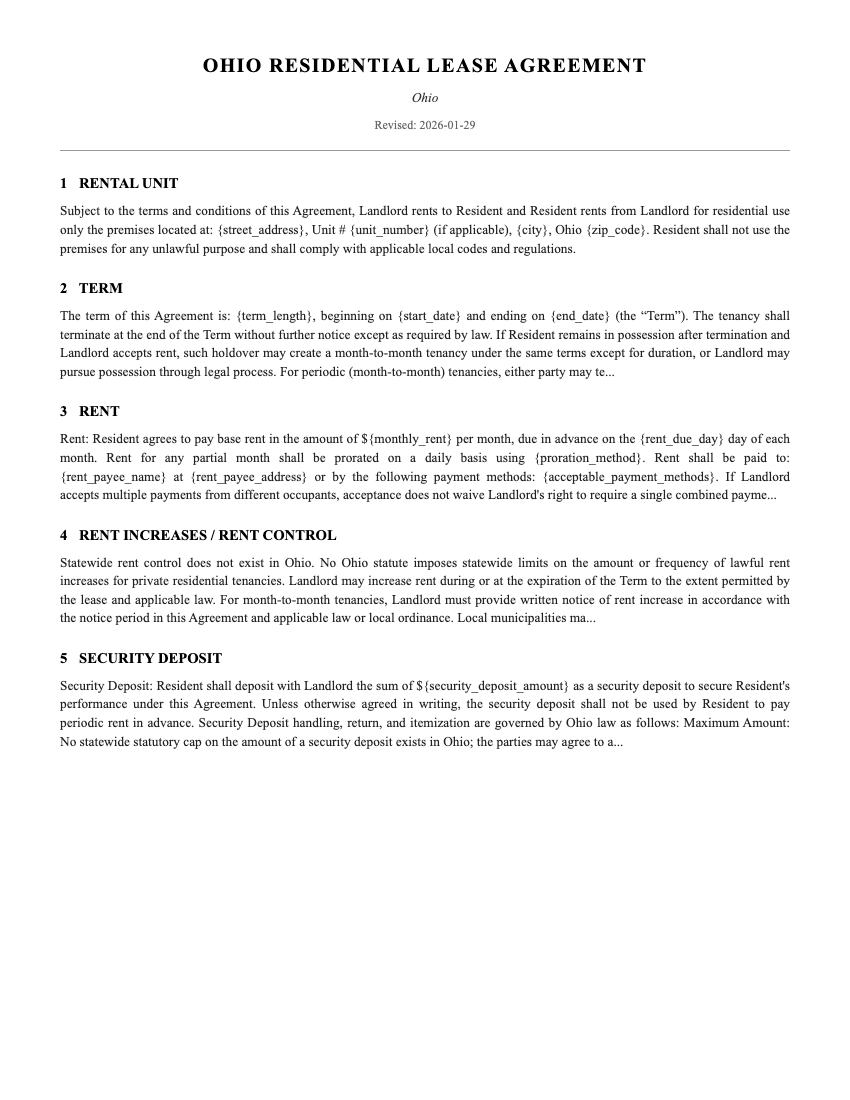
An Ohio residential lease is a written contract between a landlord (owner or agent) and a tenant that sets rental terms, rights, and obligations for occupancy of a residential property in Ohio. It must comply with state statutes (primarily Ohio Revised Code Chapter 5321), federal disclosure requirements (e.g., lead-based paint for homes built before 1978), and any applicable local ordinances. A valid lease should clearly state rent amount and due date, security deposit terms, notice periods, required disclosures, and remedies for breaches.
Why Old Templates Are Dangerous (Ohio-specific traps)
- Security deposit timing: Ohio requires the landlord to return the security deposit and an itemized statement of deductions within 30 days after termination and delivery of possession. Old templates may use different deadlines that violate ORC Chapter 5321 and expose landlords to damages and attorney fees.
- No statewide deposit cap: Because Ohio has no statutory cap on security deposits, outdated templates that assume a cap (from another state) can mislead parties. Amounts must be contractually agreed and may be subject to local rules.
- Eviction procedure mismatches: Forcible entry and detainer actions follow ORC Chapter 1923 — filing procedures and required notices vary by county and local court practices. Using a template that references the wrong notice periods (or fails to distinguish cureable vs. incurable breaches) can delay or invalidate an eviction.
- Missing federal disclosures: Housing built before 1978 requires the federal lead-based paint disclosure (42 U.S.C. § 4852d). Older forms may omit this required federal disclosure and the EPA/HUD pamphlet.
- Sex offender registry notice: Ohio law requires certain notices regarding the state's sex offender registry (ORC Chapter 2950). An old template may not include the statutorily required language or links.
- Local ordinance and licensing requirements: Cities like Columbus, Cleveland, Cincinnati, and others may have rental registration, licensing, or inspection requirements. Relying on a generic template can miss these local obligations.
What's Included in This Template
- Parties and property identification
- Lease term (fixed-term and month-to-month options) and possession provisions
- Rent amount, due date, late fees, and returned-check policies
- Security deposit clause: amount (contractual), itemization requirement, return timing consistent with ORC Chapter 5321 (30 days after termination and delivery of possession)
- Maintenance and repair obligations; habitability and statutory remedies reference (ORC Chapter 5321)
- Entry and notice provisions for landlord access
- Default, cure periods, and remedies; notice language aligned with common Ohio practices (3-day pay-or-quit language for nonpayment where appropriate)
- Eviction and unlawful detainer process summary (reference to ORC Chapter 1923) and attorney-fee provisions where lawful
- Required disclosures: Lead-based paint (federal), sex offender registry notice (ORC Chapter 2950), owner/agent contact information, flood/FEMA hazard advisory
- Utilities and services, alteration and subletting rules
- Pet policy and security deposit or pet deposit fields
- Parking, storage, and rules of occupancy
- Signature blocks and witness/acknowledgement fields
Download Options
- Single PDF: Complete, fillable Ohio Residential Lease Agreement — /downloads/ohio-lease-agreement-2026.pdf
- Editable DOCX: For customization and local counsel edits (download available from the same page)
- Checklist PDF: "Ohio Lease Compliance Checklist" summarizing required disclosures and key statutory deadlines
How to Finalize Your Lease
- Customize the template: Enter property-specific terms (rent, deposit amount, term, utilities, pet rules). Do not rely on blank defaults.
- Insert required disclosures: Attach the federal lead-based paint disclosure and EPA/HUD pamphlet if property built before 1978; include sex offender registry notice (ORC Chapter 2950) and owner/agent contact details.
- Review local rules: Confirm city/county rental registration, licensing, or other municipal requirements and incorporate any mandatory language.
- Run the AI contract review tool safety check: Upload the completed draft to an AI contract review tool to flag missing disclosures, problematic clauses, or inconsistent notice periods.
- Sign and date: Have all parties sign; provide a copy to the tenant and retain originals. Consider notarization for added evidentiary weight (optional).
- Maintain records: Keep lease, receipts for returned deposits, inspection checklists, and all written notices for at least the period required by ORC § 2305.06 and for practical recordkeeping.
Related Lease Agreement Templates
Frequently Asked Questions (Ohio)
Q: Is there a statutory limit on security deposits in Ohio?
A: No. Ohio does not impose a statewide cap on security deposit amounts. The amount is a matter of contract between landlord and tenant, subject to any local ordinance. Ohio law (ORC Chapter 5321) does require return of the deposit and an itemized statement of deductions within 30 days after termination and delivery of possession.
Q: How quickly must a landlord return a security deposit in Ohio?
A: Under Ohio law, the landlord must return the security deposit, minus lawful deductions, and provide an itemized statement of deductions within 30 days after the tenancy ends and the tenant delivers possession. Failure to comply can expose the landlord to civil remedies.
Q: Is there rent control in Ohio?
A: No statewide rent control exists in Ohio. Rent amounts and increases are governed by the lease and applicable notice provisions. Municipalities may have local ordinances affecting rents; check city-specific rules.
Q: What notice is required before filing for eviction in Ohio for nonpayment of rent?
A: Common practice is a 3-day pay-or-quit notice before filing a forcible entry and detainer action, but the exact requirements and court practices vary by county and court. Evictions proceed under ORC Chapter 1923; consult local court rules and, if needed, an attorney.
Q: What mandatory disclosures must I include in an Ohio lease?
A: At minimum, include the federal lead-based paint disclosure for properties built before 1978 (42 U.S.C. § 4852d), an owner/agent contact disclosure, a sex offender registry notice consistent with ORC Chapter 2950, and an advisory about flood/FEMA hazards where applicable. Local jurisdictions may require additional disclosures.
Q: Can a landlord evict without cause in Ohio?
A: Ohio does not have a statewide just-cause eviction requirement for private landlords. A landlord may terminate a tenancy in accordance with the lease and applicable notice periods (e.g., generally 30 days for month-to-month tenancies), and may pursue eviction for nonpayment or breach under ORC Chapter 1923. Some municipalities may impose additional tenant protections.
Final notes
This template is a starting point tailored to Ohio statutory frameworks (ORC Chapter 5321 and Chapter 1923). It is not a substitute for legal advice in complicated situations. After customization, run the lease through an AI contract review tool for a compliance check and consult local counsel if the property is in a jurisdiction with robust municipal tenant protections.
<div class="ml-embedded" data-form="bBZ9zR"></div>
Frequently Asked Questions

About Designer Content
Designer Content creates practical legal document resources for landlords, contractors, and small business owners. We simplify complex legal concepts into actionable guidance. Connect with us on LinkedIn.