
Introduction
Mississippi does not have a single, comprehensive statewide residential landlord-tenant code. Instead, tenancy relations are governed primarily by the lease contract, common law, and a limited set of statutes (notably forcible entry and detainer procedures in Title 89). That makes a clear, well-drafted lease essential: it sets expectations for rent, security deposits, notice periods, repair responsibilities, disclosures, and eviction procedures. This template is written to be practical for Mississippi landlords and tenants while incorporating the critical statutory references you need to know.
Use this template to: set clear deposit handling and itemization procedures, include federally required disclosures (e.g., lead-based paint for pre-1978 units), define cure and termination periods, and point to the applicable state eviction process (Miss. Code Ann. Title 89). Where local municipal ordinances apply (city or county rules on deposits, licensing, or housing standards), the lease instructs you to follow those local laws.
For a comprehensive lease review checklist covering residential and commercial terms, see our Lease Agreement Review Guide.
What is a Mississippi residential lease?
A Mississippi residential lease is a written contract between a landlord and tenant that defines the term of tenancy, rent amount and payment procedures, security deposit terms, responsibilities for maintenance and repairs, permitted uses, notice periods for termination, and dispute-resolution processes. In Mississippi, because state statutory regulation is limited, the lease itself controls many substantive terms; federal rules (e.g., lead-based paint disclosure for pre-1978 housing) and local ordinances may impose additional mandatory requirements.
Why Old Templates Are Dangerous (Mississippi-specific traps)
- Reliance on silence: Because Mississippi lacks a comprehensive landlord-tenant statute, silent or incomplete leases leave crucial terms (security deposit return deadline, cure periods for defaults, notice for termination) to legal implication or local practice—often resulting in disputes.
- Wrong eviction procedure: Using a procedure from another state can be fatal. Mississippi eviction actions follow the statutes in Miss. Code Ann. Title 89, Chapter 7 (Forcible Entry and Detainer). Using the wrong notice or process risks dismissal and delay.
- Deposit mishandling: There is no statewide cap on deposits, nor a statutory return deadline. An older form that doesn't require itemized accounting on return or that misstates timelines exposes a landlord to contract damages and possible Mississippi Consumer Protection Act claims (Miss. Code Ann. § 75-24-1 et seq.).
- Missing federal disclosures: Older templates may omit the federally required lead-based paint disclosure for homes built before 1978 (42 U.S.C. § 4852d; 24 C.F.R. Part 35). Failure to provide required federal disclosures can lead to enforcement or rescission rights where federal law applies.
- Overbroad waivers: Clauses that attempt to waive rights under Mississippi law or federal statutes (such as safety disclosures) are often unenforceable and create litigation risk.
What's Included in This Template
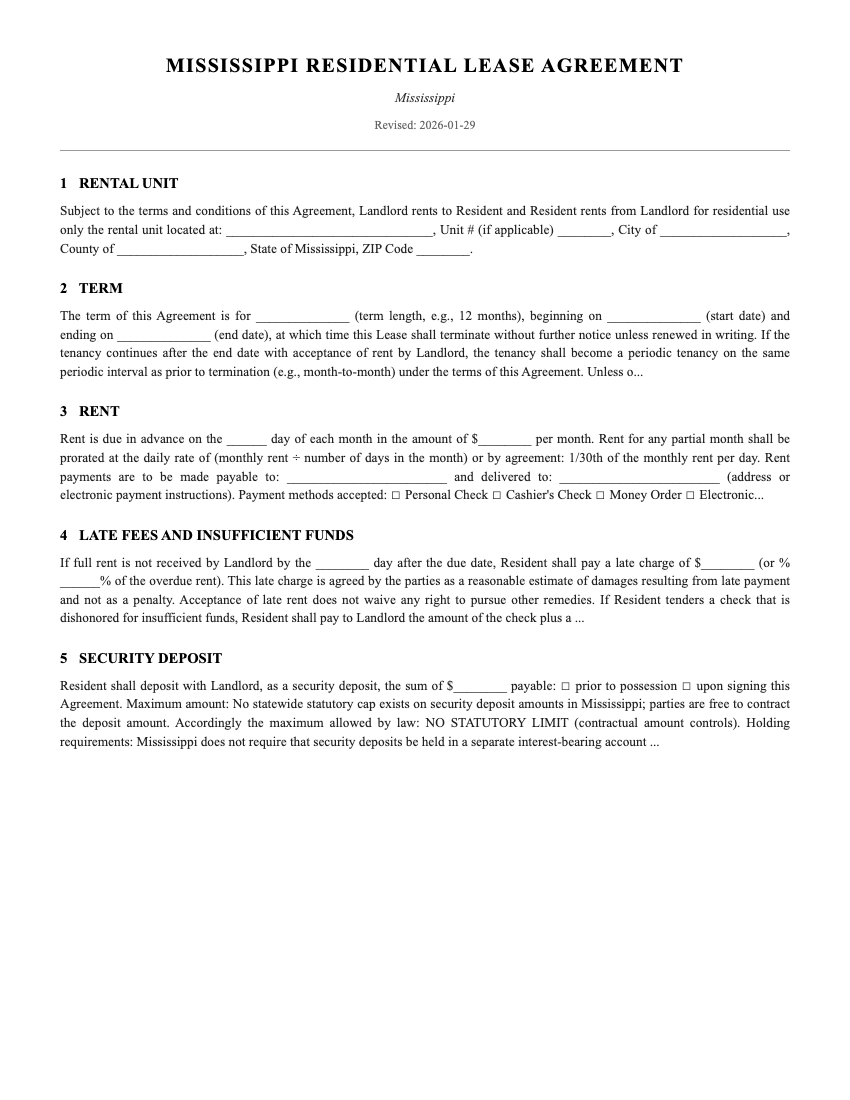
- Parties and Property: Full identification of landlord, tenant(s), and the rental property.
- Term: Fixed-term and month-to-month options with customizable notice periods.
- Rent: Amount, due date, late fees (recommended to be reasonable and compliant with local rules), accepted payment methods, and returned-payment handling.
- Security Deposit: Contracted deposit amount, statement that itemized accounting is required on return, recommended return deadline (customizable — common practice: 30–45 days), and how deposit may be applied. The template explicitly states that Mississippi imposes no statewide cap and no mandatory interest unless agreed.
- Maintenance & Repairs: Landlord and tenant responsibilities, notice procedures for repair requests, habitability obligations, and statutory references.
- Entry: Notice and reasonable entry provisions consistent with privacy expectations and practical access for repairs and inspections.
- Termination & Eviction: Contractual notice periods, cure periods for breaches, and a plain-language explanation that formal eviction must follow Miss. Code Ann. Title 89 (Forcible Entry and Detainer).
- Disclosures: Built-in slots for federally required Lead-Based Paint Disclosure (42 U.S.C. § 4852d; 24 C.F.R. Part 35), a statement regarding Mississippi Consumer Protection Act considerations (Miss. Code Ann. § 75-24-1 et seq.), and an advisory to check local ordinances including flood-zone, licensing, and nuisance rules.
- Default Remedies & Attorney Fees: Contract remedies and how attorney fees are allocated where permitted by law.
- Miscellaneous: Utilities, assignment/subletting rules, guest policy placeholder, smoking and pet rules, and an arbitration/mediation option if you choose.
Download Options
- Single-Unit PDF (fill-in-the-blank): /downloads/mississippi-lease-agreement-2026.pdf
- Editable DOCX (for customization): Available on request — ensure you preserve statutory references and an AI contract review tool review after edits.
How to Finalize Your Lease
- Customize the template: Insert names, property address, rent amount, deposit amount, and specific cure/notice periods that reflect your business needs and local practice.
- Add required disclosures: Attach the Lead-Based Paint Disclosure (if built before 1978), and include any municipal notices (flood zone, local registration, licensing) that apply to your jurisdiction.
- Confirm deposit procedures: Specify the exact timeline for deposit return (recommended 30–45 days) and require an itemized statement for any deductions.
- Run an AI contract review tool review: Upload the completed lease to an AI contract review tool for a clause and compliance check (security deposit language, eviction notice consistency, and disclosure completeness).
- Sign and date in person or via a compliant electronic-signature platform; give each party a signed copy and retain originals for at least the term of the lease plus six years (Miss. Code Ann. § 15-1-29 statute of limitations for written contracts).
- File and follow local requirements: If your city or county requires registry or business licensing for rental housing, complete those steps before occupancy.
Related Lease Agreement Templates
FAQs
- Q: Is there a statutory cap on security deposits in Mississippi?
A: No. Mississippi has no statewide statutory cap on security deposits. Landlords and tenants may contract the amount. Be aware local ordinances (city or county) may impose limits—check municipal law and include any local requirements in the lease. - Q: How long does a landlord have to return a security deposit in Mississippi?
A: There is no uniform statewide statutory deadline. Common practice is 30–45 days. To avoid disputes, the lease should set a clear deadline and require an itemized accounting of deductions. Unlawful withholding can lead to contract damages and potential claims under the Mississippi Consumer Protection Act (Miss. Code Ann. § 75-24-1 et seq.). - Q: Does Mississippi have rent control or limits on rent increases?
A: No statewide rent control exists in Mississippi. Landlords may increase rent according to the lease terms or by agreement at renewal. Municipal rent-control ordinances would be required to limit increases; such ordinances are uncommon. Always check city or county rules. - Q: What notice is required before starting an eviction in Mississippi?
A: Mississippi does not have a single statewide statutory requirement for a particular written notice period for all evictions. Common practice for nonpayment is a 3-day 'pay or quit' notice, but parties should specify notice and cure periods in the lease. Formal eviction actions must follow Miss. Code Ann. Title 89 (Forcible Entry and Detainer). Consult the statutes and local court practice before filing. - Q: Do I need to provide a lead-based paint disclosure?
A: Yes—if the housing was built before 1978 and the lease term triggers federal disclosure requirements. Federal law (42 U.S.C. § 4852d and implementing regs at 24 C.F.R. Part 35) requires delivery of the lead hazard information pamphlet and disclosure of known lead-based paint hazards. - Q: Can a lease limit guests or subletting in Mississippi?
A: Yes. Parties can contract reasonable guest and subletting rules. However, the lease should define "guest" and time limits, and specify whether subletting requires landlord consent. Overbroad or ambiguous restrictions can cause disputes—be specific and consistent with local habitability and occupancy rules.
Sources
- Mississippi Code (Justia): https://law.justia.com/codes/mississippi/ — (Mississippi legislative code online)
- Mississippi Legislature — Code Search (LexisNexis): http://www.lexisnexis.com/hottopics/mscode/ — (official codified statutes)
- Lead-Based Paint Disclosure (Federal): 42 U.S.C. § 4852d — https://www.law.cornell.edu/uscode/text/42/4852d
- HUD Lead-Based Paint Regulations: 24 C.F.R. Part 35 — https://www.ecfr.gov/current/title-24/subtitle-B/chapter-I/part-35
- FEMA Flood Map Service Center — https://msc.fema.gov/portal/home
- Mississippi Sex Offender Registry (Dept. of Public Safety) — https://www.dps.ms.gov/public-safety-services/sex-offender-registry
<div class="ml-embedded" data-form="bBZ9zR"></div>
Frequently Asked Questions

About Designer Content
Designer Content creates practical legal document resources for landlords, contractors, and small business owners. We simplify complex legal concepts into actionable guidance. Connect with us on LinkedIn.