
Georgia Residential Lease Agreement (2026)
Using a state-specific lease matters. Georgia law (see O.C.G.A. Title 44, Chapter 7) controls dispossessory (eviction) procedures, while security-deposit handling and many contractual remedies derive from Title 44 and general contract law principles (see O.C.G.A. § 9-3-24 for the statute of limitations on written contracts and O.C.G.A. § 13-6-11 for damages for bad faith breach). This template is written for landlords and tenants in Georgia: it includes recommended notice periods, required federal disclosures, and options for addressing local rules.
This article explains what's in the template, the Georgia-specific legal rules you must consider, and how to finalize and verify your lease with a contract analysis tool like an AI contract review tool.
For a comprehensive lease review checklist covering residential and commercial terms, see our Lease Agreement Review Guide.
What is a Georgia residential lease?
A Georgia residential lease is a written contract between a landlord and tenant that sets the rental term, rent amount, security deposit terms, permitted occupants, required disclosures, repair and maintenance responsibilities, and grounds and procedures for termination. In Georgia, leases operate alongside statutory dispossessory rules in O.C.G.A. Title 44, Chapter 7 and federal disclosure laws (e.g., 42 U.S.C. § 4852d for lead-based paint).
Why compliance matters in Georgia
- There is no statewide cap on security deposits; parties may agree to any lawful amount but must comply with local ordinances where applicable. The lease should set a clear deadline for return and require an itemized statement of deductions.
- Georgia has no statewide rent control — rent and increases are governed by contract and local law.
- Eviction actions (dispossessory) proceed under O.C.G.A. Title 44, Chapter 7; landlords commonly serve a short pay-or-quit demand (often three days) before filing, but county practice and the lease may vary.
- Federal lead-based paint disclosure is required for housing built before 1978 (42 U.S.C. § 4852d).
Failure to adopt Georgia-specific language can lead to invalid notice periods, improperly withheld deposits, defective eviction filings, and unnecessary litigation. The template below addresses these risks.
Why old templates are dangerous in Georgia
Old or generic lease forms commonly miss critical Georgia-specific issues:
- Security deposit timing: Georgia has no statutory deadline for returning deposits, so an old template that assumes a different state's deadline can lead to disputes. The lease must state a reasonable period (commonly 30 days) and require an itemized statement of deductions.
- Eviction procedure mistakes: Dispossessory filings must comply with county practices and O.C.G.A. Title 44. An outdated form may specify cure periods or service methods that lead to dismissal.
- Missing federal disclosures: Housing built before 1978 requires lead-based paint disclosure under 42 U.S.C. § 4852d. Failure to provide required federal forms can carry statutory penalties.
- Local ordinances: Some Georgia cities or counties may impose local requirements (e.g., registration, inspection, certificate of occupancy, or deposit limits). Older statewide templates often ignore local rules.
- Unenforceable fee provisions: Some penalty or fee clauses violate Georgia law or public policy. Unreviewed templates can include unlawful late-fee calculations or fee stacking that courts disallow.
What's Included in This Template
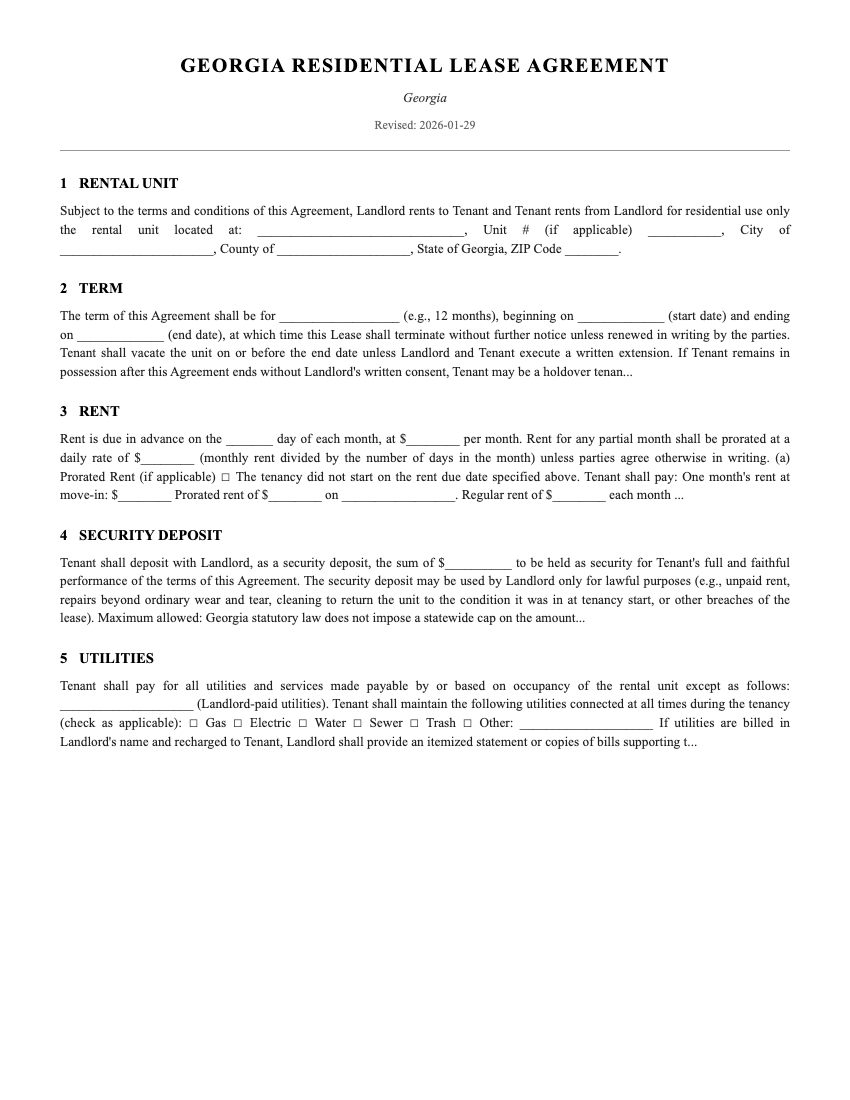
This Georgia Residential Lease Agreement (2026) includes:
- Parties, property description, and lease term (fixed-term and month-to-month options).
- Rent amount, due date, allowable payment methods, and late fee structure (with clear basis for late charges compatible with Georgia contract law).
- Security deposit clause: amount, purposes for deduction, itemized accounting requirement, recommended deposit-return period (30 days), and statement that no interest is required under Georgia law unless otherwise stated.
- Utilities, maintenance, and repair obligations; habitability language consistent with Georgia landlord duties.
- Notices and cure periods: suggested pay-or-quit practice (3 days for nonpayment) and customizable cure periods (7–14 days) for nonserious lease breaches.
- Termination: fixed-term expiration language; 30-day notice for month-to-month tenancies by default.
- Eviction and remedies: statement that dispossessory actions follow O.C.G.A. Title 44, Chapter 7 and may include recovery of damages and attorneys' fees when permitted.
- Required disclosures: lead-based paint disclosure (42 U.S.C. § 4852d) for pre-1978 housing, sex-offender registry notice (informational), and flood hazard advisory (FEMA maps).
- Optional clauses: pet addendum, smoking policy, subletting and assignment rules, guests and short-term rental prohibition, and electronic-signature consent (reference to Georgia UETA: Ga. Code Ann. § 10-1-410 et seq.).
- Signature blocks and spaces for attachments (move-in checklist, inventory, lead pamphlet, local registry confirmations).
This template is plain-language, but references Georgia statutes so you can adapt or present it to counsel.
Download Options
- Fillable PDF: /downloads/georgia-lease-agreement-2026.pdf (complete with lead disclosure and move-in checklist).
- Word DOCX: Editable version available on request (useful for customizing cure periods, adding local ordinance clauses).
- Print-friendly: Single-page summary for tenant move-in packet (includes required disclosures and contact info space).
Tip: Keep a signed PDF copy for records and upload to an AI contract review tool for verification before serving notices or filing a dispossessory action.
How to Finalize Your Lease
- Confirm property details and local requirements: verify any municipal registration, inspection, or local deposit limits.
- Enter agreed rent, deposit, and cure periods: pick explicit deadlines (e.g., rent due on the 1st; 3-day pay-or-quit for nonpayment; 30 days for deposit return).
- Attach required federal disclosures: include lead-based paint disclosure and EPA pamphlet for pre-1978 housing.
- Use electronic signatures if both parties consent: reference Georgia's UETA (Ga. Code Ann. § 10-1-410 et seq.) and keep audit trail.
- Share signed copies with all parties and retain originals: landlords should keep signed originals and a move-in condition inventory.
- Upload the executed lease to an AI contract review tool for an automated contract check before serving notices or filing in court.
Important Georgia-Specific Rules (Quick Reference)
- Security deposit: No state cap; itemized deductions required; no general interest requirement. (See O.C.G.A. Title 44; consult local ordinances.)
- Eviction: Governed by dispossessory procedures in O.C.G.A. Title 44, Chapter 7; a three-day pay-or-quit demand is a common practice for nonpayment but not a statewide statutory prerequisite for filing in every county.
- Statute of limitations: Written contracts — six years (O.C.G.A. § 9-3-24).
- Bad-faith deposit withholding: Damages for bad faith breach may be authorized under O.C.G.A. § 13-6-11 in certain circumstances.
- Federal disclosures: Lead-based paint (42 U.S.C. § 4852d) required where applicable.
Related Lease Agreement Templates
FAQs — Georgia (6 common questions)
- Q: Is there a limit on how much a landlord can require for a security deposit in Georgia?
A: No statewide statutory maximum exists. Landlords and tenants may agree to any lawful amount, but local ordinances could cap deposits in some cities or counties. The lease should state the deposit amount, permitted deductions, require an itemized statement of deductions, and set a return deadline (commonly 30 days by agreement). See O.C.G.A. Title 44 and check local rules. - Q: Do landlords in Georgia have to pay interest on security deposits?
A: Generally no. Georgia law does not require landlords to pay interest on security deposits. If a landlord chooses to pay interest (or a local ordinance requires it), the lease should state the interest rate and calculation method. - Q: Are there rent-control rules or statewide caps on rent increases in Georgia?
A: No. Georgia has no statewide rent control. Rent amounts and increases are governed by the lease and applicable local ordinances. Landlords must follow any notice provisions in the lease and any local laws that affect rent increases. - Q: What notice is required before eviction for nonpayment in Georgia?
A: Georgia law provides dispossessory procedures in O.C.G.A. Title 44, Chapter 7. A common practice is to serve a pay-or-quit demand (often three days) for nonpayment before filing a dispossessory action, but requirements can vary by county and by lease terms. Consult local court rules and consider using the lease's specified cure periods. - Q: What disclosures must Georgia landlords provide?
A: Required disclosures include the federal lead-based paint disclosure for housing built before 1978 (42 U.S.C. § 4852d). Many landlords also include advisory notices such as sex offender registry information (reference to the Georgia Bureau of Investigation registry) and flood-hazard advisories (FEMA maps). Local disclosure obligations may apply. - Q: Can I restrict guests or short-term subletting in a Georgia lease?
A: Yes. Leases may lawfully include guest policies and subletting restrictions so long as they do not conflict with federal, state, or local law (including nondiscrimination rules). Be specific about how long a guest may stay before being considered an unauthorized occupant and specify subletting procedures or prohibitions.
Final Notes
This template is written for Georgia and references key statutes and federal requirements. It is not a substitute for legal advice. Use an AI contract review tool to run a compliance scan before finalizing or serving the lease. For complex disputes, local ordinance interpretation, or eviction filings, consult a Georgia-licensed attorney or local legal aid resources.
<div class="ml-embedded" data-form="bBZ9zR"></div>
Frequently Asked Questions

About Designer Content
Designer Content creates practical legal document resources for landlords, contractors, and small business owners. We simplify complex legal concepts into actionable guidance. Connect with us on LinkedIn.