
Opening
A Suriname Master Services Agreement (MSA) is a master agreement that sets the base terms once for multiple projects in Suriname. Instead of renegotiating payment, liability, IP, and privacy for each assignment, you reference a short Statement of Work (SOW) per project. For SMEs, consultants, and agencies this provides speed and consistency. Important: Surinamese rules on prescription, interest, and personal data often render generic MSA templates unsuitable.
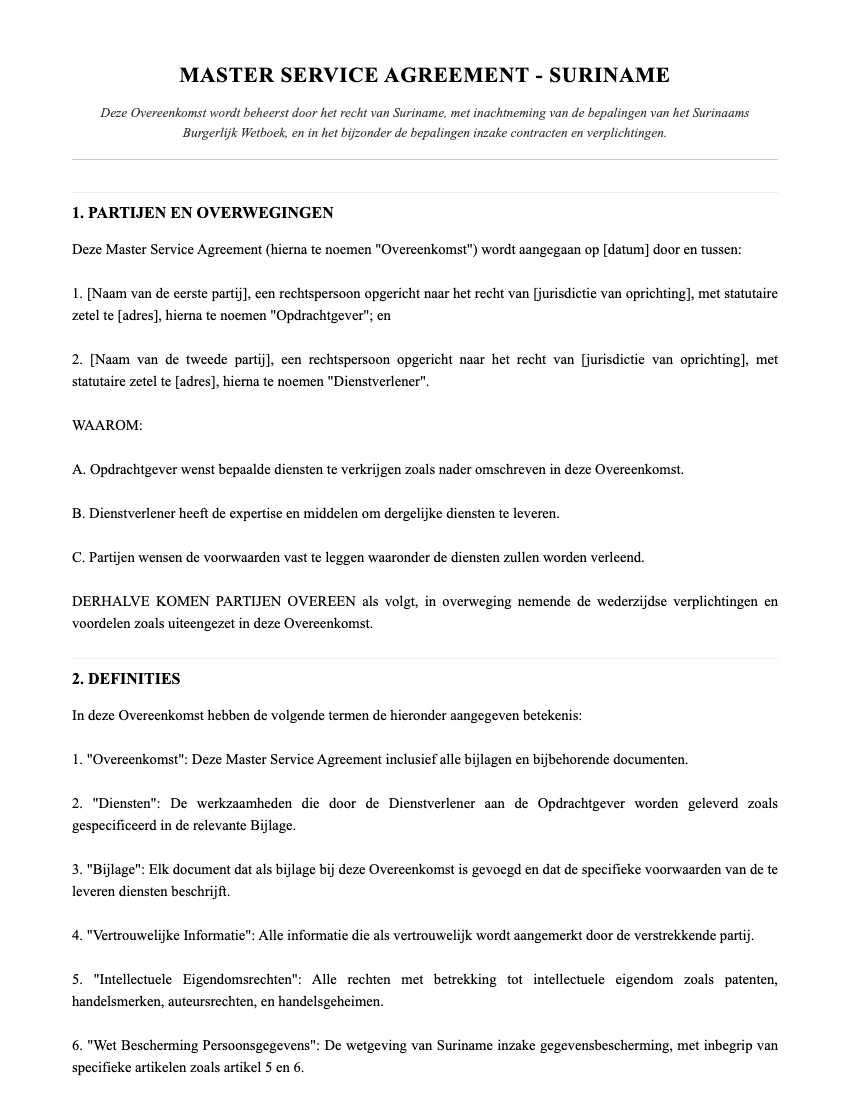
For a comprehensive guide to structuring MSAs and SOWs that protect your business, see our Freelancer Contracts Guide.
Definition Box
Definition: A Suriname Master Services Agreement is an overarching B2B agreement between client and service provider, drafted with Surinamese law as the starting point. The MSA contains the “fixed” contract terms—such as payment terms, liability limitations, confidentiality, intellectual property, and dispute resolution—that automatically apply to all future assignments. The concrete deliverables, planning, and prices are set out in separate Statements of Work (SOWs). This model prevents scope creep, accelerates approval processes, and ensures that legal points such as statutory interest (Surinamese Civil Code art. 6:119) and prescription (art. 3:306) are properly addressed in advance.
Why You Cannot Use a Generic MSA in Suriname
An “international” MSA template (for example, based on US or EU standards) often misses Surinamese core points: how worker relationships are assessed, what is enforceable or not around non-compete provisions, and how to contractually address IP and privacy risks within the Surinamese legal framework. Moreover, some standard clauses can backfire, for example by enforcing unrealistic liability waivers or by forum selections that are difficult to enforce in practice.
Worker Classification Rules
Suriname does not use a US-style “ABC test.” In practice, the worker versus independent contractor classification is assessed based on the actual execution of the relationship: is there authority/supervision, is the person embedded organizationally, and is there an obligation to perform personal work for pay. This aligns with civil-law thinking and the content of the Surinamese Civil Code and labor law rules. In a generic MSA, the label often reads “independent contractor,” but if your daily instructions, working hours, and integration resemble an employee, that label can be broken. The consequences are not only contractual: it can lead to back payments and labor-law claims. Therefore, a Suriname MSA should include clear provisions on autonomy, outcome obligation versus effort obligation, substitution/subcontracting, and invoicing as a business—so that the actual execution supports the contract.
Non-Compete Enforceability
In Suriname, non-compete provisions are not inherently “forbidden,” but enforceability depends heavily on reasonableness and balancing of interests. A generic, broad non-compete (e.g., “no clients worldwide for 24 months”) is more likely to be disproportionate in a civil-law context. In B2B relationships, it’s often better to reframe the issue: protect your genuine interests with (i) confidentiality, (ii) prohibition on use of client data, and (iii) a narrow relationship clause (not actively approaching named accounts). Also watch out for notice and expiry mechanisms: if a party complains about an alleged deficiency too late, they may forfeit rights due to the notice requirement under Surinamese Civil Code art. 6:89. A good Suriname template should therefore contain reasonable duration/territory/activities, plus alternatives that are typically better defensible than a “one size fits all” non-compete.
IP/Work-for-Hire Considerations
Many templates rely on “work made for hire” language that primarily comes from common law. In Suriname (civil law), it is safer to operate with an explicit transfer/assignment of intellectual property rights and tie it to payment: for example, that IP passes only after full payment of the invoice. Also specify who owns pre-existing tools, templates, and source code (background IP) and what license the client receives. Pair this with a quick acceptance/notice procedure (Surinamese Civil Code art. 6:89) to limit later disputes over latent defects or “not conforming” issues.
What's Included in This Template
Flexible SOW Structure
The template uses a fixed MSA plus separate SOWs. In the MSA, include definitions, payment rules, liability, privacy, and forum. In each SOW include: scope, deliverables, milestones, rates, acceptance criteria, and change control procedure. This prevents details in the MSA from becoming outdated.
Suriname-Specific Indemnification
The indemnification is aligned with B2B practice: each party indemnifies for infringement of third-party rights by its own materials, and for fines/damages arising from its own actions. The template ties this to a notice and reporting obligation so claims do not surface months later (Surinamese Civil Code art. 6:89).
Dispute Resolution and Venue
The template clearly selects Surinamese law and the competent court in Paramaribo. That avoids expensive debates over foreign competent courts and makes enforcement practical. It also provides an escalation path: first a written notice of default, then negotiation/mediation, then litigation.
Additional provisions (with citations):
- Statutory interest on late payment: Surinamese Civil Code art. 6:119
- Prescription safety net (long-term): Surinamese Civil Code art. 3:306
- Notice obligation for late or unknown complaints: Surinamese Civil Code art. 6:89
- Privacy bases and processing duties: Personal Data Protection Act art. 5 and art. 6
Who Needs This Document?
| User Type | Relationship | Key Benefit |
|---|---|---|
| IT-consultants | Ongoing support + projects | Quick SOWs without renegotiation |
| Marketing agencies | Retainers with clients | Control scope creep and clear pricing |
| Software developers | Build + maintenance | IP transfer tied to payment |
| HR/Business consultants | Advisory engagements | Clear acceptance and complaint timelines |
How to Use This MSA Template
Step 1: Fill in the parties and contact points
Use the exact trade name and legal form (NV/BV/sole proprietorship) and specify a notice address and e-mail for legally valid notices.
Step 2: Choose term and termination
Operate with a fixed term or a rolling agreement with a termination notice period. Also specify what happens to any active SOWs on termination.
Step 3: Add your first SOW
Put only project details in the SOW: deliverables, deadlines, rates, travel expenses, and a change control process.
Step 4: Sign and manage changes in writing
Have both parties sign (even digitally) and agree that changes are only valid if confirmed in writing.
Already Receiving Contracts from Clients?
Many service providers use their own MSA, but also receive MSAs from clients to sign. That’s when you risk unfavorable terms: too broad IP transfer, excessive liability, or a forum selection outside Suriname. Make a checklist: payment terms + interest, acceptance/notice periods (Civil Code art. 6:89), privacy roles under the Personal Data Protection Act, and the competent court in Paramaribo. For a quick risk scan you can also use an AI contract review tool.
Download Options
Free PDF Version: ideal for internal review or to discuss with your client.
Editable Word/Google Docs Version: suitable for direct customization by industry, with fields for SOWs, rates, acceptance criteria, and privacy provisions in line with the Personal Data Protection Act.
Disclaimer
This template provides general information for B2B in Suriname and is not legal advice. Have complex matters reviewed by a Surinamese lawyer.
Related MSA Templates
Get the Template
Sign up for our newsletter to receive the template.
Frequently Asked Questions

About Designer Content
Designer Content creates practical legal document resources for landlords, contractors, and small business owners. We simplify complex legal concepts into actionable guidance. Connect with us on LinkedIn.