
A Master Services Agreement (MSA) in Venezuela is a framework contract that sets the legal and commercial rules for multiple service projects between companies, leaving the detail of each job to annexes like a Statement of Work (SOW). In practice, this avoids renegotiating payments, intellectual property, confidentiality, and dispute resolution each time a new project arises. For SMEs, consultants, and agencies, a well-drafted MSA reduces friction, speeds up internal approvals, and provides predictability in the face of nonpayment or scope changes.
Opening
A Venezuelan MSA is the umbrella agreement that governs the ongoing relationship between a service provider and its client in Venezuela. Instead of signing a new contract for each delivery, you sign the MSA once and then add project-specific SOWs with scope, timeline, and price. This is key in Venezuela for properly managing risks related to worker classification, late payment interest, prescription and jurisdiction, avoiding generic clauses that can be ineffective.
For a comprehensive guide to structuring MSAs and SOWs that protect your business, see our Freelancer Contracts Guide.
Definition Box
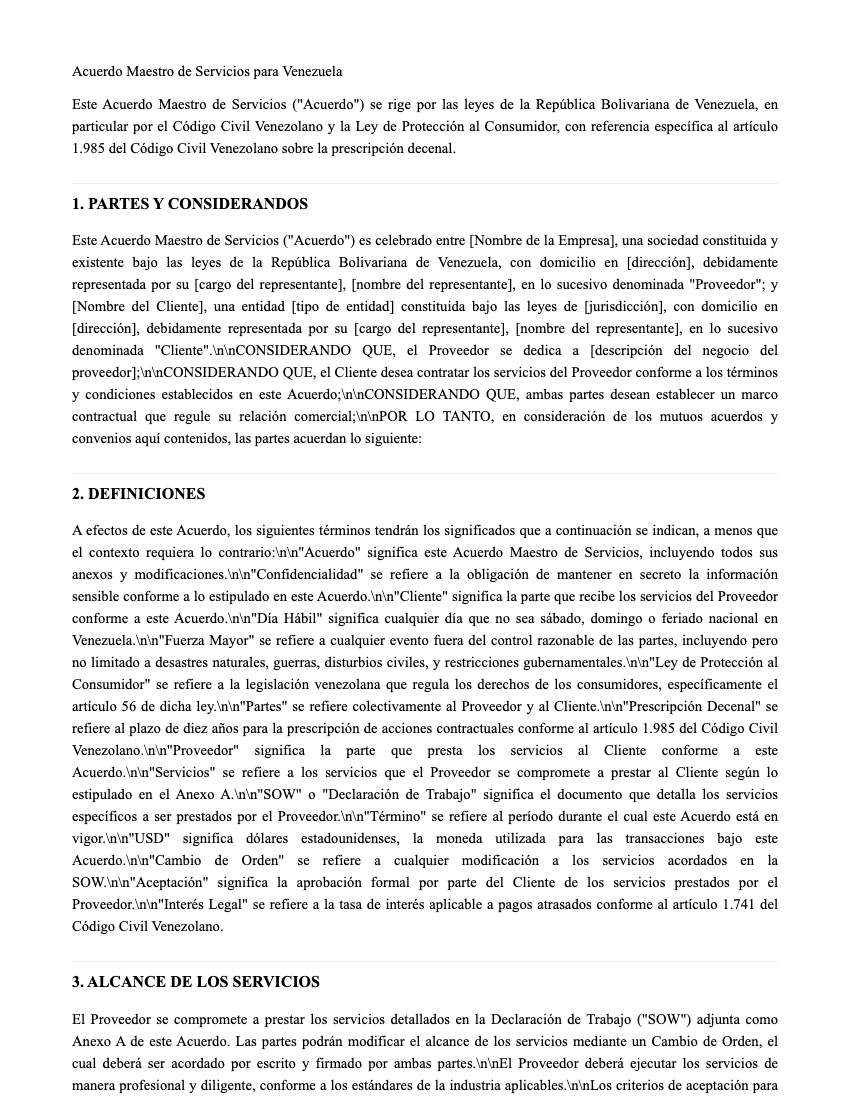
Definition: A Master Services Agreement (MSA) in Venezuela is a civil/commercial framework contract under which the Client and the Provider establish permanent terms applicable to all future services: payment terms, late payment interest, confidentiality, data protection, intellectual property, liability and indemnification, and a dispute resolution mechanism. Each concrete project is documented via a Statement of Work (SOW) or “Orden de Servicio” that describes deliverables, dates, rates, and acceptance criteria. The MSA reduces negotiation costs, standardizes terms and facilitates audits and compliance.
"Why You Cannot Use a Generic MSA in Venezuela"
Using a generic MSA “copied” from another jurisdiction typically fails in Venezuela for three reasons: (i) the risk that a service contract is reinterpreted as an employment relationship; (ii) the reality that certain post-contractual restrictions (such as non-compete) are not handled the same as in the U.S. or Europe; and (iii) practical rules on assignment of rights, confidentiality, and liability that must be mapped to Venezuelan civil law, in addition to addressing prescription and interest. A local MSA should also contemplate where litigation takes place and how to prove acceptance of deliverables, something critical when there is remote work and payments in foreign currency.
Worker Classification Rules
Venezuela does not use an “ABC test” like California; the analysis is more substantive and focuses on subordination. The Organic Law of Work, the Workers and the Working Women (LOTTT) defines work as personal service under dependency and subordination, and presumes the existence of an employment relationship when typical elements are present (direction, control, schedule, factual exclusivity, integration into the client’s organization). In particular, Article 18 LOTTT characterizes work as a protected social fact, and Article 19 LOTTT develops notions of a work relationship, which in practice leads to “what happens” weighing more than the contract’s title.
A generic MSA that only says “independent contractor” is not enough if the client controls schedules, tools, reports and disciplinary authority. The consequence can be claims for social benefits, vacations, profit sharing, surcharges and administrative penalties. Therefore, a template for Venezuela should include: (1) scope by results (not by hours), (2) lack of exclusivity, (3) technical autonomy, (4) milestone-based invoicing and (5) obligation for the provider to bear its own tax/social security burdens.
Non-Compete Enforceability
In Venezuela, non-compete clauses are not treated as “normal” in B2B contracts if they actually conceal an employment relationship. In the labor arena, the LOTTT recognizes freedom of work and limits agreements that prevent the worker from practicing their trade; therefore, a broad non-compete against a natural person who provides personal services may be challenged for unduly restricting the right to work (in line with the protective approach of the LOTTT).
In strictly between-companies contracts (agency vs. client; consultancy vs. corporation), a non-competition can be agreed as a civil obligation as long as it is reasonable in scope, territory and time, and justified by protecting confidential information or the client base. Still, many foreign templates fail because they impose excessive terms (2–5 years) or absolute prohibitions. In Venezuela, it is usually more defensible to use alternatives: (i) robust confidentiality, (ii) limited non-solicitation of personnel, (iii) non-solicitation of clients defined by “known clients” during the project, and (iv) a proportionate liquidated damages clause for breach, always avoiding preventing a person’s livelihood.
IP/Work-for-Hire Considerations
Another common clash is importing “work made for hire” without adaptation. Venezuela is governed by civil-law copyright: the creator is normally the original owner and the assignment must be explicit and clear. An appropriate template should separate: (1) final deliverables (which are ceded/licensed to the client upon payment) and (2) pre-existing tools, templates, know-how, and reusable code (which the provider retains, granting a limited license). This prevents the client from “absorbing” the provider’s entire stack and avoids disputes when there is maintenance or reuse for other clients.
"What's Included in This Template"
Flexible SOW Structure. The template uses a fixed MSA and project-specific SOWs. Each SOW defines scope, milestones, acceptance, fees, expenses, and scope changes. This reduces “scope creep” and you can approve new work with a brief annex, maintaining the same legal base.
Venezuela-Specific Indemnification. Includes indemnity aligned to civil law: liability for breach, reasonable limits, and exclusions for gross fault or willful misconduct. It also contemplates default interest under the Civil Code, article 1.741 (legal interest at 12% per year) as a reference when no other valid rate is set.
Dispute Resolution and Venue. Preconfigures Venezuelan governing law and exclusive jurisdiction in Caracas courts, avoiding foreign forums that are difficult to enforce. Also provides for notices, proof of delivery, and an initial escalation (negotiation/mediation) to resolve quickly without litigation.
Other included clauses (with citations): (i) ten-year prescription for personal actions under Civil Code art. 1.985; (ii) data protection and confidentiality obligation with reference to the Data Protection Law art. 60; (iii) anti-corruption compliance under the Anti-Corruption Law art. 70; (iv) customer service practices and transparency in services where applicable, with reference to the Consumer Protection Law art. 56.
"Who Needs This Document?"
| User Type | Relationship | Key Benefit |
|---|---|---|
| Creative agencies | Retainers and phased campaigns | Fast SOWs and change control |
| B2B consultants | Monthly or project-based advisory | Clarity of deliverables and milestone payments |
| Developers/IT | Implementation and support | IP orderly: assignment vs. licenses of tools |
| Subcontracting companies | Recurrent providers | Indemnity, confidentiality, and Caracas jurisdiction |
"How to Use This MSA Template"
Step 1: Identify the parties
Enter the complete corporate name, tax ID (RIF), address, and authorized representative of each party. This facilitates invoicing, withholdings, and enforcement in courts.
Step 2: Define term and termination
Choose a fixed or renewable term and termination rules (for convenience and for breach). Specify what happens to ongoing SOWs and outstanding payments.
Step 3: Attach your first SOW
Describe the scope, acceptance criteria, dates, price, and payment terms. Include how changes are approved and what is considered “out of scope.”
Step 4: Sign and manage by attachments
Sign the MSA once and then issue new SOWs for each project. Keep evidence of acceptance (email, minutes, ticket) to avoid disputes.
"Already Receiving Contracts from Clients?"
If you are a supplier, often you do not send your MSA: you receive the client’s MSA “to sign.” In Venezuela this can include typical risks: governing law in another country, total assignment of IP even for pre-existing tools, disproportionate penalties or language that suggests subordination (employee risk). Before signing, review what obligations survive, how acceptance is proven, and whether the default rate is valid. You can rely on an AI contract review tool to detect high-risk clauses.
"Download Options"
Free PDF Version: ideal for reading, sharing internally and comparing with the contract that is proposed.
Editable Word/Google Docs Version: for customizing fields (RIF, address, SOWs, fees, IP) and reusing it with different clients without recreating the document each time.
Disclaimer
This content is informational and does not constitute legal advice. For a specific case in Venezuela, consult a qualified Venezuelan attorney.
Related MSA Templates
Get the Template
Sign up for our newsletter to receive the template.
Frequently Asked Questions

About Designer Content
Designer Content creates practical legal document resources for landlords, contractors, and small business owners. We simplify complex legal concepts into actionable guidance. Connect with us on LinkedIn.