
Introduction
Complying with Virginia landlord-tenant law is essential to avoid costly disputes and statutory penalties. This Virginia Residential Lease Agreement template is drafted with the Virginia Residential Landlord and Tenant Act (VRLTA) — Va. Code § 55.1-1200 et seq. — in mind, and includes statutory notices, security deposit procedures, and statutory references so landlords and tenants understand their rights and obligations.
This template does not replace legal advice for complex situations (habitability claims, retaliatory conduct allegations, code enforcement matters, or local ordinance conflicts). Always check local city/county rules (some localities impose additional registration, licensing, or disclosure requirements) and consider using a contract-review tool such as an AI contract review tool to verify your completed agreement.
What is a Virginia residential lease?
A Virginia residential lease is a written contract between a landlord and tenant that establishes the tenant's right to occupy a dwelling in exchange for rent, and sets the terms and conditions governing the tenancy. For residential leases in Virginia, the contract must be consistent with the Virginia Residential Landlord and Tenant Act (Va. Code § 55.1-1200 et seq.) and include required disclosures (for example, lead-based paint for pre-1978 housing and VRLTA notices). The lease can be for a fixed term (e.g., one year) or a periodic tenancy (e.g., month-to-month).
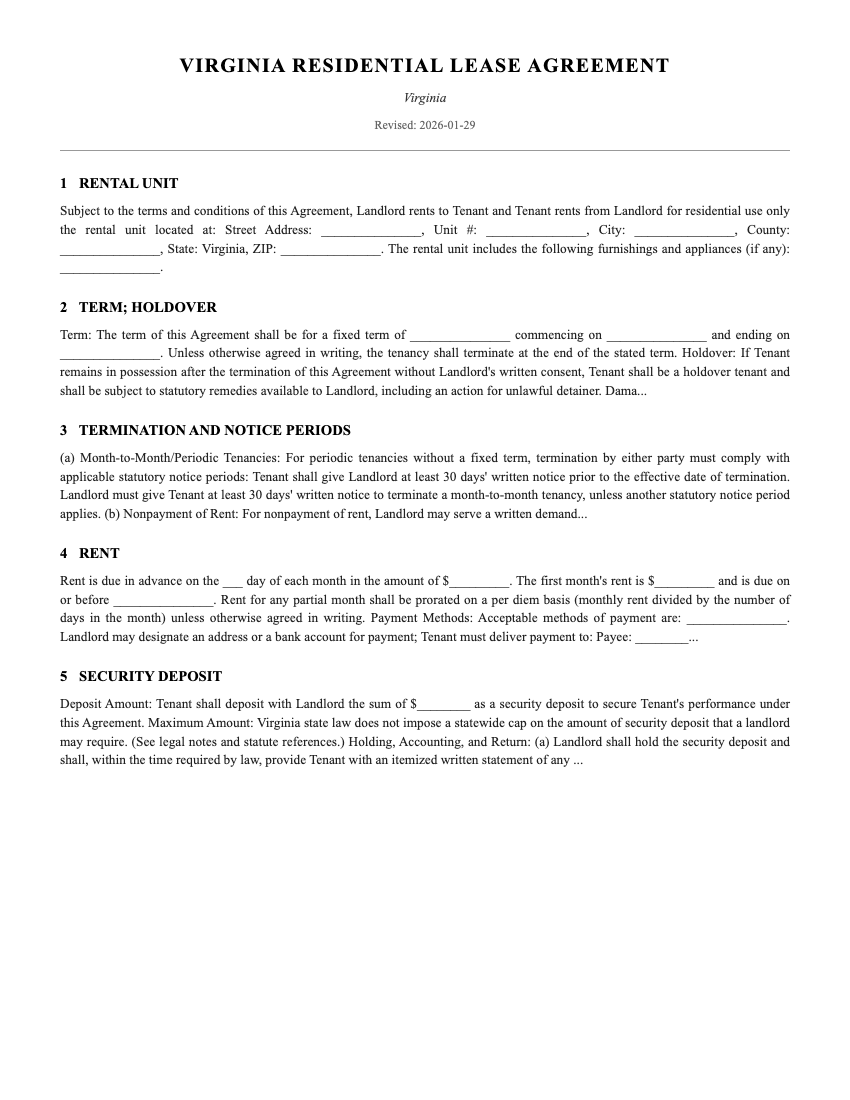
Why Old Templates Are Dangerous (Virginia-specific traps)
- Security deposit timing: Virginia requires a landlord to return the deposit with an itemized statement within 45 days after termination and surrender and receipt of the tenant's forwarding address (Va. Code § 55.1-1226). Old templates may reference outdated deadlines or fail to require an itemized statement.
- Data privacy obligations: The Virginia Consumer Data Protection Act (VCDPA) (Va. Code § 59.1-577 et seq.) affects how landlords collect, store, and share tenant personal data. Older templates won’t include data-consent or data-handling language required by modern privacy regimes.
- Eviction (unlawful detainer) procedure: Eviction in Virginia follows statutory special process and summary ejectment procedures (see Va. Code Title 8.01). Templates that instruct self-help eviction (changing locks, shutting off utilities) are unlawful and expose landlords to liability.
- Local rules and registration: Some cities/counties have rental registration, inspection, or licensing requirements. An old statewide template may miss local disclosures or registration requirements.
- Federal lead disclosures: Federal law requires a lead-based paint disclosure for housing built before 1978 (42 U.S.C. § 4852d). Missing this can lead to civil penalties and rescission rights for tenants.
What's Included in This Template
- Lease term options: fixed-term and month-to-month provisions.
- Rent and payment terms: due dates, acceptable payment methods, late fees (statutorily reasonable and enforceable), returned-check fees.
- Security deposit clause: amount (negotiable), receipt language, permitted deductions, itemized statement requirement, and Va. Code § 55.1-1226 timeline for return.
- Maintenance and repairs: landlord and tenant responsibilities, notice and cure requirements, habitability references.
- Entry by landlord: permitted access for repairs and inspections, respecting tenant privacy and notice requirements.
- Termination and notices: notice periods for month-to-month tenancy (generally 30 days), cure notice procedures, and guidance on unlawful detainer (eviction) filing.
- Disclosures: Lead-based paint (42 U.S.C. § 4852d), VRLTA notices (Va. Code § 55.1-1200 et seq.), sex offender registry information link, and data privacy notice referencing the VCDPA (Va. Code § 59.1-577 et seq.).
- Prohibited provisions: language that attempts to waive statutory rights, permit self-help evictions, or impose illegal penalties.
- Optional addenda: pet addendum, parking rules, lead-paint addendum, inventory checklist, and addendum for property-specific rules (HOA, community rules).
Who Needs This Document
| User Persona | Property Type | Key Benefit of This Template |
|---|---|---|
| Individual landlord | Single-family home or duplex | Simple, VRLTA-compliant lease with clear deposit and return rules (45-day itemization) |
| Property manager | Multi-unit building | Standardized clauses for rent, entry, repairs, and eviction steps to reduce disputes |
| Tenant signing a lease | Apartment or rental house | Understands rights to deposit return, required disclosures, and eviction notice timing |
| Small real estate investor | 2–10 rental units | Scalable template with optional addenda and POD for local ordinance overlays |
Download Options
- PDF (fillable): /downloads/virginia-lease-agreement-2026.pdf
- Word (.docx): available on request for editing before finalization
- Smart fill (recommended): download the PDF, fill online, then upload to an AI contract review tool to verify clauses
We provide a ready-to-sign PDF and an editable Word version for landlords who want to customize terms. After customizing, run the final document through an AI contract review tool for contract analysis.
How to Finalize Your Lease
- Complete the template fields: names, property address, term, rent amount, security deposit amount, and any optional clauses or addenda.
- Confirm required disclosures: provide the federal lead paint disclosure for pre-1978 housing, VRLTA notices, sex offender registry link, and a consumer data notice explaining how tenant personal information will be handled (VCDPA).
- Run the completed lease through an AI contract review tool for a safety check to identify missing statutory language, conflicting notice periods, or illegal clauses.
- Signatures: obtain signatures from all parties. Keep original signed copies for both landlord and tenant and provide a copy to the tenant.
- Security deposit handling: provide a written receipt for the deposit, hold funds per any local requirements, and be prepared to provide an itemized statement and return deposit within 45 days after lease termination and surrender (Va. Code § 55.1-1226).
- Keep documentation: retain inspection checklists, move-in photographs, receipts for repairs, and communications (written notices) to support any future disputes.
Related Lease Agreement Templates
Frequently Asked Questions (Virginia-specific)
- Can a Virginia landlord charge any amount for a security deposit?
No statewide statutory cap exists on security deposits in Virginia; landlords and tenants may agree to an amount in the lease. However, the landlord must return the deposit, less permitted deductions, together with an itemized statement within 45 days after termination and surrender and receipt of the tenant's forwarding address (Va. Code § 55.1-1226). Local ordinances may cap deposits, so check city/county rules. - Is there rent control in Virginia or limits on rent increases?
Virginia has no statewide rent control and no statutory limit on rent increases. Rent increases must comply with the lease terms and any notice provisions (for month-to-month tenancies, 30 days' written notice is typical). Check local ordinances for any city/county restrictions. - What disclosures are required with a Virginia residential lease?
Required disclosures include: the federal lead-based paint disclosure for housing built before 1978 (42 U.S.C. § 4852d), VRLTA informational notices (Va. Code § 55.1-1200 et seq.), a sex offender registry notice (informational), and a consumer data/privacy notice consistent with the Virginia Consumer Data Protection Act (Va. Code § 59.1-577 et seq.). - How long must a landlord wait before filing for eviction for nonpayment of rent?
While Virginia does not prescribe a single mandatory waiting period in all cases, landlords typically serve a demand for payment or possession (commonly a five-day demand to pay or vacate for nonpayment) before filing unlawful detainer/special process actions under Va. Code Title 8.01. Follow the lease's cure and default provisions and statutory procedures for summary ejectment. - Can a tenant have guests or sublet in Virginia?
Guest and subletting rules are governed by the lease. Landlords may restrict subletting and require written consent; they may also set reasonable limits on long-term guests in the lease. Any clause that attempts to unreasonably restrict a tenant's statutory rights (or constitutes a de facto eviction) may be unenforceable. - Do Virginia landlords need to follow special rules when collecting tenant personal data?
Yes. The Virginia Consumer Data Protection Act (VCDPA) (Va. Code § 59.1-577 et seq.) places obligations on certain businesses processing personal data. Landlords should include a consumer data notice in the lease explaining what data is collected, how it is used, and tenant rights under applicable privacy laws. If you handle sensitive tenant data (SSNs, financial info), follow secure data-handling practices and any applicable breach-notification duties under state law.
Final notes
This template is built to align with Virginia statutes and major federal disclosures, but it is not a substitute for legal advice. For complex disputes (habitability, retaliatory actions, discrimination claims under federal/state fair housing laws, or local code enforcement issues), consult a Virginia landlord-tenant attorney.
After customizing, upload your lease to an AI contract review tool for automated verification and to reduce risk of costly mistakes.
Sources
- Virginia Residential Landlord and Tenant Act (VRLTA) — Va. Code Title 55.1, Chapter 12: https://law.lis.virginia.gov/vacode/title55.1/chapter12/ (Code of Virginia)
- Virginia Code — Unlawful Detainer / Summary Ejectment (Title 8.01): https://law.lis.virginia.gov/vacode/title8.01/ (Code of Virginia)
- Virginia Consumer Data Protection Act (VCDPA): https://law.lis.virginia.gov/vacode/title59.1/chapter52.13/ (Code of Virginia)
- EPA / HUD Lead-Based Paint Information: https://www.epa.gov/lead/protect-your-family-lead-your-home (U.S. EPA)
- Virginia State Police — Sex Offender and Crimes Against Minors Registry: https://sex-offender.vsp.virginia.gov/sor/ (Virginia State Police)
<div class="ml-embedded" data-form="bBZ9zR"></div>
Frequently Asked Questions

About Designer Content
Designer Content creates practical legal document resources for landlords, contractors, and small business owners. We simplify complex legal concepts into actionable guidance. Connect with us on LinkedIn.