
Introduction
Drafting a residential lease in California requires careful attention to state law and local ordinances. Since AB 1482 (the Tenant Protection Act of 2019) and updates to security deposit rules effective July 1, 2024, landlords and tenants must ensure lease language complies with Civil Code §§ 1946.1, 1946.2, 1947.12, and § 1950.5, as well as applicable city or county rent-stabilization ordinances. Failure to include mandatory disclosures or to follow statutory notice periods (see Code Civ. Proc. § 1161 and Cal. Civ. Code § 1954) can lead to penalties, delayed evictions, or statutory damages.
This article explains what must be in a California residential lease in 2026, why older templates can be risky, and how to finalize a compliant agreement. Download the template and run it through a contract analysis tool like an AI contract review tool to check for missing jurisdictional language and local ordinance conflicts before signing.
For a comprehensive lease review checklist covering residential and commercial terms, see our Lease Agreement Review Guide.
What is a California residential lease?
A California residential lease is a written contract between a landlord and tenant that sets rental amount, term, security deposit, permitted uses, maintenance obligations, entry rights, required disclosures, and termination procedures for a dwelling within California. It must comply with state statutes including the California Civil Code (e.g., Civ. Code § 1950.5 on security deposits; Civ. Code §§ 1946.1–1947.12 on notice and rent limitations), and with applicable local rent-control and disclosure laws.
Why Old Templates Are Dangerous (California-specific traps)
- Security deposit caps: Templates written before July 1, 2024 may allow deposits greater than the new statewide cap. For deposits demanded or received on/after July 1, 2024, Cal. Civ. Code § 1950.5 generally limits deposits to one month’s rent (two months for qualifying "small landlords" who meet statutory criteria). Using an old form can create an illegal term and expose the landlord to statutory penalties (Cal. Civ. Code § 1950.5(l)).
- AB 1482 (Civil Code §§ 1947.12, 1946.2): Old leases may omit the AB 1482 rent-cap and just-cause disclosures or misstate exemptions (e.g., newer construction, certain owner-occupied duplexes, single-family homes/condos that are separately alienable). Misstating coverage can invalidate termination notices or result in statutory remedies.
- Local rent-control ordinances: Many cities (Los Angeles, San Francisco, Berkeley, West Hollywood, etc.) have stricter rules on rent increases, registration, relocation assistance, and security deposit interest. An outdated statewide form won’t address these local requirements and could allow a tenant to challenge fees or evictions.
- Required disclosures: Newer disclosure requirements and timing (Megan’s Law, MyHazards flood info, smoke/CO alarm requirements, mold booklet) must be included or delivered as required; omission can lead to penalties or tenant claims.
- Notice and entry provisions: California law limits landlord entry and requires reasonable notice (typically 24 hours; see Cal. Civ. Code § 1954). Older forms may contain overly broad access language that violates state law.
- Eviction procedure inaccuracies: Eviction is governed by Code Civ. Proc. § 1161 and related statutes; an out-of-date form might instruct incorrect notice periods (e.g., failing to account for the 30/60 day requirements in Cal. Civ. Code § 1946.1 or AB 1482’s just-cause requirements under § 1946.2).
What's Included in This Template
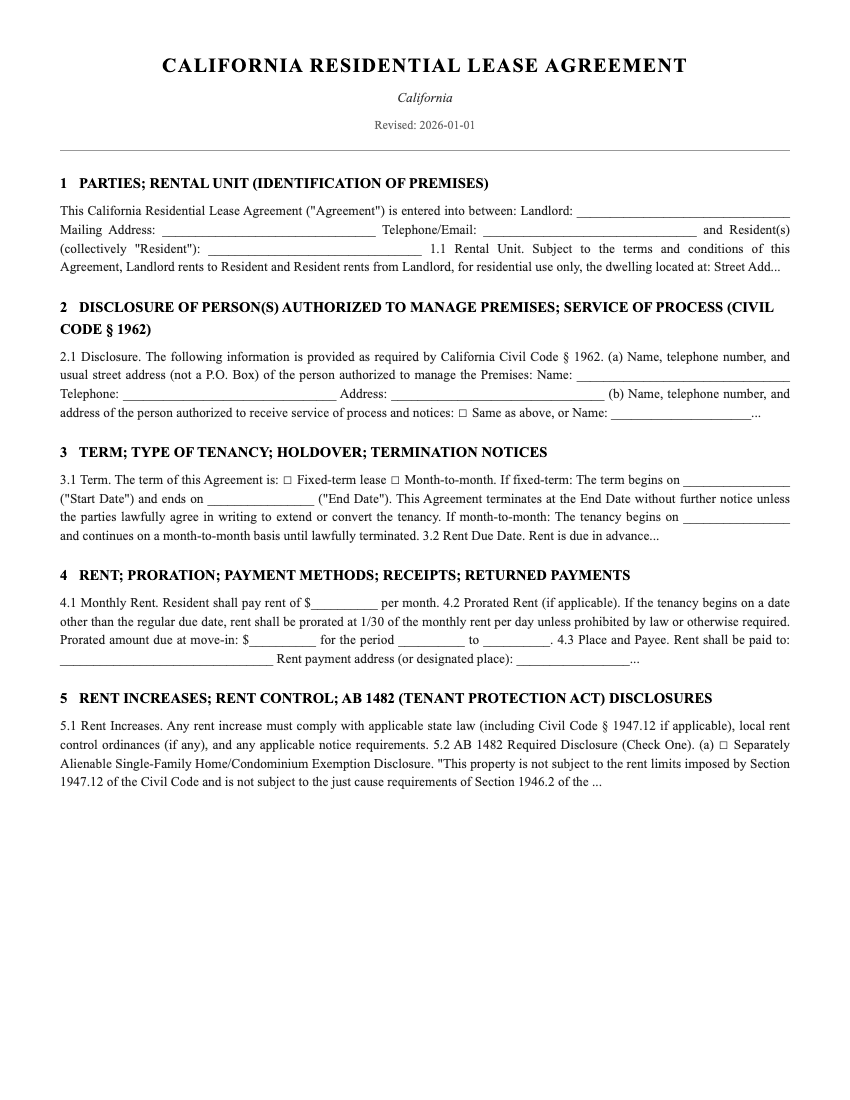
This California lease template (2026) includes:
- Lease terms: fixed-term and month-to-month options, start/end dates, and automatic holdover provisions.
- Rent: amount, due date, accepted payment methods, late-fee section (compliant with state law), and AB 1482 rent-increase language (Cal. Civ. Code § 1947.12).
- Security deposit clause: Cal. Civ. Code § 1950.5-compliant maximum, itemization and return process, 21-day deadline for return and itemized statement (Cal. Civ. Code § 1950.5(g)), and notice on possible statutory damages for bad-faith retention (Cal. Civ. Code § 1950.5(l)).
- Entry and inspection: Permitted reasons and notice requirements consistent with Cal. Civ. Code § 1954 (24-hour written notice for non-emergency entry unless otherwise permitted).
- Termination and notices: 3-day notices for nonpayment and cure/quit (Code Civ. Proc. § 1161), 30/60 day termination notices (Cal. Civ. Code § 1946.1), and AB 1482 just-cause language (Cal. Civ. Code § 1946.2) where applicable.
- Required disclosures: AB 1482 disclosure, manager/agent and service-of-process information, Megan’s Law notice, mold booklet link, MyHazards/flood disclosure, lead-based paint federal addendum (when applicable), pest control notice, military ordnance disclosure (if applicable), demolition/permit disclosure (if applicable), and death-on-property disclosure (if applicable).
- Habitability and repairs: Landlord and tenant repair responsibilities and procedures for repair requests and remedies.
- Utilities and common-area rules: Allocation of utilities, parking, and trash provisions.
- Subletting and assignment: Permission requirements and screening procedures.
- Pet addendum, smoking addendum, and move-in/move-out condition checklist.
- Optional forms: 3-Day Notice templates, move-out statement template for deposit itemization, and a sample AB 1482 coverage/exemption notice.
Related Lease Agreement Templates
Download Options
- Standard PDF (fillable): /downloads/california-lease-agreement-2026.pdf
- Editable Word (.docx): /downloads/california-lease-agreement-2026.docx
- Sample filled lease (example): /downloads/california-lease-example-2026.pdf
Always keep an executed copy for both landlord and tenant. Retain proof of delivery for any required disclosures and the signed lease.
How to Finalize Your Lease
- Verify coverage under AB 1482 and local ordinances: Confirm whether the property is covered by AB 1482 (Cal. Civ. Code §§ 1947.12 & 1946.2) and check city/county rent stabilization rules that may impose additional obligations.
- Tailor deposit and rent clauses: Adjust the security deposit amount to comply with Cal. Civ. Code § 1950.5 (one month’s rent generally for demands/receipts on/after July 1, 2024; two months for qualifying small landlords if conditions are met).
- Add required disclosures: Attach AB 1482 notice, Megan’s Law notice, MyHazards/flood information, mold booklet, lead-based paint disclosure (if built before 1978), and any city-specific forms.
- Review entry, notice, and eviction clauses: Ensure entry notice complies with Cal. Civ. Code § 1954 and that termination language mirrors statutory notice periods (e.g., Code Civ. Proc. § 1161; Cal. Civ. Code § 1946.1). Include relocation assistance language if a no-fault termination applies under Cal. Civ. Code § 1946.2(d).
- Sign, date, and exchange fully executed copies: Provide the tenant with copies of the lease and all disclosures at or before move-in (or when required by law). Keep originals and proof of delivery.
- Run the final document through an AI contract review tool: Use an AI contract review tool to scan the final agreement for missing statutory language, conflicting clauses, and local ordinance issues. Fix issues before implementation.
<div class="ml-embedded" data-form="bBZ9zR"></div>
Frequently Asked Questions

About Designer Content
Designer Content creates practical legal document resources for landlords, contractors, and small business owners. We simplify complex legal concepts into actionable guidance. Connect with us on LinkedIn.