
Introduction
A legally sound lease in New Jersey must do more than set rent and a move‑in date. New Jersey law imposes specific limits and procedures that affect security deposits, interest, returns, eviction and termination, and mandatory disclosures. This template is drafted to reflect the key statutory requirements, including the security deposit cap and interest rules (N.J.S.A. 46:8‑19 to 46:8‑26), the Anti‑Eviction Act requiring just cause for eviction (N.J.S.A. 2A:18‑61.1), and federal lead‑paint disclosure obligations (42 U.S.C. § 4852d).
Compliance matters because failure to follow statutory form and notice requirements can void lease provisions and expose a landlord to statutory damages, attorney's fees, and other penalties. Tenants who do not receive required disclosures or whose deposit handling violates statute have strong remedies. Both parties benefit from a clear, statute‑aware lease.
For a comprehensive lease review checklist covering residential and commercial terms, see our Lease Agreement Review Guide.
What is a New Jersey residential lease?
A New Jersey residential lease is a written contract between a landlord and tenant that sets the term, rent, security deposit, notices and other obligations for occupying residential premises within New Jersey. For many provisions — particularly security deposits and eviction grounds — the lease must conform to state statutes (e.g., N.J.S.A. 46:8‑19 through 46:8‑26 for security deposits and N.J.S.A. 2A:18‑61.1 for termination/eviction rules) and any applicable municipal ordinances.
Why Old Templates Are Dangerous (New Jersey traps)
- Security deposit mechanics changed and are strictly enforced: New Jersey caps deposits at 1.5 months' rent and requires placement in an interest‑bearing New Jersey bank account with annual interest credited or paid to the tenant (N.J.S.A. 46:8‑19 to 46:8‑26). Older forms may not require interest or may permit noncompliant handling.
- Anti‑Eviction Act (Just Cause): Since enactment of N.J.S.A. 2A:18‑61.1, many evictions that would previously have been treated as simple contract terminations require just cause and specific notice language. Old forms that contain unilateral termination without cause or incorrect notice language can be unenforceable.
- Municipal rent ordinances vary: New Jersey has no uniform statewide rent control — dozens of municipalities maintain local rent control/stabilization rules. An out‑of‑the‑box template won't account for municipal clauses like limits on increases, relocation assistance, or exemptions for owner‑occupied buildings.
- Required disclosures evolve: Federal lead paint rules (42 U.S.C. § 4852d) still apply to pre‑1978 housing; local flood‑hazard or inspection disclosures may be required by municipality or lender. Omitted disclosures can lead to statutory claims.
- Eviction procedure & timing: Court practice and statutory remedies (including penalties for improper deposit handling) change. Relying on outdated cure periods, notice forms, or eviction steps risks dismissal and liability.
What's Included in This Template
- Parties, premises, and lease term (fixed‑term and month‑to‑month options)
- Rent amount, due date, late fees (benchmarked to New Jersey limitations on unconscionable fees where applicable)
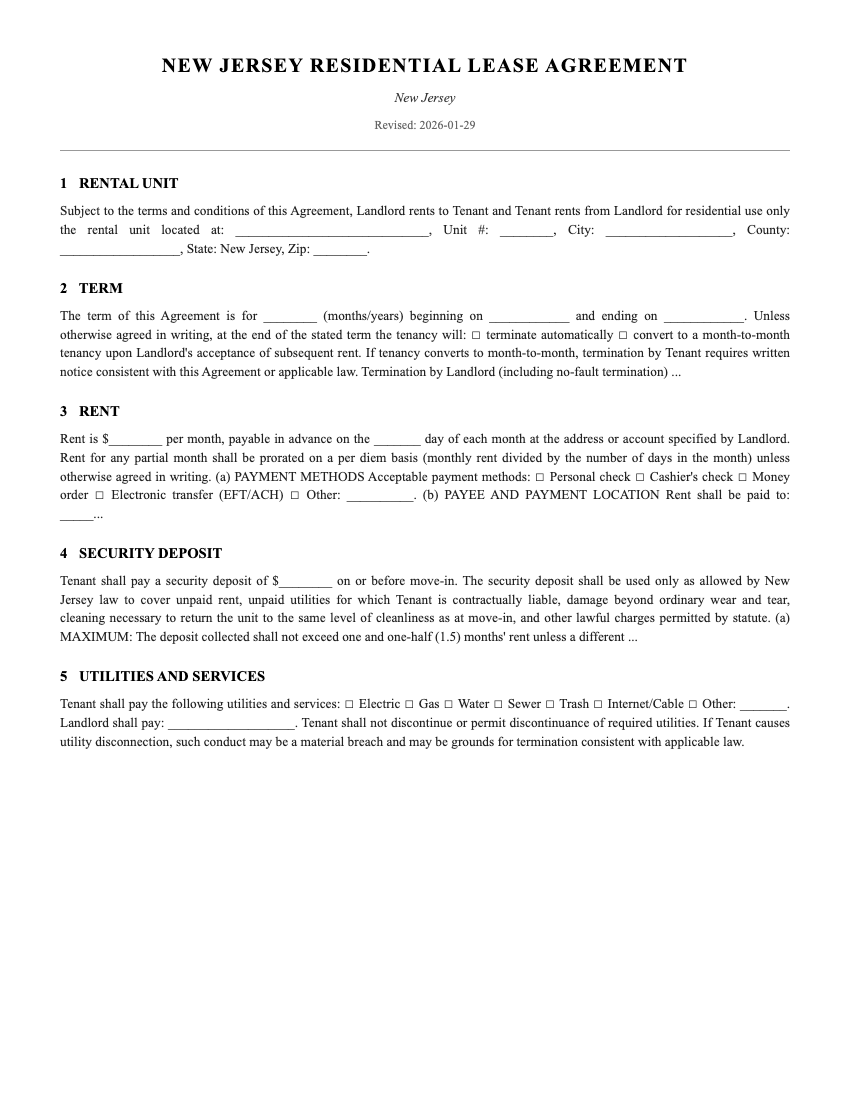
- Security deposit clause compliant with N.J.S.A. 46:8‑19 to 46:8‑26 (1.5 months cap; interest bearing; bank disclosure; annual interest payment/credit; itemized return within statutory timeframes)
- Detailed notice and cure provisions aligned with the Anti‑Eviction Act (N.J.S.A. 2A:18‑61.1) and sample notice language to state cause
- Mandatory disclosures: Security Deposit Notice, Anti‑Eviction / Just Cause disclosure, Retaliation prohibition (N.J.S.A. 2A:42‑10.10), Federal Lead‑Based Paint Disclosure (42 U.S.C. § 4852d), Flood Hazard disclosure, Truth‑in‑Renting / Tenant Information Statement, Fire Safety and Window Guard Notice
- Maintenance and repair obligations, utilities, and access for entry
- Pet addendum, smoke/carbon monoxide detector compliance, and optional local ordinance addendum space
- Subletting and assignment rules; guest policy language to reduce ambiguity about long‑term guests
- Default, cure period, and remedies (drafted to preserve landlord remedies consistent with just‑cause limits)
- Signature blocks and landlord/tenant contact information
Download Options
- PDF (Finalized 2026 text — recommended for signature): /downloads/new-jersey-lease-agreement-2026.pdf
- DOCX (Editable version for customization): available on request — ensure edits comply with statutory requirements
Note: If you customize the DOCX version, run the final draft through an AI contract review tool or a licensed New Jersey attorney to confirm municipal compliance and that required statutory language remains intact.
How to Finalize Your Lease
- Confirm the municipal code: Check the municipal ordinances in the property's local jurisdiction for rent control, registration, inspection, or relocation assistance rules and add any required language.
- Complete the template: Insert names, term, rent, deposit amount (max 1.5 months), bank name for deposit, and annual interest disclosure.
- Provide required disclosures: Attach the security deposit notice, Truth‑in‑Renting/Tenant Information Statement, lead paint pamphlet (if pre‑1978), flood hazard notice, and fire/window guard notice.
- Deliver and sign: Provide the tenant with a copy of the fully completed lease and all disclosures; obtain signed originals (or executed electronic signatures where allowed).
- Hold the deposit properly: Open/identify the New Jersey interest‑bearing account and follow the annual interest credit/payment procedure; provide tenant written receipt for deposit.
- Verify with an AI contract review tool: Upload the executed lease to an AI contract review tool to confirm statutory disclosure clauses, deposit mechanics, and notice language. Address any flagged items promptly.
Related Lease Agreement Templates
FAQs
Q: What is the maximum security deposit I can charge in New Jersey?
A: New Jersey limits security deposits to one and one‑half (1.5) months' rent. The deposit must be held in an interest‑bearing bank account located in New Jersey and the landlord must disclose the bank and method for paying/crediting interest (see N.J.S.A. 46:8‑19 to 46:8‑26).
Q: When must the landlord return the security deposit and an itemized statement?
A: The deposit and an itemized statement of deductions must be returned within 30 days after the tenant vacates. If the premises are destroyed by fire or flood such that the tenancy ends, a 5‑day return period may apply as provided in statute. Failure to comply can lead to statutory penalties including recovery of the deposit, damages, costs and attorneys' fees (N.J.S.A. 46:8‑19 et seq.).
Q: Does New Jersey have statewide rent control or limits on rent increases?
A: No statewide rent control exists. New Jersey municipalities may impose rent control or stabilization rules. For any property, check the local municipal code for restrictions on rent increases, registration, or exemptions. For fixed‑term leases, rent is controlled by the lease terms; for month‑to‑month, termination and increases must respect the Anti‑Eviction Act's just‑cause framework and any local ordinance.
Q: What notices are required before an eviction in New Jersey?
A: Eviction and termination proceedings are governed by the Anti‑Eviction Act (N.J.S.A. 2A:18‑61.1) and court rules. Notices must state the cause for termination and provide any statutory cure period where required. Nonpayment, breach, nuisance, substantial damage, illegal use, and specified owner occupancy are among enumerated lawful grounds. Always follow the statute and local court procedures when seeking possession.
Q: Can a lease restrict guests or require tenants to get permission for long‑term guests?
A: Yes, leases commonly include guest policies and time limits for visitors. However, long‑term guests may acquire tenant‑like rights in some situations; to reduce disputes, define a maximum guest stay (for example, 14–30 days) and state consequences for exceeding it. Ensure guest provisions do not conflict with fair‑housing laws.
Q: What special local requirements should I check before using this template?
A: Check for: (1) municipal rent control/stabilization laws; (2) local registration or inspection requirements; (3) municipal flood‑hazard or disclosure requirements; (4) any local window guard or fire safety rules; and (5) tenant protection ordinances (relocation assistance, just cause extensions) in your municipality. The New Jersey Department of Community Affairs and local municipal clerk are primary resources.
Final tips
- Keep evidence of all disclosures, receipts, and communications. New Jersey remedies often turn on whether the landlord provided required notices and followed the deposit rules.
- When in doubt on municipal rules or complex evictions, consult a New Jersey attorney. Use an AI contract review tool as a pre‑filing compliance check to identify obvious statutory issues before finalizing or serving notices.
<div class="ml-embedded" data-form="bBZ9zR"></div>
Frequently Asked Questions

About Designer Content
Designer Content creates practical legal document resources for landlords, contractors, and small business owners. We simplify complex legal concepts into actionable guidance. Connect with us on LinkedIn.