
Why compliance matters
A clear, legally compliant lease reduces disputes, speeds repairs and collections, and helps landlords and tenants avoid costly litigation. In Pennsylvania, leases are governed by the parties' contract terms, the Landlord and Tenant Act of 1951 (commonly cited as 68 P.S. § 250.101 et seq.), Pennsylvania common law, and applicable federal requirements such as lead-based paint disclosure rules (42 U.S.C. § 4852d). Consumer-protection claims can arise under the Pennsylvania Unfair Trade Practices and Consumer Protection Law (UTPCPL) (73 P.S. § 201-1 et seq.) for bad-faith practices. Local ordinances (for example, City of Philadelphia rental regulations) may add further duties.
What is a Pennsylvania residential lease?
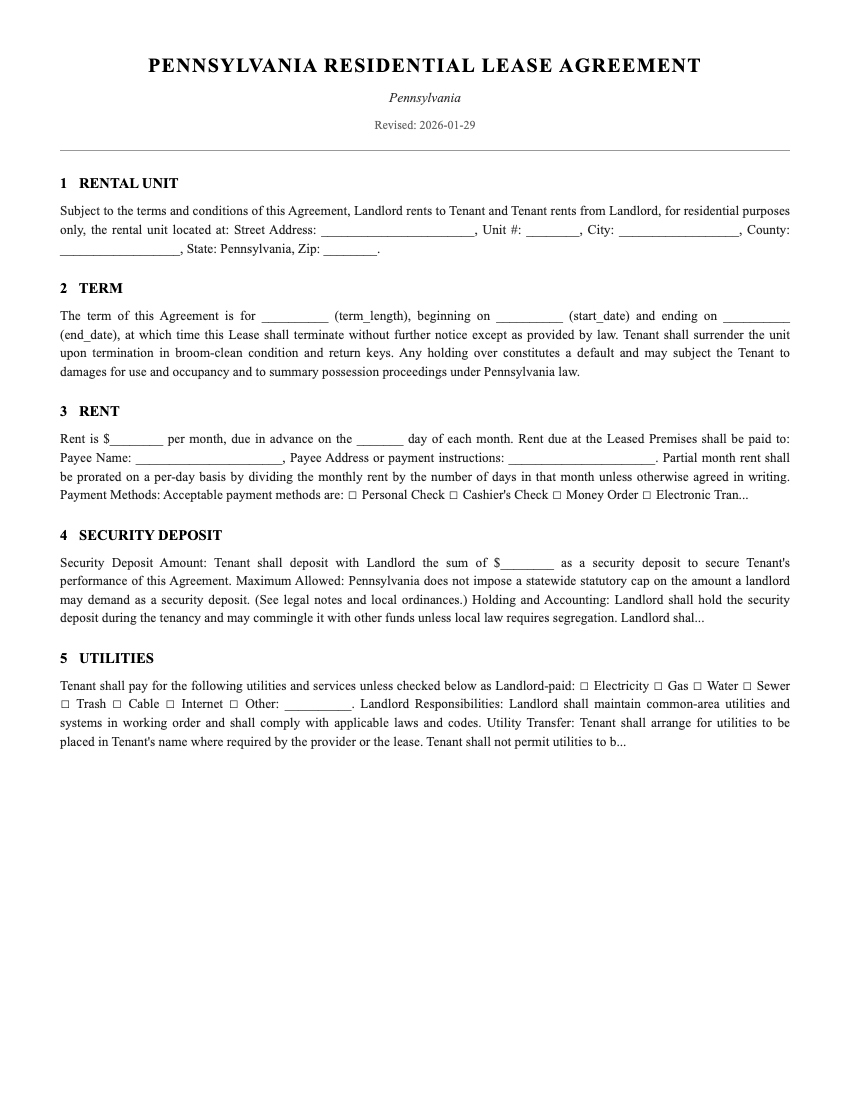
A Pennsylvania residential lease is a written contract between a landlord and tenant that defines the rental term, rent amount and payment terms, security deposit handling (including itemized return obligations), permitted uses (occupancy, pets, subletting), repair and maintenance responsibilities, notice and cure periods for breaches, and required statutory or municipal disclosures. This template is drafted to reflect Pennsylvania law (68 P.S. § 250.101 et seq.), federal lead-paint rules (42 U.S.C. § 4852d), and consumer-protection considerations under the UTPCPL (73 P.S. § 201-1 et seq.).
For a comprehensive lease review checklist covering residential and commercial terms, see our Lease Agreement Review Guide.
Why old templates are dangerous (Pennsylvania-specific traps)
- Security deposit vagueness: Pennsylvania has no statewide cap on deposit amounts. An old form that fails to require an itemized list of damages on return, or that sets no return deadline, leaves landlords exposed to UTPCPL or contract claims and tenants uncertain of their rights. Always include an itemization requirement and a clear return timeline (commonly 30 days by agreement).
- Missing federal disclosures: Dwellings built before 1978 require the federal lead-based paint disclosure and EPA/HUD pamphlet (42 U.S.C. § 4852d). Old templates often omit the lead disclosure altogether.
- Out-of-date notice language: Magisterial district courts and common practice in Pennsylvania frequently rely on lease-specified cure periods for nonpayment or breaches. An old form might reference superseded procedures or incorrect cure periods. Specify cure periods and notice methods in the lease (e.g., 10-day demand for unpaid rent before filing for summary possession if you choose that remedy).
- Overbroad entry clauses: Pennsylvania follows common-law reasonableness for landlord entry absent explicit local rules. Broad, unrestricted entry clauses ("Landlord may enter at any time") are generally unenforceable and may violate local ordinances. Define permitted reasons for entry and reasonable notice (commonly 24–48 hours for non-emergencies).
- Failure to check local law: Municipalities like the City of Philadelphia impose registration/licensing, property-maintenance, and other tenant-protection measures that override or supplement lease terms. An old statewide form that ignores municipal rules can expose the landlord to fines and tenants to unsafe conditions.
What's included in this template
- Parties and property description (landlord, tenant, premises address)
- Lease term and renewal options (fixed-term and month-to-month options)
- Rent amount, due date, late fees, accepted payment methods
- Security deposit amount, itemization requirement, and return procedure (landlord must provide an itemized statement of deductions)
- Utilities and services allocation
- Repairs, maintenance, and habitability obligations
- Entry by landlord: notice and permitted reasons
- Subletting and assignment rules
- Pets and service-animal accommodations (ADA and FHA compliance note)
- Default remedies, cure periods, and summary possession notice procedures
- Required disclosures: Lead-Based Paint (federal), consumer-protection notice (UTPCPL relevance), and Megan's Law (sex-offender registry informational notice)
- A clause identifying Pennsylvania law as governing and noting local ordinance compliance
- Signature lines and optional witness or notary blocks
Download Options
- PDF (print-ready): /downloads/pennsylvania-lease-agreement-2026.pdf
- Fillable DOCX (customize in Word)
- Plain-text version for copying into property management software
Choose the format that best fits your workflow. After customizing, run the final document through an AI contract review tool for a compliance review.
How to finalize your lease
- Customize fields: fill in names, dates, rent, deposit, utilities, and any agreed cure periods.
- Add local disclosures: check municipal requirements (e.g., City of Philadelphia rental registration or local lead-paint programs) and add any mandated language.
- Attach federal lead-based paint disclosure (if the building was built before 1978) and provide the EPA/HUD pamphlet to the tenant (42 U.S.C. § 4852d).
- Sign and date: obtain signatures from all parties and consider a witness or notary where required for your use case.
- Distribute copies: provide the tenant with a fully executed copy and keep originals in your records.
- Run an AI contract review tool safety check to flag remaining risks and confirm compliance with Pennsylvania statutes and local ordinances.
Additional drafting tips
- State the security-deposit return deadline expressly (a common and commercially reasonable choice is 30 days, but parties may agree otherwise). Although Pennsylvania has no single statewide mandatory deadline, clarity reduces disputes.
- For periodic tenancies, include the notice required to terminate (30 days is commonly used for month-to-month tenancies unless local law requires otherwise).
- If you will initiate summary possession (eviction) for nonpayment, include a written demand/cure period in the lease consistent with local magisterial court practice; consult local court rules.
- Keep repair and habitability obligations detailed and include tenant notice procedures for repair requests.
Local considerations to confirm
- Philadelphia: Check City of Philadelphia rental and licensing requirements and any local tenant-protection ordinances. See phila.gov resources.
- Other municipalities: Counties and boroughs may have property-maintenance codes, inspection programs, or registration requirements.
Related Lease Agreement Templates
FAQs
(See the FAQ section below for quick answers to common Pennsylvania questions.)
--
<div class="ml-embedded" data-form="bBZ9zR"></div>
Frequently Asked Questions

About Designer Content
Designer Content creates practical legal document resources for landlords, contractors, and small business owners. We simplify complex legal concepts into actionable guidance. Connect with us on LinkedIn.