
Vermont Residential Lease Agreement — What you need to know
Whether you are a landlord renting your first single-family home in Burlington or a tenant signing a Warwick apartment lease, Vermont law sets specific rules that affect what you can include in a residential lease and how disputes are handled. This template is drafted for compliance with Vermont landlord–tenant law found in Title 9 of the Vermont Statutes and with federal disclosure obligations (for example, lead-based paint for pre-1978 housing). Use the template as a starting point, then finalize it to reflect your agreement and local rules.
Vermont-specific highlights:
For a comprehensive lease review checklist covering residential and commercial terms, see our Lease Agreement Review Guide.
Vermont has no statewide rent control and no statutory dollar cap on security deposits; however, landlords must provide an itemized accounting and return the security deposit promptly (see Legal Sources below).
- Eviction procedures, notice periods, and cure rights are governed by provisions in Title 9 (see 9 V.S.A. and Chapter 137 on forcible entry and detainer). Tenants and landlords should follow statutory notice windows for nonpayment and breaches.
- Certain municipal ordinances, subsidized housing rules, or federal program rules can add requirements — always confirm local rules for the property.
Definition — What is a Vermont residential lease?
A residential lease in Vermont is a written agreement between a landlord and tenant that sets the terms and conditions for occupying residential premises (rental amount, term length, security deposit, disclosures, obligations, and termination procedures). In Vermont, many landlord–tenant rights and remedies are governed by Title 9 of the Vermont Statutes (including eviction procedures), alongside federal disclosure laws such as the Lead-Based Paint Disclosure Rule (42 U.S.C. § 4852d and related EPA regulations).
Why Old Templates Are Dangerous (Vermont traps to avoid)
- Security deposit misunderstandings: Vermont has no statewide dollar cap on deposits, but the law requires an itemized accounting and prompt return. Using an older template that references a different state's cap or omits the return deadline can create legal exposure.
- Wrong notice periods: Notice times vary by type of tenancy and the reason for termination. Many templates use a generic 30-day rule; Vermont law commonly requires a 14-day pay-or-quit notice for rent nonpayment and a 30-day notice for month-to-month terminations — but the exact statutory source matters. Using the wrong period can invalidate a termination.
- Missing required disclosures: Federal lead-based paint disclosures (for units built before 1978), flood-hazard advisories, material defect/habitability notices, and sex-offender registry advisories are required or strongly recommended. Old templates may omit these or present outdated federal language.
- Eviction procedure errors: Vermont eviction (forcible entry and detainer) follows statutory steps (notices, filings, court process). An out-of-jurisdiction template may prescribe an incorrect cure period or improper service method.
- Municipal law and program rules: Some towns or housing programs impose additional rules (for example, municipal rental registration, local ordinance restrictions, or subsidized housing 'cause' protections). A generic template won't catch local obligations.
Using this Vermont template helps reduce those risks by reflecting typical Vermont statutory requirements and including prompts to confirm local rules.
What's Included in This Template
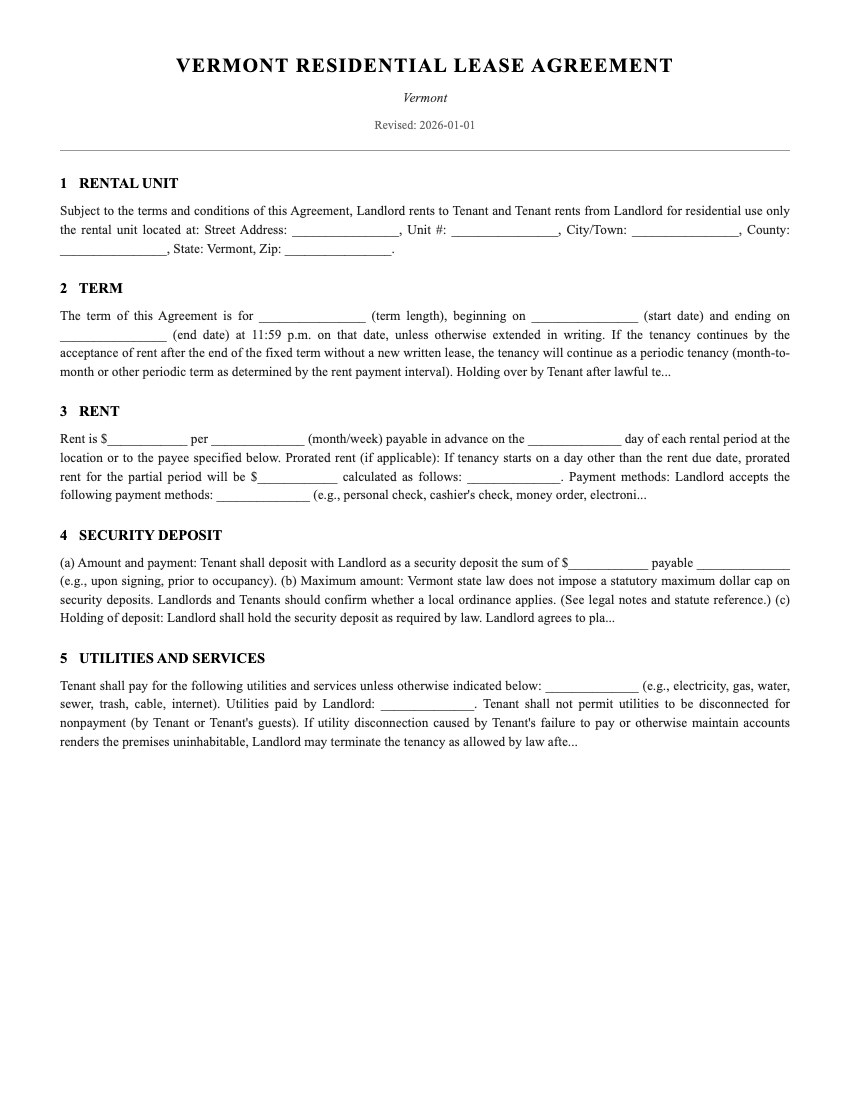
- Basic lease terms: landlord and tenant names, unit address, lease start and end dates, rent amount, late fees and grace periods (designed for Vermont enforceability), permitted uses, and utilities allocation.
- Security deposit clause: deposit amount field, itemized return procedure, 14-day return requirement, and remedies for landlord noncompliance.
- Notice and termination section: cure periods, nonpayment pay-or-quit language, month-to-month termination language tailored to Vermont notice norms, and a reference to eviction procedures under 9 V.S.A.
- Required disclosures: lead-based paint disclosure (for pre-1978 units), material defects/habitability notice, flood hazard/FEMA advisory, and sex-offender registry advisory language.
- Maintenance and habitability obligations: landlord repair duties and tenant maintenance obligations with citations to Vermont habitability standards.
- Entry and notice for landlord access: reasonable entry procedures and notice periods consistent with Vermont practice.
- Default and remedies: repair-and-deduct limitations, termination for cause, and reference to statutory eviction procedures.
- Optional addenda: pet addendum, subletting consent form, and smoke/carbon monoxide detector acknowledgment.
Download Options
- Single-file PDF (print-ready): Download
- Editable DOCX (customize terms before finalizing): contact the provider or use the PDF-to-DOC editor
- an AI contract review tool review: upload the finalized draft to an AI contract review tool for a contract safety review and suggested edits
How to Finalize Your Lease
- Complete all bracketed fields (names, dates, amounts, property details).
- Confirm local rules: check municipal ordinances and any housing-program requirements that apply to the property.
- Attach required disclosures and addenda (lead disclosure for pre-1978 properties, flood advisory, sex-offender advisory, habitability addendum).
- Both parties sign and date every page (or initial each page and sign final page) and exchange signed originals or verifiable e-signed copies.
- Landlord documents security deposit receipt and keeps copies of all disclosures given to tenant.
- Upload the fully executed lease to an AI contract review tool for a final safety check and to generate a printable signing package.
Practical Tips for Vermont Landlords and Tenants
- Landlords: Keep detailed records of deposit receipts, move-in condition reports, repair requests, and communications — these records are critical if there is a disputed deposit or eviction.
- Tenants: Request a written list of move-in damages and keep dated photos. If you pay a deposit, get a written receipt detailing the amount, where it is held, and the landlord's obligations.
- Both: Consider mediation before eviction filings — Vermont courts often encourage settlement and mediation can save time and cost.
Related Lease Agreement Templates
Frequently Asked Questions (Vermont-specific)
(See the FAQs section below for more detail.)
<div class="ml-embedded" data-form="bBZ9zR"></div>
Frequently Asked Questions

About Designer Content
Designer Content creates practical legal document resources for landlords, contractors, and small business owners. We simplify complex legal concepts into actionable guidance. Connect with us on LinkedIn.