
Introduction
Drafting a residential lease in New York requires more than filling in names and dollar amounts. Since passage of the Housing Stability and Tenant Protection Act of 2019 (L.2019, ch.36) and continuing local regulation in New York City, leases must comply with statewide limits (for example, a one‑month security deposit cap), non‑waivable tenant protections (Real Property Law § 235‑b), and procedural rules for eviction under the Real Property Actions and Proceedings Law (RPAPL). In NYC, rent‑stabilized and rent‑controlled units follow additional statutory and administrative requirements administered by state and municipal authorities. Using a current, jurisdiction‑specific template reduces risk of unenforceable provisions, statutory penalties, and costly litigation.
Definition — What is a New York residential lease?
A New York residential lease is a written contract between a landlord and tenant that sets the term, rent, security deposit, permitted uses and occupants, and the rights and obligations of each party for occupancy of a dwelling unit within New York State. Where applicable, the lease must incorporate state and local mandatory protections—such as the Housing Stability and Tenant Protection Act of 2019, the warranty of habitability under Real Property Law § 235‑b, RPAPL procedural requirements (including the 14‑day demand to pay or quit standard for nonpayment), and NYC rent‑regulation rules—and must include all required disclosures (lead paint, bed‑bug history, flood hazards, smoking policy and applicable NYC notices like window‑guard and sprinkler notices).
For a comprehensive lease review checklist covering residential and commercial terms, see our Lease Agreement Review Guide.
Why Old Templates Are Dangerous (New York‑Specific Traps)
- Security deposit cap violations: The Housing Stability and Tenant Protection Act of 2019 caps security deposits at one month's rent statewide. Older leases that require two months' rent or more are illegal and can expose landlords to statutory penalties.
- Attempting to waive habitability: Any clause purporting to waive the warranty of habitability is void under Real Property Law § 235‑b.
- Rent‑stabilization and rent‑control misclassification: Using a generic template can fail to protect regulated tenants (mandatory renewal rights, lease registration with DHCR, Rent Guidelines Board increases) or can cause landlords to accidentally overcharge regulated tenants.
- Incorrect notice periods: Eviction and termination notices in New York follow RPAPL and local rules. For nonpayment, a 14‑day demand to pay or quit is the usual predicate for summary proceedings—older forms that use different timelines may be ineffective.
- Missing disclosures: Federal and local disclosure requirements (lead‑based paint for pre‑1978 buildings, bed‑bug history, flood hazard, smoking policy, and applicable NYC notices such as window guard and sprinkler information) can trigger penalties or deprive landlords of certain remedies if omitted.
- Improper fee clauses: After 2019 reforms, many fees (late fees, application fees, etc.) are limited or must be reasonable and based on actual damages. Pre‑2019 templates often include excessive fee provisions.
Using an up‑to‑date, jurisdiction‑specific template avoids these pitfalls.
What's Included in This Template
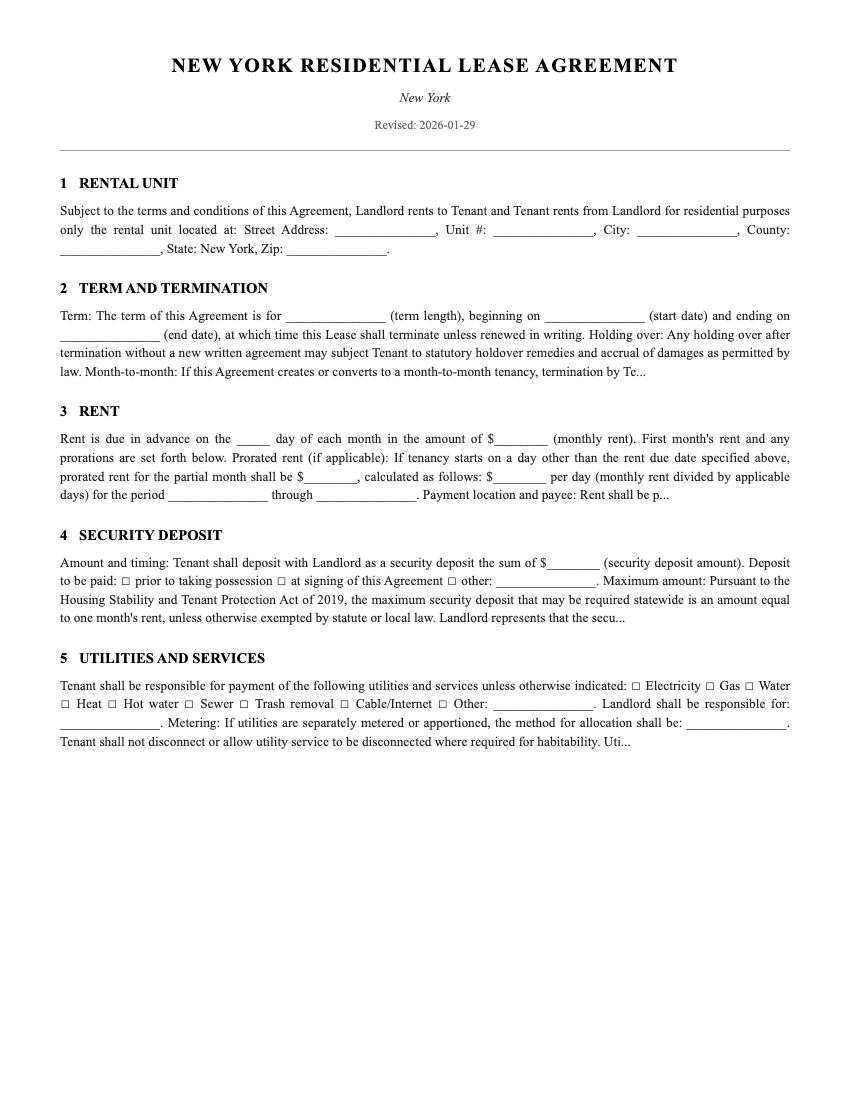
This downloadable New York Residential Lease Agreement (2026 version) includes:
- Compliant security deposit clause capped at one month's rent with itemization and return procedure language.
- Warranty of habitability language that acknowledges the tenant's statutory rights under RPL § 235‑b (non‑waivable).
- Rent payment terms, permitted late fee language consistent with state guidance (reasonable and based on actual damages), and accepted payment methods.
- Eviction and termination provisions aligned with RPAPL summary proceeding prerequisites (14‑day demand for nonpayment) and month‑to‑month notice periods (30/60/90 days based on tenancy length).
- Optional rent‑stabilization addendum and instructions for landlords with regulated units (NYC) including renewal lease language and DHCR registration reminders.
- Required disclosure checkboxes and text for: lead‑based paint (federal EPA disclosure for pre‑1978 housing), bed‑bug history, flood zone/flood hazard, smoking policy, and NYC‑specific notices (window guard, sprinkler system where applicable).
- Move‑in/checklist for condition reporting, pet/addendum sample, subletting and assignment rules, and guest/occupancy policy.
- Signature blocks, execution and service instructions, and a short landlord/tenant best‑practices checklist.
Download Options
- Full 2026 Compliant Lease (PDF): /downloads/new-york-lease-agreement-2026.pdf — ready to print and sign.
- Editable Word (.docx): download with fillable fields so landlords and property managers can customize clauses (available on the download page).
- Fillable PDF: Use to collect digital signatures and preserve form layout.
Each download is accompanied by an instruction sheet describing where to insert building‑specific disclosures and how to use the AI contract review tool Safety Check.
How to Finalize Your Lease
- Customize the template: insert the property address, term, rent, and any negotiated special terms.
- Confirm rent‑regulation status: check DHCR/HCR and NYC resources to determine if the unit is rent‑stabilized or controlled—if so, include the rent‑stabilization addendum and register as required.
- Add mandated disclosures: lead paint (for pre‑1978), bed‑bug history, flood hazard notice, smoking policy, and any NYC required notices (window guards, sprinkler info) depending on the building and unit.
- Run the lease through an AI contract review tool: upload the completed draft and address any flagged issues (illegal clauses, missing required language, or conflicts with NY statutes).
- Execute properly: have both parties sign and date the lease, provide copies to the tenant(s), collect lawful security deposit (max one month's rent) and provide a signed receipt, and, if applicable, register the lease with DHCR for regulated units.
- Maintain records: keep a signed copy of the lease, move‑in checklist, deposit receipt, notice history, and any correspondence.
Related Lease Agreement Templates
Frequently Asked Questions (New York Specific)
- Q: What is the maximum security deposit a landlord can require in New York?
A: State law (Housing Stability and Tenant Protection Act of 2019) caps security deposits at one month's rent statewide. Landlords must return the deposit (less lawful deductions) and provide an itemized statement in the time required by applicable state or local law. - Q: Do I have to pay interest on a New York security deposit?
A: New York State does not generally require landlords to pay interest on security deposits. Some local ordinances may require interest accounting—landlords should check local rules where the property is located. - Q: How do rent‑stabilization rules affect my lease in New York City?
A: If the unit is rent‑stabilized or rent‑controlled, the lease must comply with statutory protections: renewal rights, limits on increases (set by the NYC Rent Guidelines Board), succession rights, and registration with the DHCR/HCR. Use the rent‑stabilization addendum in this template and consult the NYC Rent Guidelines Board and HCR guidance. - Q: What notice do I need to give a tenant before starting eviction for nonpayment?
A: For nonpayment of rent, landlords generally must serve a 14‑day written demand to pay rent or vacate before commencing a nonpayment summary proceeding under RPAPL. Always confirm procedural requirements and local court rules before filing. - Q: What disclosures are required when renting a unit in New York?
A: Common required disclosures include federal lead‑based paint disclosures for properties built before 1978, bed‑bug history (where applicable), flood hazard information, the building smoking policy, and NYC‑specific notices (such as window‑guard and sprinkler notices when applicable). Ensure each disclosure is delivered in the required form and timeframe. - Q: Can a landlord include a clause to limit guests or short‑term sublets?
A: Yes, leases commonly include occupancy limits, guest policies (for example, a maximum consecutive days before a guest is considered an occupant), and subletting/assignment rules. However, restrictions must not conflict with statutory rights (for example, rent‑stabilized tenants have specific sublet procedures). Be specific and reasonable in drafting guest/sublet rules and follow any required approval process for regulated units.
Bottom Line
Use a New York‑specific lease template that reflects the Housing Stability and Tenant Protection Act of 2019, Real Property Law § 235‑b, RPAPL procedures, and local NYC rules where applicable. After customization, run the lease through an AI contract review tool for a contract compliance check and retain copies of all executed documents and mandated disclosures.
<div class="ml-embedded" data-form="bBZ9zR"></div>
Frequently Asked Questions

About Designer Content
Designer Content creates practical legal document resources for landlords, contractors, and small business owners. We simplify complex legal concepts into actionable guidance. Connect with us on LinkedIn.