
Section 1: Opening
An MSA for Russia is a “master agreement” (framework agreement) between the Customer and the Contractor, which sets out the general terms of service provision, while specific tasks are formalized as separate assignments/appendices (SOW/technical specification (ТЗ)). This format is convenient for agencies, IT contractors, and consultants: you agree on the “rules of the game” once and then launch new projects faster. In Russian practice, it is important to take into account the provisions of the Civil Code of the Russian Federation (ГК РФ) on obligations, liability, and interest for late performance, as well as the requirements of 152‑ФЗ when working with personal data.
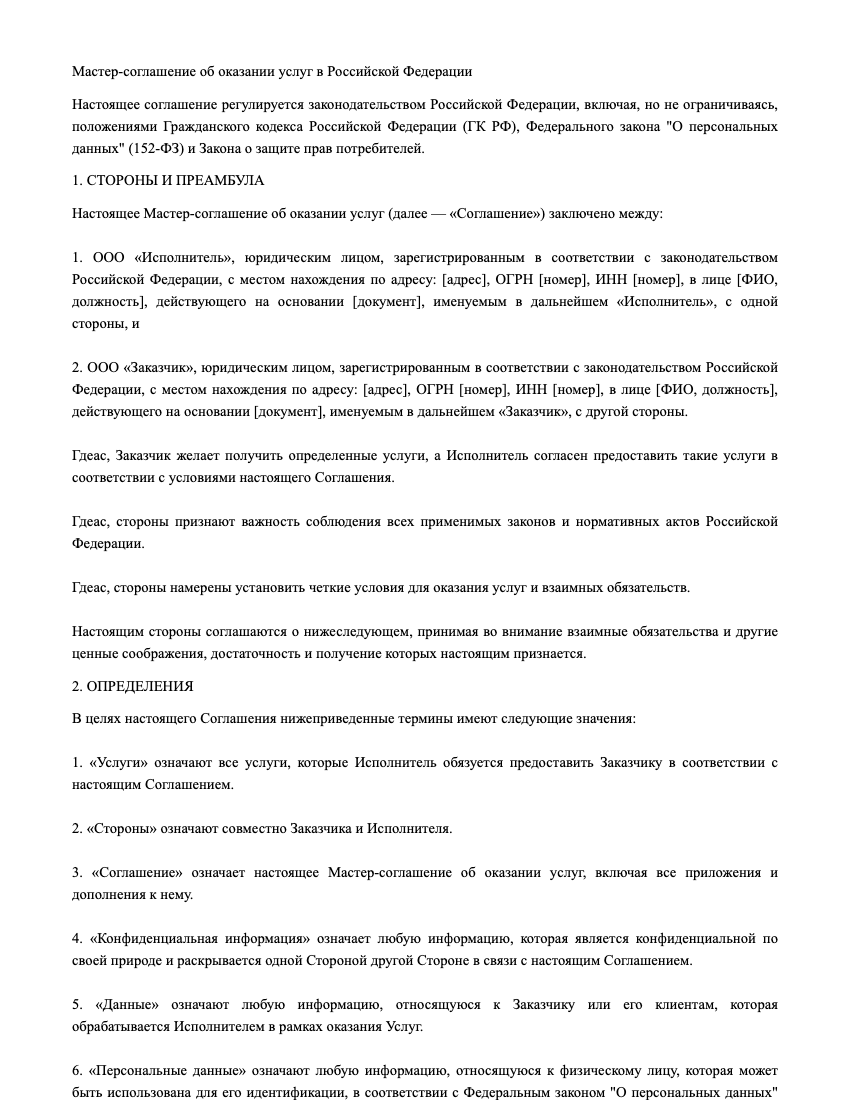
For a comprehensive guide to structuring MSAs and SOWs that protect your business, see our Freelancer Contracts Guide.
Section 2: Definition Box
Definition: A Master Services Agreement (MSA) in Russia is a framework civil-law agreement that establishes uniform terms of cooperation for many future projects (payment, acceptance, liability, confidentiality, dispute procedure). The specific scope of services, timelines, budget, and deliverables are set out in separate Statements of Work (SOW)or appendices (Statement of Work, Specification, Work Order), which become part of the agreement. In a B2B context, this approach reduces the number of negotiations and the risks of scope “creep,” but only if the MSA is adapted to Russian norms of the Civil Code of the Russian Federation (ГК РФ) and the requirements of the personal data law.
Section 3: Why You Cannot Use a Generic MSA in Russia
Generic English-language templates are often designed for common law and for other “default” concepts (consideration, broad indemnities, work‑for‑hire), which operate differently in Russia. In addition, Russian counterparties (especially large ones) expect familiar wording on acceptance, primary documents, VAT/tax clauses, and jurisdiction of commercial courts. If you use a “generic MSA,” you risk a dispute over the status of the relationship, who owns the work results, and how penalties for late payment are calculated.
Worker Classification Rules
Russia does not use the ABC test. The key risk is when an agreement with an individual contractor in fact disguises employment relations. The Labour Code of the Russian Federation defines employment relations as the performance by an employee of a labour function in the interest of, under the management and control of the employerwith subordination to internal work rules and regular payment of wages (Art. 15 of the Labour Code of the Russian Federation (ст. 15 ТК РФ)), and an employment contract is mandatory if such features are present (Art. 56 of the Labour Code of the Russian Federation (ст. 56 ТК РФ)). If in the MSA you prescribe a “9–18 schedule,” a permanent workplace, daily reports like for an employee, and disciplinary measures, the labour inspectorate or a court may reclassify the relationship as employment. Consequences: additional assessment of insurance contributions/personal income tax (НДФЛ), an obligation to execute an employment contract, and administrative liability for violation of labour legislation (e.g., under Art. 5.27 of the Code of Administrative Offences (ст. 5.27 КоАП РФ)). In the MSA and SOW it is important to expressly stipulate the Contractor’s independence, result-based remuneration, absence of subordination, and the ability to engage subcontractors (if permissible).
Non-Compete Enforceability
In Russia, “classic” non-competes, as in the U.S., are heavily limited for employees: the Constitution of the Russian Federation guarantees freedom of labour (Art. 37), and labour legislation does not provide for a full ban on working for competitors after dismissal. For B2B contractors (legal entities/individual entrepreneurs), the parties are freer to set obligations (principle of freedom of contract — Art. 421 of the Civil Code of the Russian Federation (ст. 421 ГК РФ)), but an overly broad ban “not to work in the industry” may be found disproportionate or contrary to the fundamentals of public order. In practice, it is more reliable to use alternatives: (1) strict confidentiality and protection of trade secrets relying on the trade secret regime (152‑ФЗ has nothing to do with this; rules on secrecy and contractual confidentiality apply), (2) a non-solicitation of employees/clients within narrow limits, (3) contractual penalties for disclosure, (4) restrictions on the use of results and the brand. If you nevertheless include a competitive restriction for B2B, make it narrow: a specific list of competitors/projects, a short term, geography, and compensation/reasonable fee; otherwise, dispute risk increases.
IP/Work-for-Hire Considerations
In Russia, rights to work results cannot be left "by default." For copyrightable works, there is a presumption that the exclusive right belongs to the author, and the customer receives rights only to the extent set out in the agreement. Therefore, the MSA/SOW must expressly specify: what is being created (software, design, texts), the timing of the transfer of exclusive rights, and the territory/term/methods of use. For employee-created (service) works there are separate rules (Art. 1295 of the Civil Code of the Russian Federation (ст. 1295 ГК РФ)), and in contractor B2B relationships an assignment agreement/license under Part IV of the Civil Code of the Russian Federation is more commonly used (e.g., Art. 1285 and Art. 1235 of the Civil Code of the Russian Federation (ст. 1285 и ст. 1235 ГК РФ)). "Work made for hire" as a U.S. concept is better not copied verbatim.
Section 4: What's Included in This Template
Flexible SOW structure (50 words).The MSA template sets out the general terms, and each assignment is documented in a separate SOW/technical specification: scope, timelines, cost, acceptance criteria, and result delivery format. This reduces scope creep risk and simplifies launching new work without re-signing the entire contract.
Russia-specific liability and compensation (50 words).The template relies on liability rules for breach of obligations and force majeure, including limitation of liability to permissible caps and interest on late payments (ст. 395 ГК РФ). It also provides for acceptance and documentation of results in accordance with Russian practice.
Disputes and governing law/jurisdiction (50 words). For B2B contracts, the key is to designate the court in advance: typically the Arbitration Courts of the Russian Federation, and the template can specify Moscow as the place of proceedings (by the defendant's location or contractual jurisdiction, where applicable). This saves time and reduces forum shopping.
Additional provisions (based on norms):
- Interest on late monetary obligations — Art. 395 ГК РФ.
- General statute of limitations — ст. 196 ГК РФ (3 years).
- Liability for fault and relief from liability for force majeure — Art. 401 ГК РФ.
- Processing of personal data and data processing mandate —152‑ФЗ "On Personal Data".
Section 5: Who Needs This Document?
| User Type | Relationship | Key Benefit |
|---|---|---|
| IT studios and software developers | Project development and support | Clear rights to code, acceptance and payment milestones |
| Marketing agencies | Retainer/monthly services | SOW for each month, protection from “additional work” |
| Consultants (finance/HR/business) | Long-term support | Liability limits and clear KPI/results |
| Content/design contractors | Series of tasks | Transfer of rights and prohibition of unauthorized use |
Section 6: How to Use This MSA Template
Step 1: Identify the parties and details
Enter the precise legal names, OGRN/INN (for legal entities) or IP details, addresses and banking details. This is important for subsequent acts and debt collection.
Step 2: Set the Term and Termination Process
Define a fixed term or “until termination” basis. Include notice, payment for actually rendered services and return of materials.
Step 3: Attach the first Statement of Work / Technical Specification
In the SOW, set out the deliverable, acceptance criteria, deadlines, price, milestones, and format of delivery. Do not overload the MSA with project details.
Step 4: Sign and document acceptance
Sign the MSA and SOW, then prepare stage-based acts/reports. Documented acceptance reduces the risk of disputes over quality and scope.
Section 7: Already Receiving Contracts from Clients?
An MSA is useful when you send the contract to a client, but in practice it is often the other way around: the client sends their template, which may contain hidden risks — evergreen penalties, unilateral acceptance, transfer of rights “to all future developments,” inconvenient jurisdiction, or excessive data protection requirements. Before signing, review such clauses and compare them with the Civil Code of the Russian Federation (ГК РФ) and 152‑ФЗ. For a quick initial analysis, use:an AI contract review tool.
Section 8: Download Options
Free PDF Version: download the PDF version of the MSA template for review and internal alignment. It is convenient as a “read-only” reference.
Editable Word/Google Docs Version: obtain an editable version to populate details, configure SOW, rates, liability limits, and personal data terms for your project.
Section 9: Disclaimer
Material is for informational purposes and is not legal advice. For complex projects and disputes, consult a lawyer in the Russian Federation.
Related MSA Templates
Get the Template
Sign up for our newsletter to receive the template.
Frequently Asked Questions

About Designer Content
Designer Content creates practical legal document resources for landlords, contractors, and small business owners. We simplify complex legal concepts into actionable guidance. Connect with us on LinkedIn.