
Tennessee Residential Lease Agreement — Why compliance matters
Using a lease tailored to Tennessee law prevents avoidable disputes, monetary exposure, and delays in enforcement. Tennessee's Residential Landlord and Tenant Act (Tenn. Code Ann. Title 66, Chapter 28) controls many landlord-tenant duties including security deposit handling, disclosure obligations, and remedies for breach. Eviction (forcible entry and detainer) and court timelines are governed by Tenn. Code Ann. Title 29, Chapter 18 together with Title 66, Chapter 28.
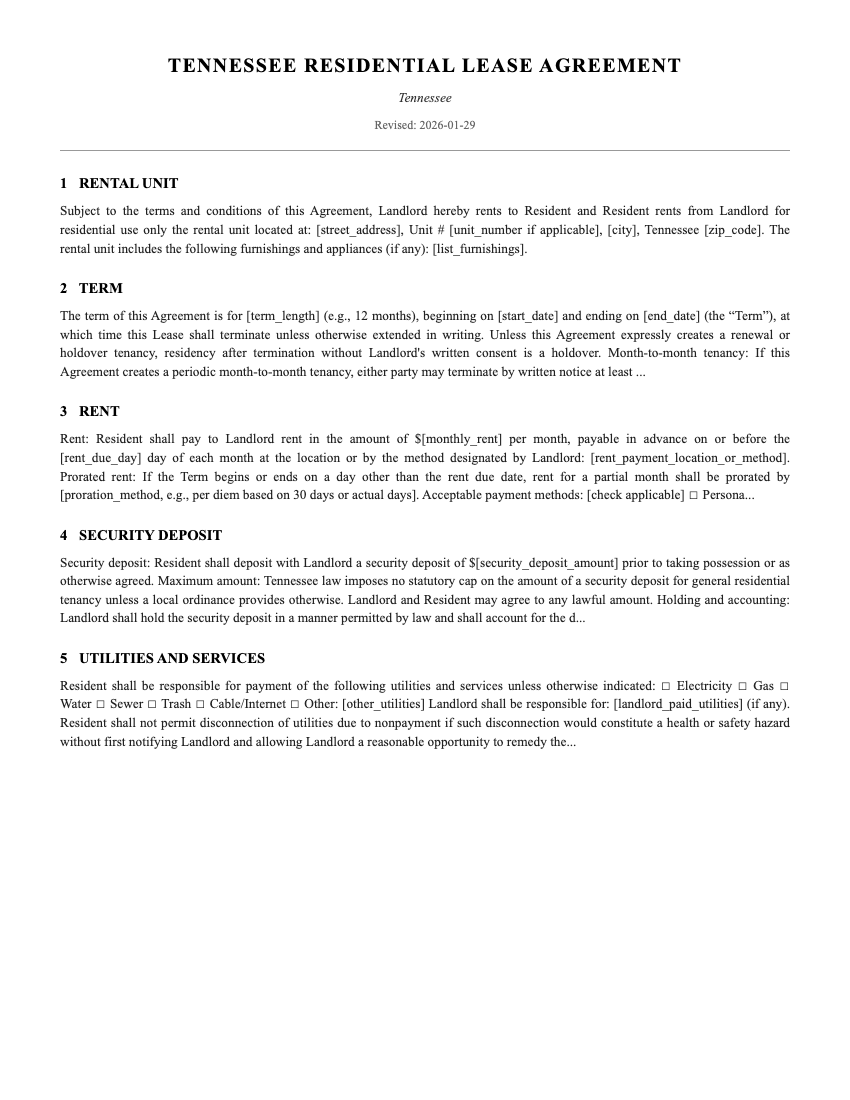
This template is drafted to reflect Tennessee's rules for security deposits, required disclosures (including federal lead-based paint notices), statutory notice periods, and common lease provisions. It is a starting point — customize it for your property, local ordinances, and the parties' negotiated terms.
For a comprehensive lease review checklist covering residential and commercial terms, see our Lease Agreement Review Guide.
Definition — What is a Tennessee residential lease?
A Tennessee residential lease is a written contract between a landlord and a tenant that establishes the rental term, rent amount and payment rules, security deposit terms, permitted use of the premises, repair and maintenance responsibilities, required disclosures (including federal lead-based paint for pre-1978 housing), and default/remedy procedures. It must be consistent with Tenn. Code Ann. Title 66, Chapter 28 and applicable local ordinances.
Why Old Templates Are Dangerous (Tennessee-specific traps)
- Security deposit timing and itemization: Tennessee practice requires an itemized statement of deductions and return of remaining deposit promptly after termination and delivery of possession (commonly 30 days). Using an old form that omits an itemization clause or gives a long indefinite return window risks statutory claims and court costs (see Tenn. Code Ann. Title 66, Chapter 28).
- Federal lead disclosure: Housing built before 1978 requires the federal lead-based paint disclosure and pamphlet (42 U.S.C. § 4852d and EPA/HUD rules). Older templates may omit the required lead notice and acknowledgment.
- Sex offender registry notice: Tennessee landlords should include or provide guidance on access to the Tennessee Sex Offender Registry; failing to advise tenants where to find this information can be a compliance gap for relocation and safety planning.
- Eviction procedural requirements: Outdated forms may specify incorrect notice periods or remedies. Tennessee eviction practice depends on both the lease and the forcible entry and detainer procedures (Tenn. Code Ann. Title 29, Chapter 18). Relying on an old template may cause defective notices or lost remedies.
- Local ordinance conflicts: Municipalities may require rental registration, local deposit limits, or specific smoke/CO detector standards. An old statewide form may miss city-specific obligations (e.g., registration, inspections).
What's Included in This Template
- Parties and premises identification
- Lease term options (fixed-term and month-to-month language)
- Rent amount, due date, late fees, and returned check policy
- Security deposit clause (amount, holding, permitted uses)
- Security deposit return procedure and requirement for an itemized statement (aligned with Tenn. Code Ann. Title 66, Chapter 28)
- Utilities and shared expense allocation
- Maintenance and repair responsibilities; notice and cure procedures
- Entry by landlord and notice requirements
- Default remedies, cure periods (template defaults: 14 days for many curable breaches; parties may change by agreement)
- Nonpayment and pay-or-quit guidance (default template uses 14 days; follow forcible entry and detainer statutes when taking action)
- Subletting and assignment rules
- Pet addendum option and associated fees
- Lead-based paint disclosure and EPA/HUD pamphlet acknowledgement for pre-1978 housing (42 U.S.C. § 4852d)
- Sex offender registry notice and links to Tennessee resources
- Move-in/move-out condition checklist and signature lines
- Signature block and witness/acknowledgment area
Download Options
- PDF — Ready-to-sign clean copy: /downloads/tennessee-lease-agreement-2026.pdf
- MS Word (.docx) — Editable version for customization
- Google Docs — Shareable editing link (request on download page)
- Fillable PDF — For electronic signature platforms
If you need a version customized for a specific Tennessee city (e.g., local rental registration, municipal inspection requirements, or local deposit caps), use the editable Word or Google Docs version and run an AI contract review tool review.
How to Finalize Your Lease
- Confirm local ordinances: Check city or county requirements (registration, inspection, local deposit caps, smoke/CO mandates).
- Complete required disclosures: Provide federal lead-based paint disclosure for properties built before 1978 (42 U.S.C. § 4852d), inform tenants about the Tennessee Sex Offender Registry, and disclose known material defects.
- Collect and document funds: Take the agreed security deposit, provide a written receipt, and place funds per any applicable local requirements.
- Sign and exchange originals: Obtain signatures from all tenants and the landlord (electronic signatures are acceptable if both parties agree and the platform is compliant).
- Deliver move-in checklist and keys: Walk the unit with the tenant, complete the checklist, and keep copies of all documents.
- Upload to an AI contract review tool: Run an automatic review to flag missing Tennessee-specific clauses and suggest improvements. Retain the final, signed version in your records.
Related Lease Agreement Templates
Frequently Asked Questions (Tennessee)
- Q: Is there a statewide limit on security deposits in Tennessee?
A: No. Tennessee does not impose a statewide statutory cap on security deposits. Parties may agree to any lawful amount unless a local ordinance sets a limit. Regardless of amount, the landlord must provide an itemized statement of deductions and return any remaining deposit within the customary period (commonly 30 days) after termination and delivery of possession (see Tenn. Code Ann. Title 66, Chapter 28). - Q: How soon must a landlord return a security deposit in Tennessee?
A: Tennessee practice requires landlords to provide an itemized statement of deductions and return the remaining deposit promptly after termination and delivery of possession — commonly within 30 days. Failure to timely return the deposit and provide an itemization can lead to liability under Tenn. Code Ann. Title 66, Chapter 28. - Q: Does Tennessee have rent control or limits on raising rent?
A: No statewide rent control exists in Tennessee. Landlords and tenants are free to negotiate rent and rent increases subject to the lease's terms. Municipal ordinances may impose local restrictions — check your city or county rules. - Q: What disclosures are required in Tennessee residential leases?
A: Required disclosures include the federal lead-based paint disclosure for properties built before 1978 (42 U.S.C. § 4852d and EPA/HUD rules), notice directing tenants to the Tennessee Sex Offender Registry, and disclosure of known material defects in the premises. Local laws may require additional disclosures (e.g., rental registration or inspection notices). - Q: What are the notice periods for termination and eviction in Tennessee?
A: Template defaults: 14 days' notice to cure for many material breaches (where cure is feasible) and 14 days for nonpayment (pay or quit) as a common contractual option. Month-to-month termination generally uses 30 days' written notice unless the lease specifies otherwise. Actual eviction actions must follow Tennessee's forcible entry and detainer statutes (Tenn. Code Ann. Title 29, Chapter 18) and related procedures in Title 66, Chapter 28. - Q: Can a landlord restrict guests or short-term rentals in a Tennessee lease?
A: Yes. Leases may lawfully define guest policies, including maximum guest duration before a guest is considered an unauthorized occupant, restrictions on short-term subletting (e.g., Airbnb), and penalties for violations. Any restrictions must be clearly written, reasonable, and consistently enforced. For subletting and assignment, include explicit consent procedures and required approvals.
Sources
- Tennessee Code Annotated — Title 66, Chapter 28 (Residential Landlord and Tenant Act). Tennessee General Assembly. https://www.capitol.tn.gov/legislation/statutes.html (search Title 66, Chapter 28)
- Tennessee Code Annotated — Title 29, Chapter 18 (Forcible Entry and Detainer). Tennessee General Assembly. https://www.capitol.tn.gov/statutes/title-29/chapter-18/
- Tennessee Code Annotated — Statute of Limitations for Written Contracts (Tenn. Code Ann. § 28-3-109). Tennessee General Assembly. https://www.capitol.tn.gov/statutes/title-28/chapter-3/
- Tennessee Bureau of Investigation — Sex Offender Registry. Tennessee Bureau of Investigation. https://www.tn.gov/tbi/topic/sex-offender-registry
- EPA — Lead in Paint: Real Estate Disclosure. U.S. Environmental Protection Agency. https://www.epa.gov/lead/real-estate-disclosure
- HUD — Lead-Based Paint Disclosure Requirements. U.S. Department of Housing and Urban Development. https://www.hud.gov/program_offices/healthy_homes/enforcement/lbp
Final notes
This template is an authoritative starting point for Tennessee residential leases but does not replace legal advice tailored to your facts. For complex situations (e.g., multi-unit buildings, subsidized housing, unclear local rules), consult a Tennessee-licensed attorney. Use an AI contract review tool to run a contract analysis and reduce the risk of missed jurisdictional requirements.
<div class="ml-embedded" data-form="bBZ9zR"></div>
Frequently Asked Questions

About Designer Content
Designer Content creates practical legal document resources for landlords, contractors, and small business owners. We simplify complex legal concepts into actionable guidance. Connect with us on LinkedIn.